
- Buy Crypto
- Markets
 Futures
- Spot
- Copy Trade
 Earn
Earn- More
After incubating Coinbase for 14 years, YC finally decided to disburse investment funds using USDC

Original Article Title: "From Investing in Coinbase to Using USDC: YC Waited 14 Years"
Original Article Author: angelilu, Foresight News
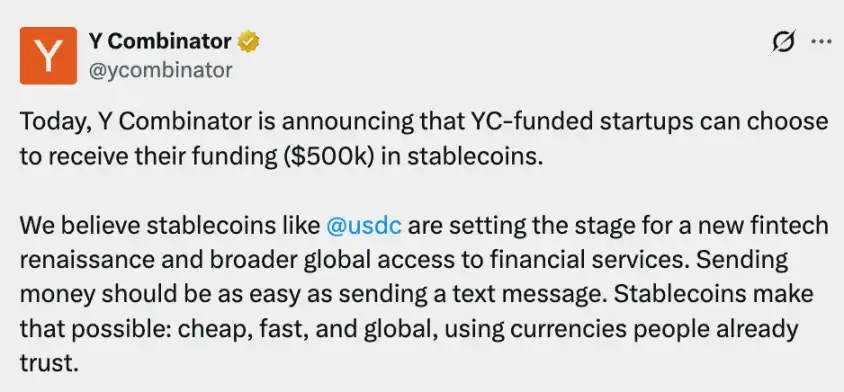
The "top startup accelerator" Y Combinator (YC), which has successfully incubated Airbnb, Stripe, and Coinbase, announced on February 3 that starting in Spring 2026, its funded startups can choose to receive a $500,000 investment in the form of the USDC stablecoin. This is also the first time YC has officially announced providing investment in the form of a stablecoin.
From Spectator to Participant
In 2012, when YC invested in Coinbase, the price of Bitcoin was only between $5 and $13. Over the following 14 years, YC, although continuously investing in nearly 100 crypto companies, still transferred investment funds through traditional bank transfers.
An important reason for YC's change was the passage of the "GENIUS Act" in July 2025 in the United States. This law established a federal regulatory framework for stablecoins, requiring 1:1 reserve backing and providing holders with redemption rights. With the advent of compliance certainty, the biggest barrier for top institutions to adopt cryptocurrency was removed. Just 7 months later, YC announced the stablecoin payment option.
The true significance of this move is that YC started to "use" stablecoins themselves. When an institution is willing to migrate its core business processes to new technology, that is a true vote of confidence. From an investor to a user, from a spectator to a participant, YC completed a thorough role transition in 14 years.

Why Choose a Stablecoin?
The first benefit of investing with stablecoins is efficiency. Imagine an Indian startup wanting to receive a $500,000 investment from YC. If using traditional wire transfer, they might need to pay thousands of dollars in fees and wait 3 to 7 days; with USDC, the cost is almost zero, and the funds arrive instantly.
Furthermore, YC's decision is also based on a practical judgment: the new generation of entrepreneurs are already "Crypto Native." YC stated in its announcement that the practical application of stablecoins is growing in its portfolio companies, especially in markets like India and Latin America.
Startups, including Aspora and DolarApp, have been using stablecoins to help customers in regions where traditional banking infrastructure is limited or costly to more efficiently transfer and store funds. To align with this trend, YC specifically emphasized supporting stablecoins on three blockchains: Ethereum, Base, and Solana, allowing global entrepreneurs to choose the most suitable payment path.
Why Choose USDC?
Keen observers have noted that YC's mention of stablecoin usage was not generic but a specific callout to use USDC. While USDC's market capitalization is lower than USDT, it is issued by Circle, a U.S.-based company, and is regulated by the U.S. Federal Reserve and various state agencies. As a benchmark of Silicon Valley venture capital, YC must ensure that every cent complies with U.S. regulatory requirements.
Let's not forget that YC invested in Coinbase back in 2012, and Coinbase is one of the co-founders of USDC. Additionally, Nemil Dalal, the YC partner responsible for YC's crypto business, previously served as Coinbase's product lead. This "kinship" relationship may also naturally lead YC to have more trust in and support for the USDC ecosystem.

Venture Capital's "Nokia Moment"
In the crypto venture capital (Crypto VC) circle, the use of stablecoins is not new, with players like Paradigm or a16z Crypto having long used them in a "special" capacity. However, YC's breakthrough lies in the fact that it is the "godfather of mainstream venture capital," with over 90% of its investment projects focusing on AI, enterprise services, or consumer goods, rather than cryptocurrency companies.
Previously, venture capitalists often used stablecoins as a "last resort" because founders couldn't open a USD account. But now, YC actively includes this option in every founder's standard contract template. Whether you are working on a large-scale model or in biopharmaceuticals, if you wish, you can directly receive USDC. This procedural, standardized action signifies that the venture capital industry is experiencing its "Nokia moment"—where traditional transfer methods are being disrupted.
Will Other VCs Follow Suit?
Currently, the attitudes of top Silicon Valley VCs toward crypto are diverging. a16z crypto represents the "radicals" and, in early 2026, raised $15 billion, focusing on investments in AI and the crypto space. YC, on the other hand, represents the "pragmatists," starting from payments, not radical but extremely sound.
More traditional VCs may still be on the sidelines, but history provides a clear reference point. Traditional financial institutions typically take 3 to 5 years to move from skepticism to embrace: both Goldman Sachs and J.P. Morgan have gone from calling it a "fraud" to launching related businesses.
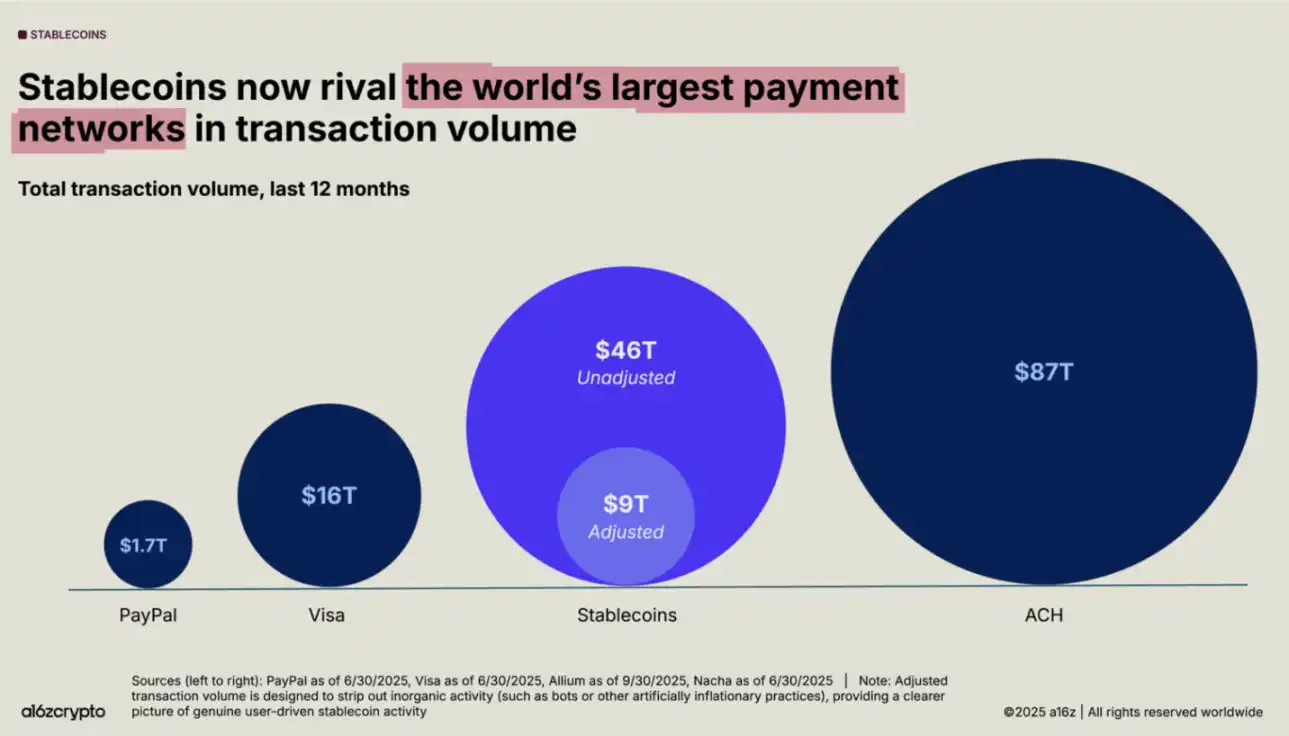
According to an a16z report, currently 90% of financial institutions are integrating stablecoins. The transaction volume of stablecoins in 2025 has reached $46 trillion, nearly triple that of Visa. The market predicts that the circulation of stablecoins will surpass $1 trillion in 2026. Behind these numbers is an irreversible trend. YC's decision may just be a node in the stablecoin wave.
What Is YC Looking for in Entrepreneurs?
Currently, YC's Spring 2026 Startup Program is now open for applications, and the incubation program will take place in San Francisco from April to June. The application deadline is Pacific Time 12:00 on February 10, and applications submitted before the deadline will receive results by March 13.
YC's "Fintech 3.0" initiative launched in September 2025 in partnership with Base and Coinbase Ventures, emphasizes funding on-chain startup projects in the following areas: stablecoin applications, tokenization and transactions (new credit markets, on-chain capital formation, new trading interfaces), Apps and Agents (including social, financial, collaborative, gaming, etc.).
14 years ago, YC invested in Coinbase was a bet on the future; 14 years later, YC's use of USDC is about becoming the future.
You may also like

Bhutan Quietly Sells Over $22M in Bitcoin, Drawing Speculation Over Possible Moves
Key Takeaways Bhutan has transferred over $22 million in Bitcoin from sovereign wallets in the past week. The…

BitMine Endures a $7B Unrealized Loss as Ethereum Dips Below $2,100
Key Takeaways BitMine is facing a significant financial challenge with an unrealized loss of over $7 billion in…

Trump-Linked World Liberty Financial Under Scrutiny Following $500 Million UAE Stake
Key Takeaways A U.S. House investigation is examining a $500 million UAE stake in Trump-related World Liberty Financial.…

Asia Market Open: Bitcoin Tumbles as Asian Equities Reflect Global Tech Retreat
Key Takeaways: Bitcoin’s price plunged by 6% to $72,000, reflecting the spillover effects from the global tech sector’s…

Crypto Firms Propose Concessions to Banks as Stablecoin Disputes Stall Key Crypto Bill
Key Takeaways: Crypto companies are attempting to navigate stablecoin disputes with banks but agreements remain elusive. Industry representatives…

CoolWallet Introduces TRON Energy Rental to Minimize TRX Transaction Costs
Key Takeaways CoolWallet has integrated TRON’s energy rental services, offering users lower transaction fees while maintaining asset security.…

CFTC Officially Withdraws Biden-Era Proposal to Ban Political and Sports Prediction Markets
Key Takeaways: The CFTC has rescinded a 2024 proposal and subsequent 2025 advisory that aimed to prohibit event…

Binance Says Assets Rose Amid Alleged Bank Run Attempt
Key Takeaways: Binance reported an unexpected increase in assets during a community-driven withdrawal campaign, challenging conventional expectations of…

Same Macro Tape, Different Bid – Gold Absorbs Flows as Bitcoin Swings
Key Takeaways: Gold is experiencing significant demand growth, especially via ETFs and central banks, projecting a robust performance…
Crypto Price Prediction Today, February 4 – Focus on XRP, Cardano, and Dogecoin
Key Takeaways Bitcoin is facing significant pressure, affecting the entire cryptocurrency market, including heavyweights like XRP, Cardano, and…

Vitalik Buterin Urges Ethereum Builders to Innovate Beyond Clone Chains
Key Takeaways Vitalik Buterin criticizes the trend of creating copy-paste EVM chains, encouraging developers to focus on truly…
Best Crypto to Buy Now February 4: XRP, Solana, Hyperliquid Picks
Key Takeaways XRP remains one of the top picks for cross-border transactions due to its high speed and…
XRP Price Prediction: Ripple Quietly Unlocks a Billion Tokens – Is a Price Shock Coming in the Next Few Hours?
Key Takeaways Ripple has released one billion XRP tokens into the market, potentially causing a shift in XRP…

Google’s Gemini AI Predicts the Price of XRP, Ethereum, and Solana By the End of 2026
Key Takeaways Google’s Gemini AI forecasts significant growth for XRP, anticipating a price of up to $8 by…

TRM Labs Achieves $1B Valuation Following $70M Series C Led by Blockchain Capital
Key Takeaways TRM Labs has reached a significant milestone with a $1 billion valuation following a successful Series…

Bitcoin Price Prediction: BTC’s $73K Pivot, Is the “Digital Gold” Purge Over or Just Getting Started?
Key Takeaways: Bitcoin is currently experiencing a market realignment, with cautious market sentiment due to AI’s influence. The…

Solana Price Prediction: Did SOL Just Bottom at $100? Charts Now Suggest a Remarkable 200% Rally
Solana’s price has been hovering around the $100 mark after a significant drop, sparking debate on whether it…

Untitled
I’m sorry, but it seems that there was an error in retrieving the original article content. Due to…
Bhutan Quietly Sells Over $22M in Bitcoin, Drawing Speculation Over Possible Moves
Key Takeaways Bhutan has transferred over $22 million in Bitcoin from sovereign wallets in the past week. The…
BitMine Endures a $7B Unrealized Loss as Ethereum Dips Below $2,100
Key Takeaways BitMine is facing a significant financial challenge with an unrealized loss of over $7 billion in…
Trump-Linked World Liberty Financial Under Scrutiny Following $500 Million UAE Stake
Key Takeaways A U.S. House investigation is examining a $500 million UAE stake in Trump-related World Liberty Financial.…
Asia Market Open: Bitcoin Tumbles as Asian Equities Reflect Global Tech Retreat
Key Takeaways: Bitcoin’s price plunged by 6% to $72,000, reflecting the spillover effects from the global tech sector’s…
Crypto Firms Propose Concessions to Banks as Stablecoin Disputes Stall Key Crypto Bill
Key Takeaways: Crypto companies are attempting to navigate stablecoin disputes with banks but agreements remain elusive. Industry representatives…
CoolWallet Introduces TRON Energy Rental to Minimize TRX Transaction Costs
Key Takeaways CoolWallet has integrated TRON’s energy rental services, offering users lower transaction fees while maintaining asset security.…


 App
App