
- Buy Crypto
- Markets
 Futures
- Spot
- Copy Trade
 Earn
Earn- More
ArkStream Capital: The Year 2025 Will Be the Crypto Inflection Point with Old Money Coming In

Original Article Title: "ArkStream Capital: Crypto Breakthrough Year, Embracing the 2025 Carnival"
Original Article Author: ArkStream Capital
2024 was a year of great turbulence in the cryptocurrency industry, marked by many significant events. At the beginning of the year, the approval of a Bitcoin spot ETF injected strong momentum into the market, and by the end of the year, the price of Bitcoin surged past the $100,000 mark, reaching a new all-time high. During this period, we witnessed the Bitcoin halving, approval of an Ethereum spot ETF, the hype around the TON/Telegram ecosystem, the surge in on-chain transactions, a USD interest rate cut, Trump's reelection, the revival of value investing, the rise of new AI Agents, and the birth of DeSci. These countless classic moments are truly worth remembering.
As we bid farewell to 2024, we stand at a new starting point, eagerly looking forward to 2025. The upcoming interest rate cuts, loose monetary policies, friendly regulatory environment, and positive attitude towards cryptocurrency all suggest that 2025 may herald a raging bull market. We anticipate that in this year, the price of Bitcoin is likely to reach a new high, aiming for $200,000 per coin. Meanwhile, looking at Bitcoin Dominance data from past bull markets, the current Bitcoin Dominance remains around 57%, indicating that altcoin Dominance has not yet peaked. We predict that in 2025, altcoins are likely to see a significant structural market rally. By then, Bitcoin's Dominance may fall to below 50%, possibly even around 45%. At the same time, established cryptocurrency projects such as Ethereum, Solana, and XRP are expected to break their all-time highs. In an environment of overall abundant liquidity, whether it's Bitcoin or altcoins, including DeFi, RWA, Meme, AI-related projects, and public chains, the total market capitalization of the entire cryptocurrency industry is highly likely to break new records.
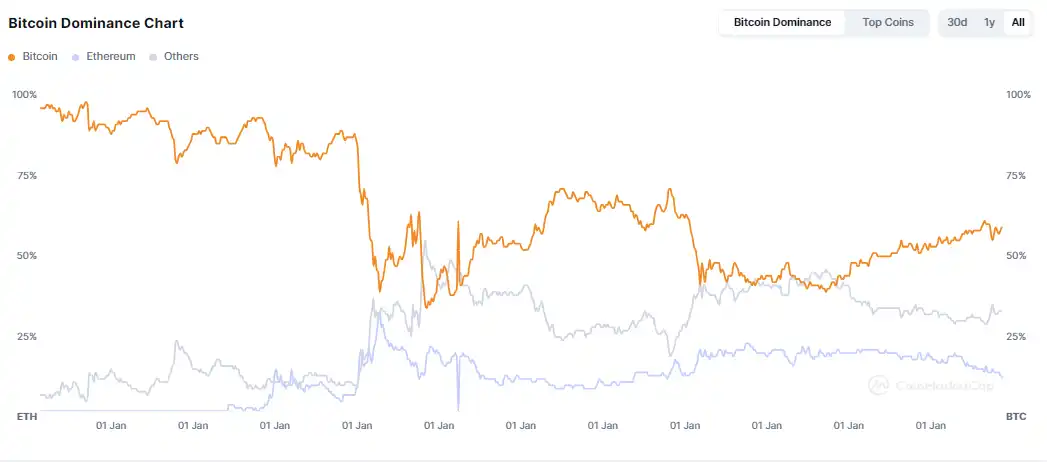
https://coinmarketcap.com/charts/bitcoin-dominance/
Of course, as market capitalization and prices surge significantly, we firmly believe that the cryptocurrency industry will take greater strides in technology and innovation, deeply integrating with the new era's policy environment and monetary trends. Whether in finance, social, or artificial intelligence, we are looking forward to cryptocurrency playing a more extensive role in reshaping the world and contributing more power.
Bitcoin and Its Ecosystem: The Continuous Journey of Mining and Building
With the continuous inflow of Bitcoin ETF, MicroStrategy's crazy leveraged Bitcoin purchases with no selling, and the possible Bitcoin national strategic reserve plan during the Trump administration, the market outlook for Bitcoin is becoming increasingly promising. With its fixed total supply and halving of block rewards leading to low inflation, and the monetary easing policies during the interest rate reduction cycle providing further impetus, Bitcoin is poised for a bright future. A convergence of many factors suggests that by 2025, Bitcoin will not only hover around the $100,000 mark but is likely to strive for a higher market cap. Often referred to as "digital gold," Bitcoin's market cap ratio to gold has steadily risen from 2% to over 10% today, with the ratio in 2024 soaring from 5% directly to 10%. Considering these bullish factors, it is expected that the Bitcoin-to-gold market cap ratio will further increase to 15% to 20%. This means that the price of Bitcoin is expected to reach $150,000 to $200,000 per coin.
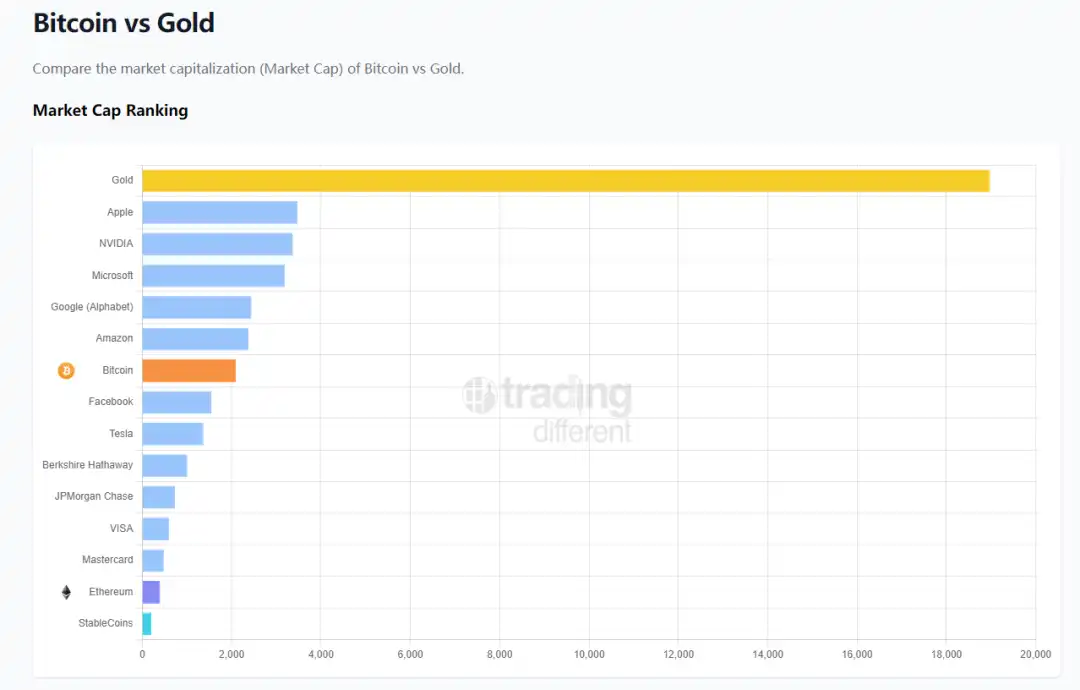
https://tradingdifferent.com/dashboard/bitcoin-vs-gold
https://ingoldwetrust.report/chart-gold-bitcoin-marketcap/?lang=en
Despite Bitcoin demonstrating a strong influence, its ecosystem projects are still in the early stages of development. Among the top one hundred projects in terms of market capitalization, only Stacks has stood out, with most other Bitcoin ecosystem projects ranking relatively lower. Currently, Bitcoin's market cap is around $2 trillion, while the total market cap of its ecosystem projects accounts for only 0.5% to 1% of Bitcoin's market cap, translating to $10 billion to $20 billion. Such a low ratio indicates that the Bitcoin ecosystem is like a treasure mountain that has not been fully developed, harboring enormous potential wealth and infinite opportunities. We anticipate that as ecosystem development progresses and resources increase, this ratio is expected to significantly increase from the current 0.5% to 1% to 2% or even 3%. This means that the total market cap of the Bitcoin ecosystem is poised to reach $50 billion to $60 billion.
Looking back at 2023, the rise of inscriptions sparked widespread attention and a craze for the Bitcoin ecosystem. Subsequently, in the first half of 2024, the Bitcoin ecosystem witnessed the first significant peak. During this period, the influx of capital and development resources showed a rapid momentum, with numerous projects emerging and launching one after another. Projects such as Stacks, Merlin Chain, Bounce Bit, Solv, Babylon, UniSat / Fractal, RGB, Nervos, Bitlayer, and Mezo were particularly noteworthy, each showcasing their abilities within the Bitcoin ecosystem and injecting strong momentum into its prosperity. Furthermore, as the Bitcoin halving event approached cyclically, the block rewards gradually decreased, posing higher demands for the maintenance of the Bitcoin network. To meet this demand, miners will have to more actively participate in ecosystem development to ensure the robust operation of the entire network.
Despite the relatively slow pace of decentralization, the continuous injection of capital and development resources, along with the urgent need for network maintenance, are driving the Bitcoin ecosystem forward. As the price of Bitcoin reaches new highs, the ecosystem inevitably requires more liquidity to maintain its vitality. In key technological areas, technologies such as OP_CAT and BitVM are gradually emerging, laying a solid foundation for the future development of the Bitcoin ecosystem. Looking ahead, after a year or two of construction period, we have reason to believe that the achievements of these projects will gradually emerge in 2025, and some key Bitcoin network technologies are expected to be truly applied, further pushing the Bitcoin ecosystem towards a more mature, stable, and prosperous new stage.
Traditional Finance Digitization: Embracing Digital Assets Fully
With the rapid development of encryption technology, the traditional financial system is undergoing a profound transformation, and digital assets are gradually moving from the periphery to the mainstream, becoming an undeniable part of the global financial system. The personal IP Meme coin issued by Trump, although to some extent has impacted the price system of past coins and projects in the industry, as a former US president, his family's every move in the cryptocurrency field undoubtedly has a huge influence. This influence is not only reflected in market sentiment fluctuations but also in the profound impact on the traditional financial system. Trump's Meme coin, as a new type of digital asset, despite its entertainment and speculative nature, the trend it represents cannot be ignored: traditional finance is accelerating its embrace of digital assets, and this trend will profoundly change the landscape of the financial industry.
In the future, the US government is expected to introduce more clear and friendly cryptocurrency regulatory policies, thus creating a more favorable environment for the development of digital assets. For example, the US may expedite the compliance process for cryptocurrency exchanges or introduce more policies that support blockchain technology innovation. As more traditional financial institutions and investors enter the cryptocurrency field, the price fluctuations of digital assets and the correlation with the traditional financial market are continuously strengthening. For example, the price trend of Bitcoin has shown some level of correlation with traditional assets such as US stocks. This deep integration will further drive the encryption process of the traditional financial system, making digital assets an indispensable part of the global financial system. In the future, we may see more traditional financial institutions launching their own cryptocurrency products or applying blockchain technology to existing financial services. With more public participation and more traditional financial institutions joining, the application of cryptocurrency in the financial field will become more widespread and profound. This trend will not only change the landscape of the financial industry but also inject new vitality into the global economy. The future of traditional finance digitization is full of challenges but also opportunities, and all of this is just the beginning.
AI Agent: The Next Evolution of Intelligent Agents
By 2025, the AI Agent sector is expected to experience explosive growth, potentially surpassing the DeFi summer of 2020 in terms of hype. Similar to the DeFi wave of that year, the development of AI Agents has also gone through a process from initial exploration to rapid rise. In the first phase, AI Agents attracted significant attention and funding through innovative applications in areas such as automated trading and intelligent analysis. However, as the market quickly heated up, the sector also experienced a period of consolidation, with some projects experiencing pullbacks due to technical or market factors. Nevertheless, the long-term development of AI Agents continues to be highly anticipated. In 2025, OpenAI introduced a new generation reasoning model called o3, with its powerful reasoning capabilities and performance close to Artificial General Intelligence (AGI), injecting new momentum into the development of AI Agents. The o3 model excelled in tasks such as mathematics and programming, being able to reason through a "private thought chain," further enhancing the level of intelligence of AI Agents. Additionally, the application scenarios of AI Agents continue to expand, from DeFi to DAO governance, demonstrating significant potential in optimizing trading decisions, enhancing user experience, and improving governance efficiency.
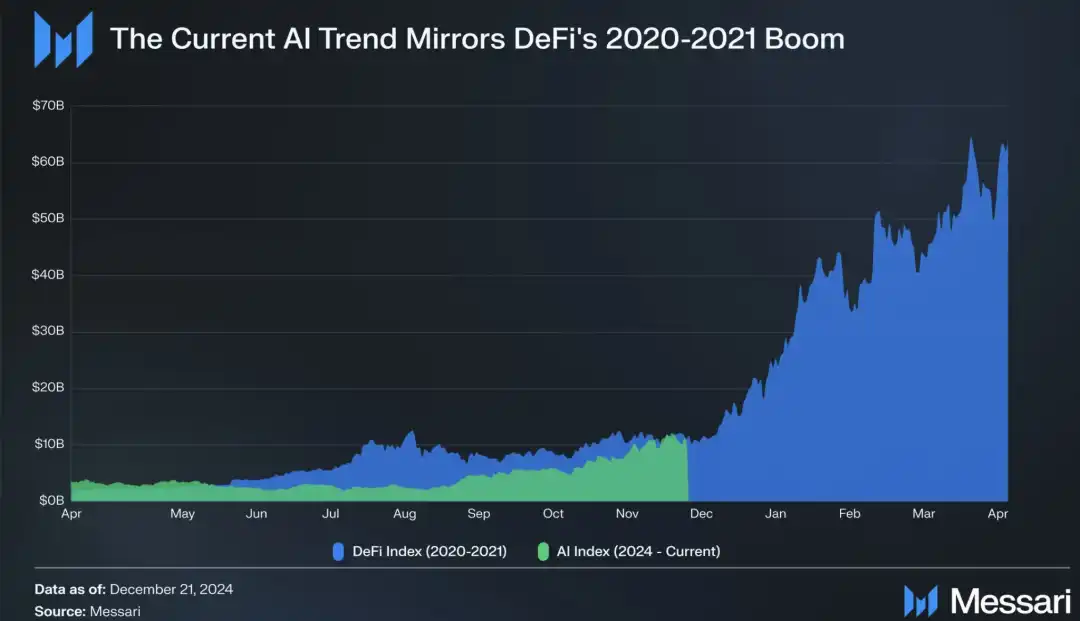
https://x.com/MessariCrypto/status/1874104196800405935
In the new cycle, AI Agents have evolved from being mere tools for traditional AI models to becoming the core driving force of the community ecosystem, transcending the limitations of a single "tool attribute." Today, its development model is guided by "community orientation," focusing on the growth of AI Agents themselves and the construction of the ecosystem, as if building a fully robotic autonomous community.
Under the "community-oriented" model, ai16z and Virtuals stand out as two major representatives. Virtuals has built a complete AI Agent creation and token issuance platform similar to the "Apple system," establishing a closed-loop ecosystem. ai16z, on the other hand, focuses on open-source frameworks and decentralized governance. Both have distinctive features in technical architecture, tokenomics, and market strategy, precisely meeting different user needs.
Currently, the AI Agent market is mainly divided into two major project categories: the "technical support layer" and the "scenario implementation layer." The "technical support layer" is dedicated to providing AI Agents with underlying technology and infrastructure support, while the "scenario implementation layer" focuses on applying AI Agents to specific business scenarios to realize their practical value. As the infrastructure gradually matures and saturates, the coordinated development of infrastructure and applications will become the core theme of the next stage, driving the field towards a period of deep integration. ArkStream points out that the current momentum of AI Agents is evident, with FOMO emotions driving various funds to pour in, attempting to get a piece of the action. This rapid expansion has led to a proliferation of projects, but currently, no single project has a market capitalization exceeding 10 billion. This stage can be seen as the "early stage" of the Web3 AI Agent track, characterized by its time orientation: market participants generally hold speculative attitudes, rushing to enter at the fastest speed possible.
ArkStream Capital predicts that the "Second Stage" will arrive in 2025, shifting the market focus to product quality, leading to a major reshuffle where low-quality, opportunistic projects will be swiftly eliminated by mainstream funds. With the continuous iterative upgrades of traditional AI technology, ArkStream Capital remains optimistic about the overall outlook of the field. The current level of heat is enough to demonstrate its potential for development, and it is expected that the first batch of AI Agent projects with market capitalization surpassing one hundred billion will soon become a significant milestone in the industry's development. The market capitalization of the current AI Agent has already entered the range of 150 billion to 200 billion USD and has shown strong growth momentum in the past few months, with a market cap increase of over 30% in the past week alone. With the ongoing maturity of the technology and widespread market acceptance, AI Agent is expected to become one of the most promising sectors in 2025. Its market capitalization is expected to continue to grow rapidly, potentially reaching 500 billion USD or even higher by 2025. This growth trend is not only benefiting from the advancement of AI technology but also from its extensive application and implementation in multiple fields.
https://www.cookie.fun/
RWA and Stablecoins: A Financial Bridge with Boundless Opportunities
RWA covers a wide range of asset classes, including stablecoins, private loans, US Treasury bonds, commodities, and stocks, among others. Among these assets, stablecoins, due to their uniqueness and importance, can be considered a separate track. For non-stablecoin RWA, due to the complexity of asset standardization and imperfect policy regulations, the scale is relatively smaller, so we will focus on the stablecoin field.
In the cryptocurrency market, since 2018, USD-pegged stablecoins have played a critical role. They not only serve as the base currency for trading but also act as shadow USD assets, actively involved in various scenarios such as transfer payments. As of December 1, 2024, the total market capitalization of stablecoins has increased to 1.93 trillion USD, a year-on-year growth of 48%. Taking the on-chain daily transfer volume as an example, the current daily transfer volume remains in the high range of 250 billion to 300 billion USD, even during market downturns, the data has not dropped below 100 billion USD. In terms of trading volume, according to industry data from CoinMarketCap, the monthly trading volume in November reached 60 trillion USD, indicating that stablecoins account for 30% of the industry's trading volume in centralized exchanges. This ratio does not yet include on-chain stablecoin trading volume, meaning the actual share may be even higher. In addition to issuance, trading, and transfer volume as the three core indicators, stablecoins have also introduced stable income assets such as US Treasury bonds as underlying assets, providing stable and sustainable income, bringing positive externalities to the industry, further promoting the connectivity and integration of Web3 with the real world.
In the stablecoin market, various types of stablecoins have gradually emerged as market demand has increased, including fiat-backed stablecoins, decentralized collateralized stablecoins, algorithmic stablecoins, and more. Among them, fiat-backed stablecoins have already taken the majority of the market share and the market size continues to grow. However, due to the emerging trading demand in the market, decentralized stablecoins have been exploring new paths. In this regard, Ethena has emerged as a leader, with Ethena's issuance of USDe, a synthetic dollar, occupying a prominent position in the DeFi space with its innovative financial solution. A key feature of USDe is the adoption of an advanced Delta hedging strategy to maintain its peg to the dollar, setting it apart from traditional stablecoins. In just over a year, the issuance of USDe has steadily grown, successfully withstanding the downturns in the market in Q2 and Q3, and is now ranked third, following only USDT and USDC, and is once again entering a phase of rapid growth.
ArkStream Capital believes that stablecoins play a crucial role in the cryptocurrency industry in navigating bull and bear cycles, with strong growth momentum that shows no signs of slowing down. Whether in payments or trading, all key metrics of stablecoins are expected to continue growing. With the arrival of a bull market, the issuance of stablecoins will expand alongside industry growth, with its market capitalization expected to double and surpass $400 billion. In this trend, decentralized stablecoins, with their advantages in transparency, decentralization, and yield, are significantly superior to traditional stablecoins and are poised to capture more market share. It is projected that the market share of decentralized stablecoins will increase from the current $20 billion to over $60 billion, accounting for over 15% of the entire stablecoin market in the future. Ethena, as a leader in the decentralized stablecoin space, has built various innovative stablecoin products around USDe, such as USDtb and iUSDe. Through collaboration with traditional financial and asset management institutions, these products further drive the market penetration of decentralized stablecoins.
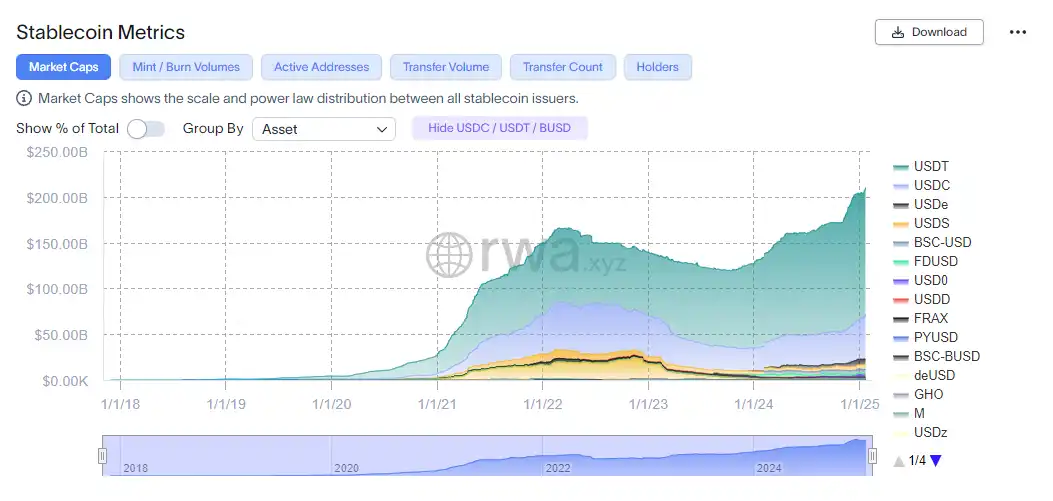
https://app.rwa.xyz/stablecoins
DeFi: A Pillar of Continuous Development and Prosperity
By 2025, the DeFi sector is poised to see unprecedented development opportunities. With the gradual relaxation of regulatory policies in the United States, the formal entry of a large amount of traditional financial institution funds has significantly enhanced the industry's liquidity. With the surge of capital, the Total Value Locked (TVL) in the DeFi sector is expected to soar rapidly, potentially surpassing the previous high and heading towards $200 billion, becoming a shining pinnacle in the crypto finance field. Moreover, user activities in lending, DEX, and the stablecoin market are also expected to significantly increase, with the number of daily active addresses and active funds reaching new levels, thereby driving another milestone in asset appreciation in the DeFi ecosystem. Meanwhile, major exchanges are vigorously promoting the popularity of Web3 wallets, which have undergone significant improvements in user experience, greatly reducing the operational barriers and enabling more users to easily participate in the DeFi ecosystem.
Furthermore, the on-chain economy's activity has seen a significant increase due to various on-chain events organized by a multitude of DeFi projects in collaboration with exchanges. These events have not only attracted a large number of participants but have also further promoted the prosperity and development of the on-chain ecosystem. Against this backdrop, DeFi has gradually moved away from its reliance on traditional finance or exchanges, presenting a new development situation. In this new era, DeFi's development is no longer limited to traditional functions such as DEX, lending, and staking. In the future, DeFi will focus more on new key metrics such as Daily Active Users (DAU) and capital activity. DeFi protocol product design will also closely revolve around users' core needs, such as security, usability, and optimizing user experience.
In the past, DeFi successfully attracted a large number of on-chain natives, and with the support of Web3 wallets, more and more users are entering the on-chain space, continuously expanding the scale of on-chain natives. We believe that by 2025, the entire industry will witness breakthroughs in various on-chain data metrics. It is worth noting that the boundary between DeFi and CeFi is gradually blurring, and the trend of their integration is becoming more apparent. Liquidity flowing between CeFi and DeFi has significantly increased, and this bidirectional interaction has injected more vitality into the entire financial ecosystem. Meanwhile, the diversification and innovation of wallet products continue to stimulate user engagement, injecting new momentum into the industry. It can be foreseen that in the future, DeFi will embrace a more open and inclusive posture to welcome broader development opportunities.
Meme: A Vivid Interpretation of the Attention Economy
In 2024, Meme underwent significant growth and evolution, especially in terms of total market capitalization, trading activity, thematic diversity, and exchange support. From October to early December, the total market cap of Meme coins experienced a significant increase, reaching a historic high, and trading volume also surged. The market witnessed the emergence of various new types of Meme coins, including AI Agent-themed Meme coins (GOAT, ACT), art BAN linked to Sotheby's art auctions, squirrel PNUT related to Trump and Elon Musk, and CHILLGUY, which attracted a large number of TikTok fans. The rise of these emerging Memes has not only injected vitality into the market, spurred on-chain liquidity flow but has also attracted a significant number of new investors to the market, contributing to the prosperity and development of the Meme and crypto industry.
Compared to emerging Memes, traditional Memes such as DOGE, PEPE, and WIF have also performed strongly in the market. In particular, PEPE and WIF successfully landed on Robinhood in November 2024, highlighting not only North American compliant exchanges' recognition of Memes but also further expanding the market influence of these established Memes.
Based on the data from the Meme track over the past year, as of the end of 2023, the number of Meme coins in the top 500 by market capitalization was extremely limited, mainly including a few such as DOGE, SHIB, BONK, PEPE, FLOKI, and ELON, while the majority of Meme coins had lower market values. However, by the end of 2024, the number of Meme coins in the top 500 by market capitalization had significantly increased to 48, accounting for close to 10% of the total, with a total market capitalization of approximately $104.7 billion and a 24-hour trading volume of up to $7.4 billion. All these indicate that Meme coins' recognition and market consensus are continuously expanding.
Especially in the fourth quarter, Memes became the focus of the cryptocurrency market, attracting a lot of attention from investors. With the return of the value investing trend in November, some funds started to flow out of Memes, but some newly listed popular Memes quickly debuted on mainstream exchanges such as Binance and Upbit due to their strong market performance and large user base. Although the insufficient market relay funds led to significant pullbacks from the highs for these Memes, ArkStream Capital believes that this pullback is a perfect reflection of the market's attention economy, indicating that the inflow and outflow of funds in Memes will undergo significant changes with fluctuations in market attention. Many Memes experienced rapid market value growth to $1 billion or even higher in a short period; therefore, experiencing pullbacks and time validation is reasonable. Meanwhile, some emerging sectors, such as DeSci (Decentralized Science), are attracting attention and resources in the form of Memes. Compared to traditional scientific funding methods, this approach is more flexible and efficient, able to quickly gather global funding support for innovative and forward-looking scientific projects, providing timely financial security. Furthermore, Memes as carriers of DeSci can also stimulate public interest and engagement in scientific research, creating a positive research atmosphere and promoting the transformation and application of research results.
Of particular note, the newly elected U.S. President Trump issued a Meme token named after himself (TRUMP), which undoubtedly attracted a lot of attention and funds from outsiders. Unlike traditional financial products, TRUMP completely bypassed centralized exchanges, relying on the power of the blockchain and the community to achieve a market capitalization of hundreds of billions of dollars in a short time. This model not only sets an example for celebrities and businesses entering the cryptocurrency field but also demonstrates the strong potential of decentralized finance. As a highly influential political figure, any action by Trump could have a profound impact on the market. The release of the TRUMP token not only drove the explosive growth of the Meme track but also may have a chain reaction on the entire cryptocurrency industry.
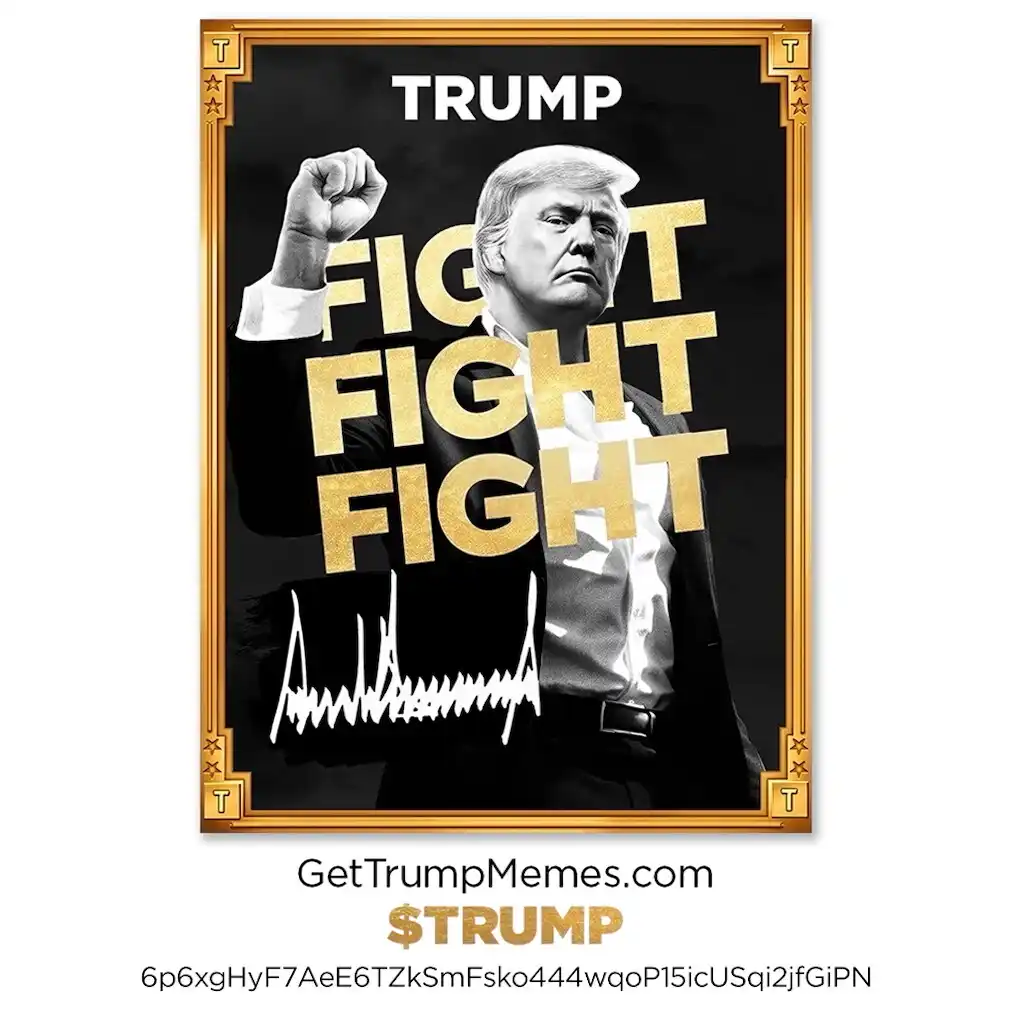
Therefore, ArkStream Capital believes that the prosperity of Memes in the industry is not a temporary phenomenon. Serving as a bridge between Gen Z and the Web3 world, Memes are expected to continue to exist and inject emotion and value into the market due to their easy-to-understand and engaging nature. With the successful launch of the Trump Meme, future Memes will deepen their integration with traditional celebrities and well-known companies, further expanding their influence and market potential. Therefore, ArkStream Capital is actively seeking opportunities to establish a presence in the Meme sector. The focus is on two main areas: first, portals that provide token information and trading data, as well as Bot products that offer trading convenience and custom strategies, and new Meme launch platforms like Pump Fun, which are core infrastructure in the Meme sector with actual sustainable revenue streams; second, Memes are gradually becoming a means of issuing assets that embody fairness. Many projects with real value are exploring the use of Memes to attract users. They embrace the concept of organic growth, with low market value openings, representing a relatively healthy growth approach that also reflects the active exploration and innovation of primary market projects in the Meme space.
You may also like

Token Cannot Compound, Where Is the Real Investment Opportunity?

February 6th Market Key Intelligence, How Much Did You Miss?

China's Central Bank and Eight Other Departments' Latest Regulatory Focus: Key Attention to RWA Tokenized Asset Risk
Foreword: Today, the People's Bank of China's website published the "Notice of the People's Bank of China, National Development and Reform Commission, Ministry of Industry and Information Technology, Ministry of Public Security, State Administration for Market Regulation, China Banking and Insurance Regulatory Commission, China Securities Regulatory Commission, State Administration of Foreign Exchange on Further Preventing and Dealing with Risks Related to Virtual Currency and Others (Yinfa [2026] No. 42)", the latest regulatory requirements from the eight departments including the central bank, which are basically consistent with the regulatory requirements of recent years. The main focus of the regulation is on speculative activities such as virtual currency trading, exchanges, ICOs, overseas platform services, and this time, regulatory oversight of RWA has been added, explicitly prohibiting RWA tokenization, stablecoins (especially those pegged to the RMB). The following is the full text:
To the people's governments of all provinces, autonomous regions, and municipalities directly under the Central Government, the Xinjiang Production and Construction Corps:
Recently, there have been speculative activities related to virtual currency and Real-World Assets (RWA) tokenization, disrupting the economic and financial order and jeopardizing the property security of the people. In order to further prevent and address the risks related to virtual currency and Real-World Assets tokenization, effectively safeguard national security and social stability, in accordance with the "Law of the People's Republic of China on the People's Bank of China," "Law of the People's Republic of China on Commercial Banks," "Securities Law of the People's Republic of China," "Law of the People's Republic of China on Securities Investment Funds," "Law of the People's Republic of China on Futures and Derivatives," "Cybersecurity Law of the People's Republic of China," "Regulations of the People's Republic of China on the Administration of Renminbi," "Regulations on Prevention and Disposal of Illegal Fundraising," "Regulations of the People's Republic of China on Foreign Exchange Administration," "Telecommunications Regulations of the People's Republic of China," and other provisions, after reaching consensus with the Cyberspace Administration of China, the Supreme People's Court, and the Supreme People's Procuratorate, and with the approval of the State Council, the relevant matters are notified as follows:
(I) Virtual currency does not possess the legal status equivalent to fiat currency. Virtual currencies such as Bitcoin, Ether, Tether, etc., have the main characteristics of being issued by non-monetary authorities, using encryption technology and distributed ledger or similar technology, existing in digital form, etc. They do not have legal tender status, should not and cannot be circulated and used as currency in the market.
The business activities related to virtual currency are classified as illegal financial activities. The exchange of fiat currency and virtual currency within the territory, exchange of virtual currencies, acting as a central counterparty in buying and selling virtual currencies, providing information intermediary and pricing services for virtual currency transactions, token issuance financing, and trading of virtual currency-related financial products, etc., fall under illegal financial activities, such as suspected illegal issuance of token vouchers, unauthorized public issuance of securities, illegal operation of securities and futures business, illegal fundraising, etc., are strictly prohibited across the board and resolutely banned in accordance with the law. Overseas entities and individuals are not allowed to provide virtual currency-related services to domestic entities in any form.
A stablecoin pegged to a fiat currency indirectly fulfills some functions of the fiat currency in circulation. Without the consent of relevant authorities in accordance with the law and regulations, any domestic or foreign entity or individual is not allowed to issue a RMB-pegged stablecoin overseas.
(II)Tokenization of Real-World Assets refers to the use of encryption technology and distributed ledger or similar technologies to transform ownership rights, income rights, etc., of assets into tokens (tokens) or other interests or bond certificates with token (token) characteristics, and carry out issuance and trading activities.
Engaging in the tokenization of real-world assets domestically, as well as providing related intermediary, information technology services, etc., which are suspected of illegal issuance of token vouchers, unauthorized public offering of securities, illegal operation of securities and futures business, illegal fundraising, and other illegal financial activities, shall be prohibited; except for relevant business activities carried out with the approval of the competent authorities in accordance with the law and regulations and relying on specific financial infrastructures. Overseas entities and individuals are not allowed to illegally provide services related to the tokenization of real-world assets to domestic entities in any form.
(III) Inter-agency Coordination. The People's Bank of China, together with the National Development and Reform Commission, the Ministry of Industry and Information Technology, the Ministry of Public Security, the State Administration for Market Regulation, the China Banking and Insurance Regulatory Commission, the China Securities Regulatory Commission, the State Administration of Foreign Exchange, and other departments, will improve the work mechanism, strengthen coordination with the Cyberspace Administration of China, the Supreme People's Court, and the Supreme People's Procuratorate, coordinate efforts, and overall guide regions to carry out risk prevention and disposal of virtual currency-related illegal financial activities.
The China Securities Regulatory Commission, together with the National Development and Reform Commission, the Ministry of Industry and Information Technology, the Ministry of Public Security, the People's Bank of China, the State Administration for Market Regulation, the China Banking and Insurance Regulatory Commission, the State Administration of Foreign Exchange, and other departments, will improve the work mechanism, strengthen coordination with the Cyberspace Administration of China, the Supreme People's Court, and the Supreme People's Procuratorate, coordinate efforts, and overall guide regions to carry out risk prevention and disposal of illegal financial activities related to the tokenization of real-world assets.
(IV) Strengthening Local Implementation. The people's governments at the provincial level are overall responsible for the prevention and disposal of risks related to virtual currencies and the tokenization of real-world assets in their respective administrative regions. The specific leading department is the local financial regulatory department, with participation from branches and dispatched institutions of the State Council's financial regulatory department, telecommunications regulators, public security, market supervision, and other departments, in coordination with cyberspace departments, courts, and procuratorates, to improve the normalization of the work mechanism, effectively connect with the relevant work mechanisms of central departments, form a cooperative and coordinated working pattern between central and local governments, effectively prevent and properly handle risks related to virtual currencies and the tokenization of real-world assets, and maintain economic and financial order and social stability.
(5) Enhanced Risk Monitoring. The People's Bank of China, China Securities Regulatory Commission, National Development and Reform Commission, Ministry of Industry and Information Technology, Ministry of Public Security, State Administration of Foreign Exchange, Cyberspace Administration of China, and other departments continue to improve monitoring techniques and system support, enhance cross-departmental data analysis and sharing, establish sound information sharing and cross-validation mechanisms, promptly grasp the risk situation of activities related to virtual currency and real-world asset tokenization. Local governments at all levels give full play to the role of local monitoring and early warning mechanisms. Local financial regulatory authorities, together with branches and agencies of the State Council's financial regulatory authorities, as well as departments of cyberspace and public security, ensure effective connection between online monitoring, offline investigation, and fund tracking, efficiently and accurately identify activities related to virtual currency and real-world asset tokenization, promptly share risk information, improve early warning information dissemination, verification, and rapid response mechanisms.
(6) Strengthened Oversight of Financial Institutions, Intermediaries, and Technology Service Providers. Financial institutions (including non-bank payment institutions) are prohibited from providing account opening, fund transfer, and clearing services for virtual currency-related business activities, issuing and selling financial products related to virtual currency, including virtual currency and related financial products in the scope of collateral, conducting insurance business related to virtual currency, or including virtual currency in the scope of insurance liability. Financial institutions (including non-bank payment institutions) are prohibited from providing custody, clearing, and settlement services for unauthorized real-world asset tokenization-related business and related financial products. Relevant intermediary institutions and information technology service providers are prohibited from providing intermediary, technical, or other services for unauthorized real-world asset tokenization-related businesses and related financial products.
(7) Enhanced Management of Internet Information Content and Access. Internet enterprises are prohibited from providing online business venues, commercial displays, marketing, advertising, or paid traffic diversion services for virtual currency and real-world asset tokenization-related business activities. Upon discovering clues of illegal activities, they should promptly report to relevant departments and provide technical support and assistance for related investigations and inquiries. Based on the clues transferred by the financial regulatory authorities, the cyberspace administration, telecommunications authorities, and public security departments should promptly close and deal with websites, mobile applications (including mini-programs), and public accounts engaged in virtual currency and real-world asset tokenization-related business activities in accordance with the law.
(8) Strengthened Entity Registration and Advertisement Management. Market supervision departments strengthen entity registration and management, and enterprise and individual business registrations must not contain terms such as "virtual currency," "virtual asset," "cryptocurrency," "crypto asset," "stablecoin," "real-world asset tokenization," or "RWA" in their names or business scopes. Market supervision departments, together with financial regulatory authorities, legally enhance the supervision of advertisements related to virtual currency and real-world asset tokenization, promptly investigating and handling relevant illegal advertisements.
(IX) Continued Rectification of Virtual Currency Mining Activities. The National Development and Reform Commission, together with relevant departments, strictly controls virtual currency mining activities, continuously promotes the rectification of virtual currency mining activities. The people's governments of various provinces take overall responsibility for the rectification of "mining" within their respective administrative regions. In accordance with the requirements of the National Development and Reform Commission and other departments in the "Notice on the Rectification of Virtual Currency Mining Activities" (NDRC Energy-saving Building [2021] No. 1283) and the provisions of the "Guidance Catalog for Industrial Structure Adjustment (2024 Edition)," a comprehensive review, investigation, and closure of existing virtual currency mining projects are conducted, new mining projects are strictly prohibited, and mining machine production enterprises are strictly prohibited from providing mining machine sales and other services within the country.
(X) Severe Crackdown on Related Illegal Financial Activities. Upon discovering clues to illegal financial activities related to virtual currency and the tokenization of real-world assets, local financial regulatory authorities, branches of the State Council's financial regulatory authorities, and other relevant departments promptly investigate, determine, and properly handle the issues in accordance with the law, and seriously hold the relevant entities and individuals legally responsible. Those suspected of crimes are transferred to the judicial authorities for processing according to the law.
(XI) Severe Crackdown on Related Illegal and Criminal Activities. The Ministry of Public Security, the People's Bank of China, the State Administration for Market Regulation, the China Banking and Insurance Regulatory Commission, the China Securities Regulatory Commission, as well as judicial and procuratorial organs, in accordance with their respective responsibilities, rigorously crack down on illegal and criminal activities related to virtual currency, the tokenization of real-world assets, such as fraud, money laundering, illegal business operations, pyramid schemes, illegal fundraising, and other illegal and criminal activities carried out under the guise of virtual currency, the tokenization of real-world assets, etc.
(XII) Strengthen Industry Self-discipline. Relevant industry associations should enhance membership management and policy advocacy, based on their own responsibilities, advocate and urge member units to resist illegal financial activities related to virtual currency and the tokenization of real-world assets. Member units that violate regulatory policies and industry self-discipline rules are to be disciplined in accordance with relevant self-regulatory management regulations. By leveraging various industry infrastructure, conduct risk monitoring related to virtual currency, the tokenization of real-world assets, and promptly transfer issue clues to relevant departments.
(XIII) Without the approval of relevant departments in accordance with the law and regulations, domestic entities and foreign entities controlled by them may not issue virtual currency overseas.
(XIV) Domestic entities engaging directly or indirectly in overseas external debt-based tokenization of real-world assets, or conducting asset securitization activities abroad based on domestic ownership rights, income rights, etc. (hereinafter referred to as domestic equity), should be strictly regulated in accordance with the principles of "same business, same risk, same rules." The National Development and Reform Commission, the China Securities Regulatory Commission, the State Administration of Foreign Exchange, and other relevant departments regulate it according to their respective responsibilities. For other forms of overseas real-world asset tokenization activities based on domestic equity by domestic entities, the China Securities Regulatory Commission, together with relevant departments, supervise according to their division of responsibilities. Without the consent and filing of relevant departments, no unit or individual may engage in the above-mentioned business.
(15) Overseas subsidiaries and branches of domestic financial institutions providing Real World Asset Tokenization-related services overseas shall do so legally and prudently. They shall have professional personnel and systems in place to effectively mitigate business risks, strictly implement customer onboarding, suitability management, anti-money laundering requirements, and incorporate them into the domestic financial institutions' compliance and risk management system. Intermediaries and information technology service providers offering Real World Asset Tokenization services abroad based on domestic equity or conducting Real World Asset Tokenization business in the form of overseas debt for domestic entities directly or indirectly venturing abroad must strictly comply with relevant laws and regulations. They should establish and improve relevant compliance and internal control systems in accordance with relevant normative requirements, strengthen business and risk control, and report the business developments to the relevant regulatory authorities for approval or filing.
(16) Strengthen organizational leadership and overall coordination. All departments and regions should attach great importance to the prevention of risks related to virtual currencies and Real World Asset Tokenization, strengthen organizational leadership, clarify work responsibilities, form a long-term effective working mechanism with centralized coordination, local implementation, and shared responsibilities, maintain high pressure, dynamically monitor risks, effectively prevent and mitigate risks in an orderly and efficient manner, legally protect the property security of the people, and make every effort to maintain economic and financial order and social stability.
(17) Widely carry out publicity and education. All departments, regions, and industry associations should make full use of various media and other communication channels to disseminate information through legal and policy interpretation, analysis of typical cases, and education on investment risks, etc. They should promote the illegality and harm of virtual currencies and Real World Asset Tokenization-related businesses and their manifestations, fully alert to potential risks and hidden dangers, and enhance public awareness and identification capabilities for risk prevention.
(18) Engaging in illegal financial activities related to virtual currencies and Real World Asset Tokenization in violation of this notice, as well as providing services for virtual currencies and Real World Asset Tokenization-related businesses, shall be punished in accordance with relevant regulations. If it constitutes a crime, criminal liability shall be pursued according to the law. For domestic entities and individuals who knowingly or should have known that overseas entities illegally provided virtual currency or Real World Asset Tokenization-related services to domestic entities and still assisted them, relevant responsibilities shall be pursued according to the law. If it constitutes a crime, criminal liability shall be pursued according to the law.
(19) If any unit or individual invests in virtual currencies, Real World Asset Tokens, and related financial products against public order and good customs, the relevant civil legal actions shall be invalid, and any resulting losses shall be borne by them. If there are suspicions of disrupting financial order and jeopardizing financial security, the relevant departments shall deal with them according to the law.
This notice shall enter into force upon the date of its issuance. The People's Bank of China and ten other departments' "Notice on Further Preventing and Dealing with the Risks of Virtual Currency Trading Speculation" (Yinfa [2021] No. 237) is hereby repealed.

Former Partner's Perspective on Multicoin: Kyle's Exit, But the Game He Left Behind Just Getting Started
Why Bitcoin Is Falling Now: The Real Reasons Behind BTC's Crash & WEEX's Smart Profit Playbook
Bitcoin's ongoing crash explained: Discover the 5 hidden triggers behind BTC's plunge & how WEEX's Auto Earn and Trade to Earn strategies help traders profit from crypto market volatility.

Wall Street's Hottest Trades See Exodus

Vitalik Discusses Ethereum Scaling Path, Circle Announces Partnership with Polymarket, What's the Overseas Crypto Community Talking About Today?

Believing in the Capital Markets - The Essence and Core Value of Cryptocurrency

Polymarket's 'Weatherman': Predict Temperature, Win Million-Dollar Payout

$15K+ Profits: The 4 AI Trading Secrets WEEX Hackathon Prelim Winners Used to Dominate Volatile Crypto Markets
How WEEX Hackathon's top AI trading strategies made $15K+ in crypto markets: 4 proven rules for ETH/BTC trading, market structure analysis, and risk management in volatile conditions.

A nearly 20% one-day plunge, how long has it been since you last saw a $60,000 Bitcoin?

Raoul Pal: I've seen every single panic, and they are never the end.

Key Market Information Discrepancy on February 6th - A Must-Read! | Alpha Morning Report

2026 Crypto Industry's First Snowfall
The Harsh Reality Behind the $26 Billion Crypto Liquidation: Liquidity Is Killing the Market
Why Is Gold, US Stocks, Bitcoin All Falling?

Key Market Intelligence for February 5th, how much did you miss out on?

Wintermute: By 2026, crypto had gradually become the settlement layer of the Internet economy
Token Cannot Compound, Where Is the Real Investment Opportunity?
February 6th Market Key Intelligence, How Much Did You Miss?
China's Central Bank and Eight Other Departments' Latest Regulatory Focus: Key Attention to RWA Tokenized Asset Risk
Foreword: Today, the People's Bank of China's website published the "Notice of the People's Bank of China, National Development and Reform Commission, Ministry of Industry and Information Technology, Ministry of Public Security, State Administration for Market Regulation, China Banking and Insurance Regulatory Commission, China Securities Regulatory Commission, State Administration of Foreign Exchange on Further Preventing and Dealing with Risks Related to Virtual Currency and Others (Yinfa [2026] No. 42)", the latest regulatory requirements from the eight departments including the central bank, which are basically consistent with the regulatory requirements of recent years. The main focus of the regulation is on speculative activities such as virtual currency trading, exchanges, ICOs, overseas platform services, and this time, regulatory oversight of RWA has been added, explicitly prohibiting RWA tokenization, stablecoins (especially those pegged to the RMB). The following is the full text:
To the people's governments of all provinces, autonomous regions, and municipalities directly under the Central Government, the Xinjiang Production and Construction Corps:
Recently, there have been speculative activities related to virtual currency and Real-World Assets (RWA) tokenization, disrupting the economic and financial order and jeopardizing the property security of the people. In order to further prevent and address the risks related to virtual currency and Real-World Assets tokenization, effectively safeguard national security and social stability, in accordance with the "Law of the People's Republic of China on the People's Bank of China," "Law of the People's Republic of China on Commercial Banks," "Securities Law of the People's Republic of China," "Law of the People's Republic of China on Securities Investment Funds," "Law of the People's Republic of China on Futures and Derivatives," "Cybersecurity Law of the People's Republic of China," "Regulations of the People's Republic of China on the Administration of Renminbi," "Regulations on Prevention and Disposal of Illegal Fundraising," "Regulations of the People's Republic of China on Foreign Exchange Administration," "Telecommunications Regulations of the People's Republic of China," and other provisions, after reaching consensus with the Cyberspace Administration of China, the Supreme People's Court, and the Supreme People's Procuratorate, and with the approval of the State Council, the relevant matters are notified as follows:
(I) Virtual currency does not possess the legal status equivalent to fiat currency. Virtual currencies such as Bitcoin, Ether, Tether, etc., have the main characteristics of being issued by non-monetary authorities, using encryption technology and distributed ledger or similar technology, existing in digital form, etc. They do not have legal tender status, should not and cannot be circulated and used as currency in the market.
The business activities related to virtual currency are classified as illegal financial activities. The exchange of fiat currency and virtual currency within the territory, exchange of virtual currencies, acting as a central counterparty in buying and selling virtual currencies, providing information intermediary and pricing services for virtual currency transactions, token issuance financing, and trading of virtual currency-related financial products, etc., fall under illegal financial activities, such as suspected illegal issuance of token vouchers, unauthorized public issuance of securities, illegal operation of securities and futures business, illegal fundraising, etc., are strictly prohibited across the board and resolutely banned in accordance with the law. Overseas entities and individuals are not allowed to provide virtual currency-related services to domestic entities in any form.
A stablecoin pegged to a fiat currency indirectly fulfills some functions of the fiat currency in circulation. Without the consent of relevant authorities in accordance with the law and regulations, any domestic or foreign entity or individual is not allowed to issue a RMB-pegged stablecoin overseas.
(II)Tokenization of Real-World Assets refers to the use of encryption technology and distributed ledger or similar technologies to transform ownership rights, income rights, etc., of assets into tokens (tokens) or other interests or bond certificates with token (token) characteristics, and carry out issuance and trading activities.
Engaging in the tokenization of real-world assets domestically, as well as providing related intermediary, information technology services, etc., which are suspected of illegal issuance of token vouchers, unauthorized public offering of securities, illegal operation of securities and futures business, illegal fundraising, and other illegal financial activities, shall be prohibited; except for relevant business activities carried out with the approval of the competent authorities in accordance with the law and regulations and relying on specific financial infrastructures. Overseas entities and individuals are not allowed to illegally provide services related to the tokenization of real-world assets to domestic entities in any form.
(III) Inter-agency Coordination. The People's Bank of China, together with the National Development and Reform Commission, the Ministry of Industry and Information Technology, the Ministry of Public Security, the State Administration for Market Regulation, the China Banking and Insurance Regulatory Commission, the China Securities Regulatory Commission, the State Administration of Foreign Exchange, and other departments, will improve the work mechanism, strengthen coordination with the Cyberspace Administration of China, the Supreme People's Court, and the Supreme People's Procuratorate, coordinate efforts, and overall guide regions to carry out risk prevention and disposal of virtual currency-related illegal financial activities.
The China Securities Regulatory Commission, together with the National Development and Reform Commission, the Ministry of Industry and Information Technology, the Ministry of Public Security, the People's Bank of China, the State Administration for Market Regulation, the China Banking and Insurance Regulatory Commission, the State Administration of Foreign Exchange, and other departments, will improve the work mechanism, strengthen coordination with the Cyberspace Administration of China, the Supreme People's Court, and the Supreme People's Procuratorate, coordinate efforts, and overall guide regions to carry out risk prevention and disposal of illegal financial activities related to the tokenization of real-world assets.
(IV) Strengthening Local Implementation. The people's governments at the provincial level are overall responsible for the prevention and disposal of risks related to virtual currencies and the tokenization of real-world assets in their respective administrative regions. The specific leading department is the local financial regulatory department, with participation from branches and dispatched institutions of the State Council's financial regulatory department, telecommunications regulators, public security, market supervision, and other departments, in coordination with cyberspace departments, courts, and procuratorates, to improve the normalization of the work mechanism, effectively connect with the relevant work mechanisms of central departments, form a cooperative and coordinated working pattern between central and local governments, effectively prevent and properly handle risks related to virtual currencies and the tokenization of real-world assets, and maintain economic and financial order and social stability.
(5) Enhanced Risk Monitoring. The People's Bank of China, China Securities Regulatory Commission, National Development and Reform Commission, Ministry of Industry and Information Technology, Ministry of Public Security, State Administration of Foreign Exchange, Cyberspace Administration of China, and other departments continue to improve monitoring techniques and system support, enhance cross-departmental data analysis and sharing, establish sound information sharing and cross-validation mechanisms, promptly grasp the risk situation of activities related to virtual currency and real-world asset tokenization. Local governments at all levels give full play to the role of local monitoring and early warning mechanisms. Local financial regulatory authorities, together with branches and agencies of the State Council's financial regulatory authorities, as well as departments of cyberspace and public security, ensure effective connection between online monitoring, offline investigation, and fund tracking, efficiently and accurately identify activities related to virtual currency and real-world asset tokenization, promptly share risk information, improve early warning information dissemination, verification, and rapid response mechanisms.
(6) Strengthened Oversight of Financial Institutions, Intermediaries, and Technology Service Providers. Financial institutions (including non-bank payment institutions) are prohibited from providing account opening, fund transfer, and clearing services for virtual currency-related business activities, issuing and selling financial products related to virtual currency, including virtual currency and related financial products in the scope of collateral, conducting insurance business related to virtual currency, or including virtual currency in the scope of insurance liability. Financial institutions (including non-bank payment institutions) are prohibited from providing custody, clearing, and settlement services for unauthorized real-world asset tokenization-related business and related financial products. Relevant intermediary institutions and information technology service providers are prohibited from providing intermediary, technical, or other services for unauthorized real-world asset tokenization-related businesses and related financial products.
(7) Enhanced Management of Internet Information Content and Access. Internet enterprises are prohibited from providing online business venues, commercial displays, marketing, advertising, or paid traffic diversion services for virtual currency and real-world asset tokenization-related business activities. Upon discovering clues of illegal activities, they should promptly report to relevant departments and provide technical support and assistance for related investigations and inquiries. Based on the clues transferred by the financial regulatory authorities, the cyberspace administration, telecommunications authorities, and public security departments should promptly close and deal with websites, mobile applications (including mini-programs), and public accounts engaged in virtual currency and real-world asset tokenization-related business activities in accordance with the law.
(8) Strengthened Entity Registration and Advertisement Management. Market supervision departments strengthen entity registration and management, and enterprise and individual business registrations must not contain terms such as "virtual currency," "virtual asset," "cryptocurrency," "crypto asset," "stablecoin," "real-world asset tokenization," or "RWA" in their names or business scopes. Market supervision departments, together with financial regulatory authorities, legally enhance the supervision of advertisements related to virtual currency and real-world asset tokenization, promptly investigating and handling relevant illegal advertisements.
(IX) Continued Rectification of Virtual Currency Mining Activities. The National Development and Reform Commission, together with relevant departments, strictly controls virtual currency mining activities, continuously promotes the rectification of virtual currency mining activities. The people's governments of various provinces take overall responsibility for the rectification of "mining" within their respective administrative regions. In accordance with the requirements of the National Development and Reform Commission and other departments in the "Notice on the Rectification of Virtual Currency Mining Activities" (NDRC Energy-saving Building [2021] No. 1283) and the provisions of the "Guidance Catalog for Industrial Structure Adjustment (2024 Edition)," a comprehensive review, investigation, and closure of existing virtual currency mining projects are conducted, new mining projects are strictly prohibited, and mining machine production enterprises are strictly prohibited from providing mining machine sales and other services within the country.
(X) Severe Crackdown on Related Illegal Financial Activities. Upon discovering clues to illegal financial activities related to virtual currency and the tokenization of real-world assets, local financial regulatory authorities, branches of the State Council's financial regulatory authorities, and other relevant departments promptly investigate, determine, and properly handle the issues in accordance with the law, and seriously hold the relevant entities and individuals legally responsible. Those suspected of crimes are transferred to the judicial authorities for processing according to the law.
(XI) Severe Crackdown on Related Illegal and Criminal Activities. The Ministry of Public Security, the People's Bank of China, the State Administration for Market Regulation, the China Banking and Insurance Regulatory Commission, the China Securities Regulatory Commission, as well as judicial and procuratorial organs, in accordance with their respective responsibilities, rigorously crack down on illegal and criminal activities related to virtual currency, the tokenization of real-world assets, such as fraud, money laundering, illegal business operations, pyramid schemes, illegal fundraising, and other illegal and criminal activities carried out under the guise of virtual currency, the tokenization of real-world assets, etc.
(XII) Strengthen Industry Self-discipline. Relevant industry associations should enhance membership management and policy advocacy, based on their own responsibilities, advocate and urge member units to resist illegal financial activities related to virtual currency and the tokenization of real-world assets. Member units that violate regulatory policies and industry self-discipline rules are to be disciplined in accordance with relevant self-regulatory management regulations. By leveraging various industry infrastructure, conduct risk monitoring related to virtual currency, the tokenization of real-world assets, and promptly transfer issue clues to relevant departments.
(XIII) Without the approval of relevant departments in accordance with the law and regulations, domestic entities and foreign entities controlled by them may not issue virtual currency overseas.
(XIV) Domestic entities engaging directly or indirectly in overseas external debt-based tokenization of real-world assets, or conducting asset securitization activities abroad based on domestic ownership rights, income rights, etc. (hereinafter referred to as domestic equity), should be strictly regulated in accordance with the principles of "same business, same risk, same rules." The National Development and Reform Commission, the China Securities Regulatory Commission, the State Administration of Foreign Exchange, and other relevant departments regulate it according to their respective responsibilities. For other forms of overseas real-world asset tokenization activities based on domestic equity by domestic entities, the China Securities Regulatory Commission, together with relevant departments, supervise according to their division of responsibilities. Without the consent and filing of relevant departments, no unit or individual may engage in the above-mentioned business.
(15) Overseas subsidiaries and branches of domestic financial institutions providing Real World Asset Tokenization-related services overseas shall do so legally and prudently. They shall have professional personnel and systems in place to effectively mitigate business risks, strictly implement customer onboarding, suitability management, anti-money laundering requirements, and incorporate them into the domestic financial institutions' compliance and risk management system. Intermediaries and information technology service providers offering Real World Asset Tokenization services abroad based on domestic equity or conducting Real World Asset Tokenization business in the form of overseas debt for domestic entities directly or indirectly venturing abroad must strictly comply with relevant laws and regulations. They should establish and improve relevant compliance and internal control systems in accordance with relevant normative requirements, strengthen business and risk control, and report the business developments to the relevant regulatory authorities for approval or filing.
(16) Strengthen organizational leadership and overall coordination. All departments and regions should attach great importance to the prevention of risks related to virtual currencies and Real World Asset Tokenization, strengthen organizational leadership, clarify work responsibilities, form a long-term effective working mechanism with centralized coordination, local implementation, and shared responsibilities, maintain high pressure, dynamically monitor risks, effectively prevent and mitigate risks in an orderly and efficient manner, legally protect the property security of the people, and make every effort to maintain economic and financial order and social stability.
(17) Widely carry out publicity and education. All departments, regions, and industry associations should make full use of various media and other communication channels to disseminate information through legal and policy interpretation, analysis of typical cases, and education on investment risks, etc. They should promote the illegality and harm of virtual currencies and Real World Asset Tokenization-related businesses and their manifestations, fully alert to potential risks and hidden dangers, and enhance public awareness and identification capabilities for risk prevention.
(18) Engaging in illegal financial activities related to virtual currencies and Real World Asset Tokenization in violation of this notice, as well as providing services for virtual currencies and Real World Asset Tokenization-related businesses, shall be punished in accordance with relevant regulations. If it constitutes a crime, criminal liability shall be pursued according to the law. For domestic entities and individuals who knowingly or should have known that overseas entities illegally provided virtual currency or Real World Asset Tokenization-related services to domestic entities and still assisted them, relevant responsibilities shall be pursued according to the law. If it constitutes a crime, criminal liability shall be pursued according to the law.
(19) If any unit or individual invests in virtual currencies, Real World Asset Tokens, and related financial products against public order and good customs, the relevant civil legal actions shall be invalid, and any resulting losses shall be borne by them. If there are suspicions of disrupting financial order and jeopardizing financial security, the relevant departments shall deal with them according to the law.
This notice shall enter into force upon the date of its issuance. The People's Bank of China and ten other departments' "Notice on Further Preventing and Dealing with the Risks of Virtual Currency Trading Speculation" (Yinfa [2021] No. 237) is hereby repealed.
Former Partner's Perspective on Multicoin: Kyle's Exit, But the Game He Left Behind Just Getting Started
Why Bitcoin Is Falling Now: The Real Reasons Behind BTC's Crash & WEEX's Smart Profit Playbook
Bitcoin's ongoing crash explained: Discover the 5 hidden triggers behind BTC's plunge & how WEEX's Auto Earn and Trade to Earn strategies help traders profit from crypto market volatility.


 App
App