
- Buy Crypto
- Markets
 Futures
- Spot
- Copy Trade
 Earn
Earn- More
Berachain Launches PoL Mining: Can $HONEY "Sticky" Liquidity in the Ecosystem?

Original Article Title: Berachain's Proof of Liquidity: Is It Sticky Though?
Original Article Author: Castle Labs, Web3 Ecosystem Partner
Original Article Translation: DeepSeek
Editor's Note: PoL requires staking assets in a liquidity pool rather than static locking, utilizing liquidity incentives, validator dynamics, and ecosystem optimization to improve capital efficiency, enhance network security, and DeFi liquidity. Currently, Berachain has a stablecoin APR of over 20%, and with the PoL launch, Berachain is expected to address DeFi inefficiencies and drive ecosystem growth. However, its success still faces challenges such as operational complexity, incentive misalignment, and regulatory uncertainty.
Below is the original content (slightly rephrased for clarity):
With the launch of PoL, can Berachain prove that its liquidity mechanism will fundamentally transform the DeFi landscape?
Berachain is an emerging Layer1 blockchain with a core design principle of leveraging Proof of Liquidity (PoL), a consensus mechanism that integrates liquidity provision into network security to empower value for ecosystem applications.
The system adopts a dual-token model ($BERA and $BGT) aimed at building a mutually beneficial ecosystem for validators, developers, and users (refer to the Honeypaper whitepaper).
With the PoL deployment, we will witness whether Berachain can address the inefficiencies in the DeFi space and meet market expectations.
Operation Mechanism of Proof of Liquidity
Unlike traditional Proof of Stake (PoS), PoL requires staked assets to be in a liquidity pool rather than static locking. This mechanism operates through the synergy of the following components:
1. Liquidity Incentives
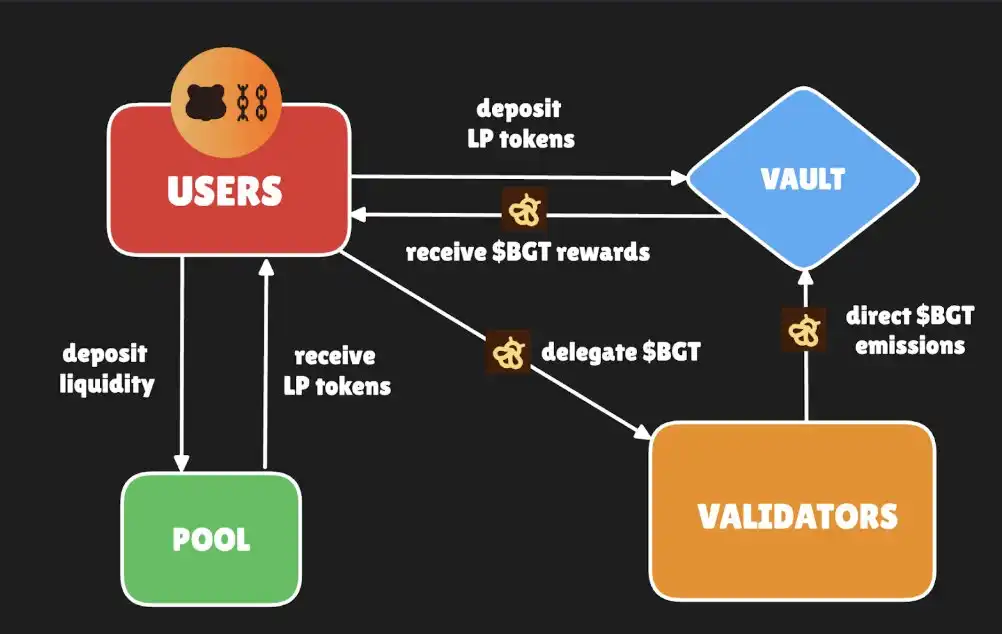
Users who deposit assets into whitelisted DeFi protocols (such as DEX or lending markets) can receive $BGT from a reward treasury. These smart contract-controlled pools continuously release $BGT to incentivize users to enhance ecosystem liquidity.
Unlike transferable rewards, the non-transferable nature of $BGT ties its value to ongoing participation, promoting long-term commitment.
2. Validator Dynamics
Validators stake the network Gas token $BERA to maintain chain security and earn $BGT rewards. Their key obligation is to allocate a portion of the rewards to a designated treasury to guide liquidity toward specific applications. In return, validators may receive protocol fees or native tokens as incentives, forming a symbiotic relationship. This structure highlights PoL's emphasis on mutualistic benefits.
3. Ecosystem Synergy
PoL builds a triple-incentive system for validators, applications, and liquidity providers. The protocol boosts competition rewards for validators distributing $BGT, while users delegate their $BGT to preferred validators. This design of a quasi-resource allocation market achieves network-level optimization of capital efficiency.
4. Capital Efficiency and Security
Traditional PoS locks capital in staking contracts, whereas PoL enables staked assets to secure the network and provide DeFi liquidity simultaneously. If this dual-purpose design scales successfully, it could make Berachain a benchmark for a sustainable blockchain economy.
Tokenomics: Dual-Token System
According to the Honeypaper, the Berachain ecosystem is driven by two distinct utility tokens:
· $BERA: The native Gas token used to pay transaction fees and validator staking, serving as the cornerstone of network security and operational costs.
· $BGT (Governance Token): Liquidity providers acquire it through market-making, holders can burn $BGT at a 1:1 rate to receive $BERA, or influence reward distribution through delegation. Its non-transferability ensures governance remains in the hands of active participants.
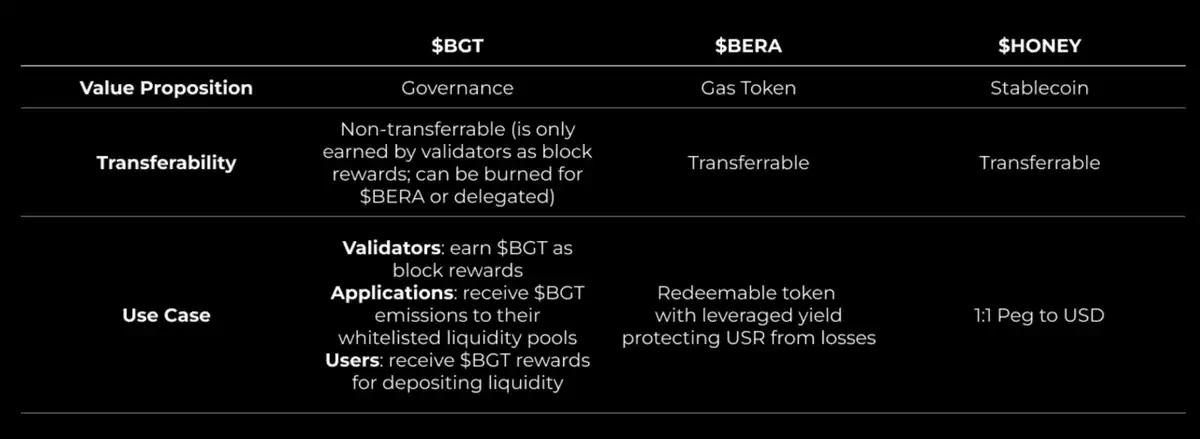
This model establishes validators relying on $BERA for security and users guiding liquidity through $BGT, creating a positive feedback loop to drive ecosystem growth.
$BGT Liquidity Forecast and Ecosystem Impact
The success of PoL hinges on the distribution and use of $BGT. This section outlines its potential impact:
1. Liquidity Aggregation
$BGT is expected to flow into DEXs, lending protocols, and other high-yield platforms—areas that have long dominated DeFi transaction volume. Validators may prioritize treasury rewards, leading liquidity toward established use cases. However, with a well-designed incentive mechanism, emerging areas such as derivatives or RWAs also have opportunities.
2. Network Activity
Validators maintain blockchain security and earn $BGT rewards by staking the Gas token $BERA in the staking network. Their key responsibility is to allocate a portion of the $BGT issuance to a reward pool, effectively directing liquidity into specific applications. In return, validators receive income shares, native token rewards, and other diverse incentives—forming a symbiotic relationship. This architecture distinctly embodies the core pursuit of PoL (Proof of Liquidity) for mutual benefit and incentive alignment.
3. Ecosystem Expansion
The deep liquidity spawned by PoL attracts developers and capital influx. Blocmates analysis suggests that new projects, from yield aggregators to cross-chain bridges, may onboard, echoing the scenario of Polygon's ecosystem TVL growing by 300% in 18 months post-2021.
4. Validator Competition
Validators strategically allocate $BGT rewards to attract delegations. According to Berachain forum disclosures on the reward pool whitelist mechanism, protocols offering the optimal risk-adjusted return may dominate early liquidity trends, shaping the overall ecosystem development focus.
Opportunities and Risks
Opportunities
• Capital Efficiency Enhancement: The dual-purpose staking assets enable PoL's locked capital throughput to potentially exceed traditional PoS by 15-25%, significantly reducing opportunity costs compared to the Ethereum staking model
• Decentralization Resilience: The distributed distribution of rewards among validators, users, and applications helps mitigate centralization risks
• Long-Term Growth: A liquidity-driven security model can attract institutional-grade DeFi projects, supporting 3-5 years of ecosystem expansion
Risks
• Operational Complexity: The multi-layered mechanisms involving validator rewards, reward pool whitelist, and $BGT delegation may deter regular users, with the first-year adoption rate potentially reaching only 10-20% of the target audience
• Incentive Misalignment: Validator collusion with protocols can distort the flow of $BGT (as evidenced by early governance disputes in SushiSwap)
• Validator Reliance: Network stability hinges on validators surpassing short-term self-interest to pursue collective well-being—something hard to predict pre-mainnet launch
• Regulatory Changes: The integration design of liquidity tokens and governance tokens may face regulatory uncertainty in jurisdictions such as the United States regarding DeFi regulations
Summary
In the current sluggish market environment, Berachain's PoL launch can be considered one of the few highlights, injecting new excitement into the industry.
This is the first major test of its concept validation, which will determine whether PoL can truly open up a new paradigm. Although projects like Initia have had similar attempts with "built-in liquidity," Berachain is the first case to undergo a real test.
Will it be a success? Can the "honey" truly create highly sticky liquidity? The answer will soon be revealed!
Original article link: Link
You may also like

WEEX AI Trading Hackathon Paris Workshop Reveals: How Retail Crypto Traders Can Outperform Hedge Funds
Witness how WEEX's Paris AI Trading Hackathon revealed AI's edge over human traders. Explore key strategies, live competition results & how to build your own AI trading bot.

U.S. Oil (USOR) Price Prediction 2026–2030
Key Takeaways U.S. Oil (USOR) is a speculative Solana-based crypto project that aims to index the United States…

USOR Surges on Meme Narrative Despite No Real-World Asset Backing
Key Takeaways: USOR, a Solana-based token, has seen a notable surge driven by speculative narratives rather than verifiable…

How to Buy U.S. Oil Reserve (USOR) Cryptocurrency
Key Takeaways U.S. Oil Reserve (USOR) is a Solana-based token primarily traded on decentralized exchanges (DEXs). Claims have…

USOR vs Oil ETFs: Understanding Why the ‘Oil Reserve’ Token Doesn’t Track Crude Prices
Key Takeaways The U.S. Oil Reserve (USOR) token has become noteworthy for its claims, yet it does not…

Trend Research Reduces Ether Holdings After Major Market Turbulence
Key Takeaways: Trend Research has significantly cut down its Ether holdings, moving over 404,000 ETH to exchanges recently.…
Investors Channel $258M into Crypto Startups Despite $2 Trillion Market Sell-Off
Key Takeaways: Investors pumped approximately $258 million into crypto startups in early February, highlighting continued support for blockchain-related…
NBA Star Giannis Antetokounmpo Becomes Shareholder in Prediction Market Kalshi
Key Takeaways: Giannis Antetokounmpo, the NBA’s two-time MVP, invests in the prediction market platform Kalshi as a shareholder.…

Arizona Home Invasion Targets $66 Million in Cryptocurrency: Two Teens Charged
Key Takeaways Two teenagers from California face serious felony charges for allegedly attempting to steal $66 million in…

El Salvador’s Bukele Approval Reaches Record 91.9% Despite Limited Bitcoin Use
Key Takeaways: El Salvador President Nayib Bukele enjoys a record high approval rating of 91.9% from his populace,…

Crypto Price Prediction for February 6: XRP, Dogecoin, and Shiba Inu’s Market Movements
Key Takeaways: The crypto market experienced a notable shift with Bitcoin’s significant surge, impacting altcoins like XRP, Dogecoin,…

China Restricts Unapproved Yuan-Pegged Stablecoins to Maintain Currency Stability
Key Takeaways: China’s central bank and seven government agencies have banned the issuance of yuan-pegged stablecoins abroad without…

Solana Price Prediction: $80 SOL Looks Scary – But Smart Money Just Signaled This Might Be the Bottom
Key Takeaways Despite Solana’s descent to $80, some traders find security as smart money enters the fray, suggesting…

XRP Price Prediction: Major Ledger Upgrade Quietly Activated – Why This Could Be the Most Bullish Signal Yet
Key Takeaways: The activation of the Permissioned Domains amendment on XRPL represents a significant development in XRP’s potential…

Dogecoin Price Prediction: Death Cross Confirmed as DOGE Falls Below $0.10 – Is DOGE Reaching Zero?
Key Takeaways The death cross event signals potential bearish trends for Dogecoin as its price dips under $0.10,…

Stablecoin Inflows Have Doubled to $98B Amid Selling Pressure
Key Takeaways Stablecoin inflows to crypto exchanges have surged to $98 billion, doubling previous levels amidst heightened market…

Coinbase UK Executive Declares Tokenised Collateral a Mainstream Financial Force
Key Takeaways Tokenised collateral is transitioning from its initial experimental stages into becoming core infrastructure within financial markets.…

Best Crypto to Buy Now February 6 – XRP, Solana, Bitcoin
Key Takeaways The cryptocurrency market witnesses volatility amid a technology-sector selloff, but opportunities still exist for keen investors.…
WEEX AI Trading Hackathon Paris Workshop Reveals: How Retail Crypto Traders Can Outperform Hedge Funds
Witness how WEEX's Paris AI Trading Hackathon revealed AI's edge over human traders. Explore key strategies, live competition results & how to build your own AI trading bot.
U.S. Oil (USOR) Price Prediction 2026–2030
Key Takeaways U.S. Oil (USOR) is a speculative Solana-based crypto project that aims to index the United States…
USOR Surges on Meme Narrative Despite No Real-World Asset Backing
Key Takeaways: USOR, a Solana-based token, has seen a notable surge driven by speculative narratives rather than verifiable…
How to Buy U.S. Oil Reserve (USOR) Cryptocurrency
Key Takeaways U.S. Oil Reserve (USOR) is a Solana-based token primarily traded on decentralized exchanges (DEXs). Claims have…
USOR vs Oil ETFs: Understanding Why the ‘Oil Reserve’ Token Doesn’t Track Crude Prices
Key Takeaways The U.S. Oil Reserve (USOR) token has become noteworthy for its claims, yet it does not…
Trend Research Reduces Ether Holdings After Major Market Turbulence
Key Takeaways: Trend Research has significantly cut down its Ether holdings, moving over 404,000 ETH to exchanges recently.…


 App
App