
- Buy Crypto
- Markets
 Futures
- Spot
- Copy Trade
- Earn
- More
Bitcoin Core devs want Bitcoin governed by ‘transparent, minimal rules’
By: bitcoin ethereum news|2025/05/08 00:15:01
0
Share
This is a segment from the Supply Shock newsletter. To read full editions, subscribe. Bitcoin miners are earning more than $1.2 billion per month to secure the chain. What are they securing, exactly? At its core, the collective hash power of honest miners ensures that bad actors can’t suddenly build up and release a second, dubious chain that might usurp the current one’s claim as the longest. Together with full node operators, miners also protect the chain from non-standard transactions. But miners can only ever select transactions that full nodes (which they generally operate themselves) have already deemed to be valid. So, how do those nodes decide which transactions are valid? That’s the role of Bitcoin Core’s relay code, which enforces standardness rules that determine whether a transaction ever makes it to a miner’s mempool at all. Those standardness rules (also referred to as policy rules) secure Bitcoin in a very different way. They effectively define what Bitcoin is and isn’t, and they’re routinely up for debate. On This Day: Ordinals take Bitcoin This time around, discussion has centered on the lifting of a policy rule that capped OP_RETURN outputs at 80 bytes, limiting the amount of arbitrary information that can be posted to the network through individual transactions. Two years ago to the day, however, Bitcoin was reckoning with the sudden popularity of digital collectibles protocol Ordinals, which utilizes three other opcodes introduced under the Taproot umbrella in 2021. At the time, 425,000 transactions were sitting in the Bitcoin mempool, as represented by Jochen Hoenicke’s full node, breaking the previous record of almost 262,000 from peak bull market in December 2017. Average bitcoin transaction fees spiked to more than $31, up from $2 days earlier. Through Ordinals, files of close to 4MB (enough to fill an entire block) have been written to Bitcoin including images, videos, audio and video games without relying on OP_RETURN, thereby avoiding its 80-byte limit altogether. All this has made Bitcoin a content storage network, to some degree. Each Ordinal is, essentially, tokenized non-financial data that can be traded peer-to-peer — the type of nonsense utility that had been typically reserved for virtual machine chains like Ethereum and Solana. These days, Ordinals activity has cooled, but has its moments. Bitcoin Core developers, in lifting the 80-byte policy rule on OP_RETURN data, are hoping to reduce the incentives for further workarounds that might damage the network in unknown ways. “The change re-affirms that Bitcoin is governed by transparent, minimal rules rather than editorial preference,” Blockstream engineer Gregory Sanders wrote. “By retiring a deterrent that no longer deters, Bitcoin Core keeps the policy surface lean and lets the fee market arbitrate competing demands.” Times like these remind us that Bitcoin is not sentient, but it does evolve. For living things, it’s the biological code inside DNA that informs how they grow. On the other hand, Bitcoin’s “blind watchmaker” is the collective resolve of its active developers, even if they don’t have unanimous support for their proposed changes, as expressed through the willingness of miners, node operators and users to adopt them. Or, as Sanders put it: “Dissenting parties remain free to modify software, run stricter policy, or propose new resource limits if empirical harm emerges.” Get the news in your inbox. Explore Blockworks newsletters: Source: https://blockworks.co/news/bitcoin-op-return-ordinals-miners-chain-data
You may also like

Particle Founder: The entrepreneurial insights I have gained the most from in the past year
Stop lean startup, stop lightning entrepreneurship, and think carefully about what your product aspirations are.

Huang Renxun's latest podcast transcript: The future of Nvidia, the development of embodied intelligence and agents, the explosion of inference demand, and the public relations crisis of artificial intelligence
The competition in the future is not just about whose model is larger or whose computing power is stronger, but also about who understands the industry better, who can embed AI more deeply into real processes, and who can organize these capabilities into a runnable and scalable system.

OKX Ventures Research Report: AI Agent Economic Infrastructure Research Report (Part 1)
The existing infrastructure is hostile to the Agent economy. Agents can think and act independently at the "capability level," but at the "economic level," they are still locked into infrastructure designed for humans.

The migration of settlement rights: B18 and the institutional starting point of on-chain banks
In the traditional system, banks decide the settlement; in the on-chain system, code begins to take over this responsibility.

From Tencent and Circle: Looking at the Simple and Difficult Questions of Investment
The AI narrative continues to ferment, but the recent performance of related stocks varies, with some in the midst of summer and others as if in winter.

The second half of stablecoins no longer belongs to the crypto circle
What Coinbase doesn't want, Mastercard is eager to buy.

Cursor "Shell" Kimi Controversy Reversed: From Copyright Infringement Allegations to Authorized Collaboration, China's Open Source Model Once Again Becomes a Global AI Foundation
Cursor was accused of being based on Kimi K2.5, which sparked controversy, and was later confirmed to be compliant through Fireworks AI due diligence.

The Real Reason Tokens Don't Sell: 90% of Crypto Projects Overlook Investor Relations
Provide an Investor Relations Best Practices Guide for Crypto Projects.

Is the income of pump.fun real, earning a million dollars a day despite the market downturn?
If it can really earn this much, what is the reason for the low price of $PUMP?

The real reason why tokens are not selling: 90% of crypto projects neglect investor relations
Investor Relations Practice Guide for Cryptocurrency Projects.

Who is the true winner of the "Tokenization" narrative?
Virtually everyone benefits, but the reason for the benefit, the timing, and the underlying logic are completely different.

Moss: The Era of AI-Traded by Anyone | Project Introduction
AI Trading Agent is rapidly growing its infrastructure.

Chip Smuggling Case Exposes Regulatory Loophole | Rewire News Evening Update
AI chips have become a strategic asset more sensitive than missiles

How a Structured AI Crypto Trading Bot Won at the WEEX Hackathon
Ritmex demonstrates how disciplined risk control and structured signals can make an AI crypto trading bot more stable and reliable on WEEX, highlighting the importance of combining execution discipline with scalable AI trading systems.

Old Indicator Fails, Three Major New Signals Emerge: BTC True Bottom May Still Be Below $60K
When the grocery shopping auntie on the subway, or Tony the hairdresser, start asking you about BTC, crypto, and cryptocurrency investments, selling immediately will be the only best option.

Meeting OpenClaw Founder at a Hackathon: What Else Can Lobsters Do?
Imperial College London MetaGame: AI Agent × Web3 Landing Three Major Directions.
Huang Renxun's Latest Podcast Transcript: NVIDIA's Future, Embodied Intelligence and Agent Development, Soaring Demand for Inferencing, and AI's PR Crisis
The future of competition is not only about whose model is bigger, whose computing power is stronger, but also about who understands the industry better, who can more deeply integrate AI into real processes, and who can organize these capabilities into a set of executable, scalable systems
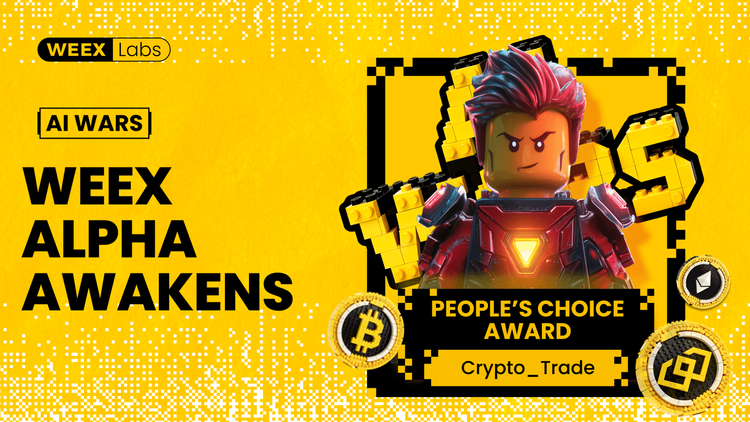
How a Structured AI Crypto Trading Bot Won at the WEEX Hackathon
Crypto_Trade shows how structured inputs and controlled adaptability can build a more stable and reliable AI crypto trading bot within the WEEX AI Trading Hackathon, highlighting a practical path toward scalable AI trading systems.
Particle Founder: The entrepreneurial insights I have gained the most from in the past year
Stop lean startup, stop lightning entrepreneurship, and think carefully about what your product aspirations are.
Huang Renxun's latest podcast transcript: The future of Nvidia, the development of embodied intelligence and agents, the explosion of inference demand, and the public relations crisis of artificial intelligence
The competition in the future is not just about whose model is larger or whose computing power is stronger, but also about who understands the industry better, who can embed AI more deeply into real processes, and who can organize these capabilities into a runnable and scalable system.
OKX Ventures Research Report: AI Agent Economic Infrastructure Research Report (Part 1)
The existing infrastructure is hostile to the Agent economy. Agents can think and act independently at the "capability level," but at the "economic level," they are still locked into infrastructure designed for humans.
The migration of settlement rights: B18 and the institutional starting point of on-chain banks
In the traditional system, banks decide the settlement; in the on-chain system, code begins to take over this responsibility.
From Tencent and Circle: Looking at the Simple and Difficult Questions of Investment
The AI narrative continues to ferment, but the recent performance of related stocks varies, with some in the midst of summer and others as if in winter.
The second half of stablecoins no longer belongs to the crypto circle
What Coinbase doesn't want, Mastercard is eager to buy.


 App
App