
- Buy Crypto
- Markets
 Futures
- Spot
- Copy Trade
 Earn
Earn- More
Can IBIT Really Trigger a Market-Wide Liquidation?

Original Title: "Can IBIT Really Trigger a Market-Wide Liquidation?"
Original Author: ChandlerZ, Foresight News
When the market experiences a sharp downturn, the narrative often quickly seeks an identifiable source.
Recently, the market has begun a deep dive into the discussion surrounding the plunge on February 5th and the close to $10,000 rebound on February 6th. Bitwise advisor and ProCap Chief Investment Officer Jeff Park believes that this volatility is more closely linked to the Bitcoin spot ETF ecosystem than the outside world imagines, with key clues concentrated in the secondary market and options market of BlackRock's iShares Bitcoin Trust Fund (IBIT).
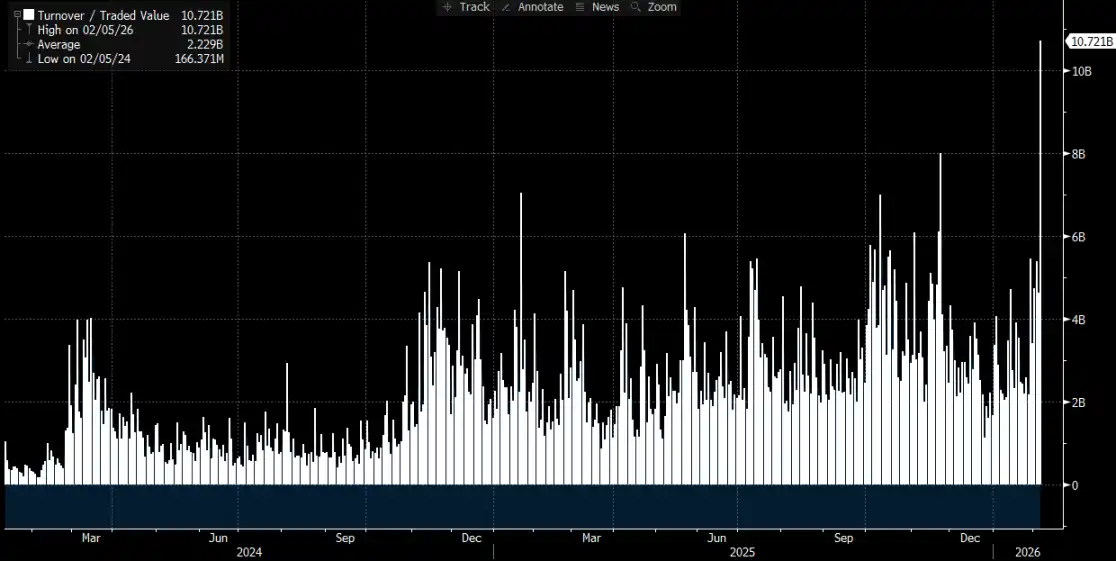
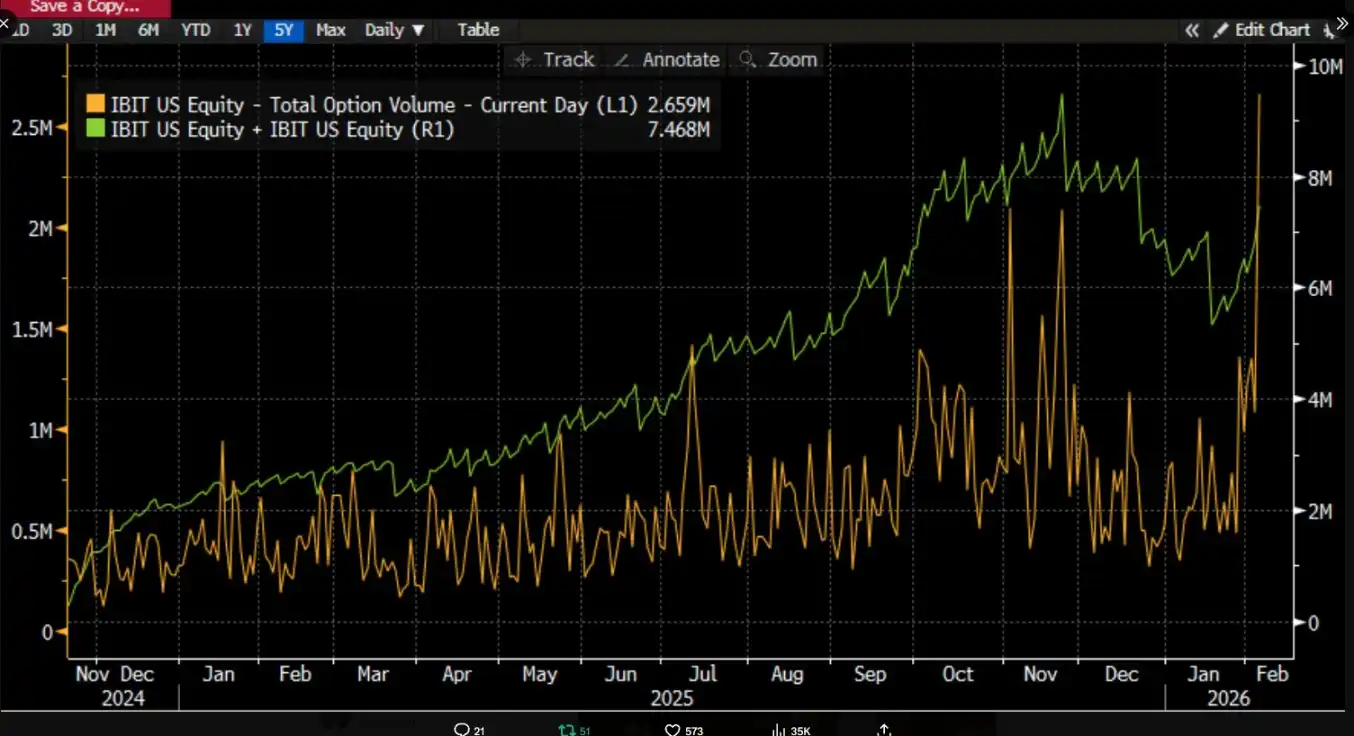
He pointed out that on February 5th, IBIT saw record-breaking trading volume and option activity, with the trading volume significantly higher than before, and the option trading structure skewing towards put options. More counterintuitively, based on historical experience, if the price experiences a double-digit decline in a single day, the market usually witnesses significant net redemptions and outflows of funds, but the opposite occurred. IBIT recorded net creations, with new shares driving asset growth, and the entire spot ETF portfolio also experienced net inflows.
Jeff Park believes that this combination of "plunge and net creation coexistence" has weakened the explanatory power of the ETF investor panic redemption leading to a decline, instead aligning more with the deleveraging and risk reduction occurring within the traditional financial system. Traders, market makers, and multi-asset portfolios have been forced to reduce risk in derivative and hedging frameworks, with selling pressure coming more from the adjustments of positions in the fiat money system and the squeeze in the hedging chain, ultimately transmitting the impact through IBIT's secondary market trading and options hedging to the Bitcoin price.
Many market discussions easily link institutional liquidation through IBIT directly to the market-driven crash. However, if this causal chain is not broken down into mechanism details, the sequence can be easily reversed. The secondary market trading of an ETF targets ETF shares, while primary market creations and redemptions correspond to changes in BTC on the custody side. Linearly mapping the trading volume of the secondary market to an equivalent spot sell-off is logically missing several necessary explanatory steps.
The so-called "IBIT Triggered Large-Scale Liquidation" is actually a debate about the transmission pathway.
Regarding the controversy surrounding IBIT, the main focus is on which layer of the ETF market and through what mechanism the pressure is transmitted to the price formation side of BTC.
A more common narrative focuses on net outflows from the primary market. The intuition behind it is quite simple: if ETF investors panic-sell and redeem, the issuer or authorized participant needs to sell the underlying BTC to fulfill the redemption, introducing selling pressure into the spot market. This price drop triggers further liquidations, leading to a cascade.
While this logic sounds sound, it often overlooks one key fact. Retail investors and the vast majority of institutions cannot directly subscribe to or redeem ETF shares; only authorized participants can create and redeem in the primary market. The widely cited "daily net inflow and outflow" typically refers to changes in the total shares outstanding in the primary market, and no matter how large the trading volume in the secondary market, it only changes the ownership of shares, does not automatically change the total share count, and certainly does not automatically lead to BTC movement on the custody side.
Analyst Phyrex Ni suggests that what Parker referred to as liquidation is actually the settlement of the IBIT spot ETF, not Bitcoin's settlement. For IBIT, the only thing trading in the secondary market is IBIT itself, with its price pegged to BTC. However, the trading activity itself only occurs internally within the securities market.
The real impact on BTC only occurs in the primary market, where share creation and redemption happen, and this channel is executed by APs (akin to market makers). During creation, when new IBIT shares are needed, the AP must provide the corresponding BTC or cash consideration, and the BTC will enter the custody system, subject to regulatory constraints, where the issuer and relevant institutions cannot freely access it. During redemption, the custodian will transfer the BTC to the AP, who will then handle the subsequent disposition and settle the redemption proceeds.
ETFs effectively operate on a two-tier market system, with the primary market mainly dealing with Bitcoin's acquisition and redemption, a process mostly handled by APs providing liquidity—fundamentally similar to using USD to mint USDC. APs rarely circulate BTC through trading platforms, so the primary usefulness of a spot ETF purchase is to lock up Bitcoin's liquidity.
Even in the case of redemption, APs' sell-off behavior may not necessarily need to occur through the public market, especially not through trading platform spot markets. APs themselves may hold inventory BTC and can employ more flexible means to settle deliveries and arrange funding within a T+1 settlement window. Therefore, even during the mass liquidation on January 5th, the BTC redeemed from BlackRock's outflows was less than 3,000, and total BTC redeemed by ETF institutions across the U.S. was less than 6,000, meaning the maximum BTC sold to the market by ETF institutions was only around 6,000. Moreover, these 6,000 BTC may not all have been transferred to trading platforms.
What Parker referred to as IBIT's settlement actually occurred in the secondary market, with a total trading volume of approximately $10.7 billion, making it the largest transaction volume in IBIT's history. While this did trigger some institutional settlements, it is important to note that this particular settlement was specific to IBIT and did not involve Bitcoin's settlement. At least, this settlement did not transmit to the primary market of IBIT.
Therefore, Bitcoin's sharp decline only triggered IBIT's settlement but did not result in BTC's settlement caused by IBIT. The underlying asset of ETF secondary market trading is fundamentally the ETF itself, with BTC merely serving as a price anchor for the ETF. The most significant impact on the market would be the liquidation triggered by the primary market's BTC sell-off, not IBIT. In fact, although Bitcoin's price dropped by over 14% on Thursday, BTC's net outflow in the ETF was only 0.46%, with a total of 1,273,280 BTC held by BTC spot ETF and 5,952 BTC flowed out that day.
Transmission from IBIT to Spot
@MrluanluanOP believes that when IBIT's long positions are liquidated, concentrated selling will occur in the secondary market. If the natural buying pressure in the market is insufficient, IBIT will trade at a discount relative to its implied net asset value. The greater the discount, the more significant the arbitrage opportunity, motivating Authorized Participants (APs) and market arbitrageurs to buy the discounted IBIT shares, as this is their usual way to profit. As long as the discount covers costs sufficiently, there will theoretically always be professional capital willing to take on the risk, so there is no need to worry about "unmatched selling pressure."
However, after taking on the IBIT shares, the focus shifts to risk management. After AP acquires IBIT shares, they cannot immediately redeem and realize these shares at the current price due to redemption timing and process costs. During this period, the prices of BTC and IBIT will continue to fluctuate, exposing AP to net exposure risks, prompting them to hedge immediately. Hedging may involve selling spot inventory or opening a BTC short position in the futures market.
If the hedge involves selling spot assets, it will directly impact the spot price; if the hedge involves shorting BTC futures, it will first affect the spread and basis changes and then further influence the spot market through quantitative, arbitrage, or cross-market trading.
After completing the hedge, AP will have a relatively neutral or fully hedged position, allowing them to flexibly decide when to deal with these IBIT shares at the execution level. One option is to redeem them with the issuer on the same day, reflecting in the end-of-day official inflow/outflow data as redemptions and net outflows. Alternatively, they may choose not to redeem immediately, waiting for the secondary market sentiment to recover or prices to rebound before selling the IBIT directly back into the market, thus completing the entire trade without going through the primary market. If IBIT returns to a premium or the discount converges the next day, AP can sell the position in the secondary market to realize spread profits, while closing out any futures short positions established earlier or replenishing previously sold spot inventory.
Even though the majority of share redemption takes place in the secondary market and there may not be significant net redemptions on the primary market, the transmission of IBIT to BTC can still occur due to the hedging actions taken by Authorized Participants when taking on a discount position, shifting the pressure to the BTC spot or derivative market, thereby creating a link for IBIT’s secondary market selling pressure to spill over into the BTC market through hedging activities.
You may also like

U.S. Oil (USOR) Price Prediction 2026–2030
Key Takeaways U.S. Oil (USOR) is a speculative Solana-based crypto project that aims to index the United States…

USOR Surges on Meme Narrative Despite No Real-World Asset Backing
Key Takeaways: USOR, a Solana-based token, has seen a notable surge driven by speculative narratives rather than verifiable…

How to Buy U.S. Oil Reserve (USOR) Cryptocurrency
Key Takeaways U.S. Oil Reserve (USOR) is a Solana-based token primarily traded on decentralized exchanges (DEXs). Claims have…

USOR vs Oil ETFs: Understanding Why the ‘Oil Reserve’ Token Doesn’t Track Crude Prices
Key Takeaways The U.S. Oil Reserve (USOR) token has become noteworthy for its claims, yet it does not…

Trend Research Reduces Ether Holdings After Major Market Turbulence
Key Takeaways: Trend Research has significantly cut down its Ether holdings, moving over 404,000 ETH to exchanges recently.…
Investors Channel $258M into Crypto Startups Despite $2 Trillion Market Sell-Off
Key Takeaways: Investors pumped approximately $258 million into crypto startups in early February, highlighting continued support for blockchain-related…
NBA Star Giannis Antetokounmpo Becomes Shareholder in Prediction Market Kalshi
Key Takeaways: Giannis Antetokounmpo, the NBA’s two-time MVP, invests in the prediction market platform Kalshi as a shareholder.…

Arizona Home Invasion Targets $66 Million in Cryptocurrency: Two Teens Charged
Key Takeaways Two teenagers from California face serious felony charges for allegedly attempting to steal $66 million in…

El Salvador’s Bukele Approval Reaches Record 91.9% Despite Limited Bitcoin Use
Key Takeaways: El Salvador President Nayib Bukele enjoys a record high approval rating of 91.9% from his populace,…

Crypto Price Prediction for February 6: XRP, Dogecoin, and Shiba Inu’s Market Movements
Key Takeaways: The crypto market experienced a notable shift with Bitcoin’s significant surge, impacting altcoins like XRP, Dogecoin,…

China Restricts Unapproved Yuan-Pegged Stablecoins to Maintain Currency Stability
Key Takeaways: China’s central bank and seven government agencies have banned the issuance of yuan-pegged stablecoins abroad without…

Solana Price Prediction: $80 SOL Looks Scary – But Smart Money Just Signaled This Might Be the Bottom
Key Takeaways Despite Solana’s descent to $80, some traders find security as smart money enters the fray, suggesting…

XRP Price Prediction: Major Ledger Upgrade Quietly Activated – Why This Could Be the Most Bullish Signal Yet
Key Takeaways: The activation of the Permissioned Domains amendment on XRPL represents a significant development in XRP’s potential…

Dogecoin Price Prediction: Death Cross Confirmed as DOGE Falls Below $0.10 – Is DOGE Reaching Zero?
Key Takeaways The death cross event signals potential bearish trends for Dogecoin as its price dips under $0.10,…

Stablecoin Inflows Have Doubled to $98B Amid Selling Pressure
Key Takeaways Stablecoin inflows to crypto exchanges have surged to $98 billion, doubling previous levels amidst heightened market…

Coinbase UK Executive Declares Tokenised Collateral a Mainstream Financial Force
Key Takeaways Tokenised collateral is transitioning from its initial experimental stages into becoming core infrastructure within financial markets.…

Best Crypto to Buy Now February 6 – XRP, Solana, Bitcoin
Key Takeaways The cryptocurrency market witnesses volatility amid a technology-sector selloff, but opportunities still exist for keen investors.…
Why Is Crypto Down Today, February 6, 2026
Key Takeaways The global cryptocurrency market has seen an 8% decline in the last 24 hours, standing at…
U.S. Oil (USOR) Price Prediction 2026–2030
Key Takeaways U.S. Oil (USOR) is a speculative Solana-based crypto project that aims to index the United States…
USOR Surges on Meme Narrative Despite No Real-World Asset Backing
Key Takeaways: USOR, a Solana-based token, has seen a notable surge driven by speculative narratives rather than verifiable…
How to Buy U.S. Oil Reserve (USOR) Cryptocurrency
Key Takeaways U.S. Oil Reserve (USOR) is a Solana-based token primarily traded on decentralized exchanges (DEXs). Claims have…
USOR vs Oil ETFs: Understanding Why the ‘Oil Reserve’ Token Doesn’t Track Crude Prices
Key Takeaways The U.S. Oil Reserve (USOR) token has become noteworthy for its claims, yet it does not…
Trend Research Reduces Ether Holdings After Major Market Turbulence
Key Takeaways: Trend Research has significantly cut down its Ether holdings, moving over 404,000 ETH to exchanges recently.…
Investors Channel $258M into Crypto Startups Despite $2 Trillion Market Sell-Off
Key Takeaways: Investors pumped approximately $258 million into crypto startups in early February, highlighting continued support for blockchain-related…


 App
App