
 Buy Crypto
- Markets
 Futures
- Spot
- Copy Trade
- Earn
- More
Rhythm X Zhihu Event Guest Announcement, featuring experts from academia, institutions, and individuals covering all aspects of the AI Agent's transformative financial model.


For two consecutive days, two groups of people showed up at the doorstep of GPT's creator Sam Altman's house. One group threw a Molotov cocktail towards his house, while the other group fired gunshots directly into the house.
No one was injured. But the timing of this event is noteworthy—just a few days after OpenAI released its latest model, just a few days after Anthropic's Earth's most powerful model Mythos became widely known, just a few days after Hermes 3 had just surpassed OpenClaw in multiple benchmarks, just in the week when the entire AI industry began seriously discussing whether the "model iteration speed has exceeded human comprehension speed."
This is not just a piece of ordinary social news. This is a signal: when the speed of technological change starts to feel out of control, feelings of being out of control will find a specific outlet.
From any perspective, the AI industry from the beginning of the year until now is in an accelerated state. The release cycle of new models has been compressed from quarters to weeks, sometimes days. A product that was considered the strongest reasoning model just a month ago may have been surpassed by three competitors today. Hermes replaced OpenClaw—not in the distant future, but last week.
This speed itself has become a structural variable.
On April 21, Rhythm BlockBeats, in collaboration with Zhihu, held "Decoding Web 4.0: When AI Agent Takes Over On-Chain Permissions" in Hong Kong. The purpose is to capture at the earliest possible time what kind of financial scenario we will face when AI Agent integrates with the chain.
The theme of this event is not "What is Web 4.0," but "When the Agent becomes the primary on-chain participant, in what dimension do the rules of the game shift." This event is not to define what, but to find some solutions.
This event was jointly organized by Cobo and MuleRun, and thanks to Noxcat, Lutos, SmallWOD, and others as event supporters, they are the first to run in this intersection.
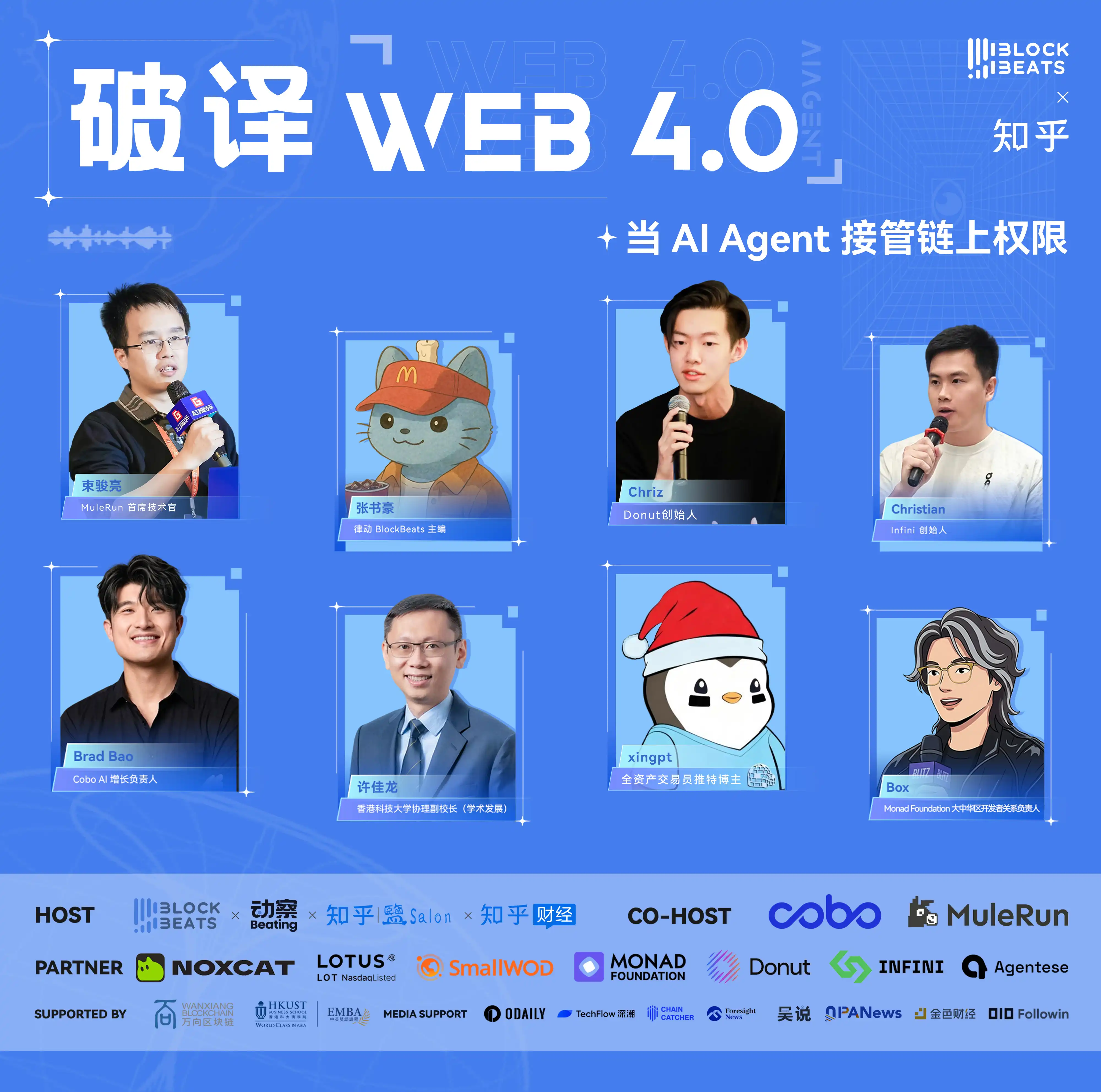
Junliang Shu, MuleRun CTO
When the model iteration speed is compressed to a weekly basis, the bottleneck is no longer whether AI is smart enough, but who can quickly and safely deploy it. MuleRun, as the world's first self-evolving personal AI, has replaced the technological threshold with natural language. Users can open their browsers and describe their trading logic, and the Agent can automatically monitor the market, build workflows, and generate institutional-grade research signals 24/7. It does not make decisions for users but empowers professionals to drive AI with their own judgment.
Shu Junliang has been in cybersecurity for over a decade, and MuleRun has embedded security from day one. The issue he will discuss at the event is very straightforward: how to free human judgment from execution friction.
Brad Bao, Head of AI Growth at Cobo Al
When an Agent starts actively managing on-chain assets, how do you ensure it never crosses the line while unleashing its autonomous execution capability? The roles of digital asset custody and wallets also need to be redefined in the AI era. This is not a product feature upgrade but rather infrastructure building.
Since its founding in 2017, Cobo has provided digital asset custody and wallet infrastructure to over 500 institutions worldwide, managing assets worth trillions of dollars with zero security incidents to date. Facing the rise of AI Agents, Cobo is exploring the creation of a trusted infrastructure for the Agentic economy, combining a comprehensive wallet solution with advanced risk management systems and developer tools to empower various institutions and AI Agent users to efficiently build, operate, and achieve scalable expansion in the ever-changing digital financial world. Brad Bao is mainly responsible for Cobo's strategic implementation in the AI direction.
NOXCAT
NOXCAT is building a Web3 infrastructure platform for the next generation of digital financial scenarios—integrating on-chain collateral mechanisms, social relationship networks, and multi-asset trading systems to allow users to exchange value and allocate assets without the need for trusted intermediaries.
The core judgment in this direction is: the next threshold of digital finance is not technology but the cost of trust. What NOXCAT is doing is embedding the cost of trust into the protocol layer.
Kevin Xu, Associate Vice President of The Hong Kong University of Science and Technology
The Hong Kong University of Science and Technology has long been at the forefront of digital finance research. Professor Kevin Xu brings a structural analysis perspective beyond the narrative of technology and capital intersection.
xingpt, Full-Stack Trader
His post on "AI-Optimized Workflow" once had over 2 million views on Platform X.
Chriz, Founder of Donut AI
Formerly at ByteDance, he founded Donut AI to build the transaction infrastructure of the AI era. The first product—serving the full-stack trading active Agent D0—is already live.
Christian, Founder of Infini
As the founder of Infini, Christian has long focused on stablecoin payments, cross-border fund transfers, and global financial infrastructure. He is committed to promoting the integration of fiat currency systems, crypto networks, and AI capabilities, helping businesses achieve higher efficiency in receivables, payments, fund management, and financial collaboration. He is building an AI Financial OS for global business, serving next-generation globalized enterprises such as cross-border e-commerce, SaaS, and digital entertainment.
He believes that "true global finance belongs not to the old system, but to the stablecoin and AI-driven next-generation infrastructure."
Box, Developer Relations, Monad Foundation Greater China
As a highly performant public chain in the current crypto industry, Monad is particularly focused on AI Agent + on-chain applications, such as the "Monad AI Blueprint" program designed specifically for Agents and the AI Hackathon, which has attracted many high-quality teams and projects.
We believe that the insights shared by these guests on the new financial model brought by AI Agents will provide everyone with a different perspective. The event will still be open for registration on April 21 in Hong Kong, hosted by Rhythm X Zhihu. To register, please click: https://luma.com/r3h4eqk
You may also like

Is your gold really "within reach"? The geographical blind spots of custodial services behind tokenized gold

Cook Passes the Baton, Anthropic Gears Up | Rewire News Morning Brief

Will the Fed Cut Interest Rates Again? Tonight's Data Is Key

The person taking over Apple has to do something he has never done before

Why Are You Always Losing Money on Polymarket? Because You're Betting on News, While The Rulebook Favors Insiders

Not a Price Hike, but a Supply Shortage? Oil Price Has Crossed the Threshold

a16z: 5 Ways Blockchain Helps AI Agent Infrastructure

Morning News | The Hong Kong Securities and Futures Commission announced the regulatory framework for secondary market trading of tokenized investment products; Strategy increased its holdings by 34,164 bitcoins last week; KAIO completed a strategic fi...
What Is an XRP Wallet? The Best Wallets to Store XRP (2026 Updated)
An XRP wallet lets you safely store, send, and receive XRP on the XRP Ledger. Learn what wallets support XRP and discover the best XRP wallets for beginners and long-term holders in 2026.

What are the Top AI Crypto Coins? Render vs. Akash: 5 Gems Solving the 2026 GPU Crisis
What are the best AI crypto coins for the 2026 cycle? Beyond the hype, we analyze top tokens like RNDR, AKT, and FET that provide real-world solutions to the global GPU shortage and the rise of autonomous agents.

What Is a Token in AI? What Is an AI Token + 3 Gems You Can't Miss in 2026
The era of AI hype has transitioned into an era of utility. As we move through Q2 2026, the market is no longer rewarding "narrative-only" projects. At WEEX Research, we are seeing a massive capital rotation into Decentralized Compute (DePIN) and Autonomous Agent coordination layers. This guide analyzes which AI tokens are capturing institutional liquidity and how to spot high-conviction setups in a maturing market.
Consumer-grade Crypto Global Survey: Users, Revenue, and Track Distribution

Prediction Markets Under Bias

Stolen: $290 million, Three Parties Refusing to Acknowledge, Who Should Foot the Bill for the KelpDAO Incident Resolution?

ASTEROID Pumped 10,000x in Three Days, Is Meme Season Back on Ethereum?

ChainCatcher Hong Kong Themed Forum Highlights: Decoding the Growth Engine Under the Integration of Crypto Assets and Smart Economy

Why can this institution still grow by 150% when the scale of leading crypto VCs has shrunk significantly?



 App
App