
- Buy Crypto
- Markets
 Futures
- Spot
- Copy Trade
- Earn
- More
The US’s Back-Channel Helper in Attacking Iran, How Evil is Palantir

Original Author: Jack, Visionist at Beating
Introduction: This article was first published on February 2, 2026. In less than a month after writing this article, Palantir once again used data to validate that unsettling logic loop: War is its best marketing campaign. Yesterday, as the US-Iran conflict escalated and global risk assets were being ground into the floor, PLTR surged against the trend by 7%, closing at $145. Q4 revenue grew by 70% year-on-year, with a full-year 2026 guidance of $7.2 billion (+61%), and US commercial revenue growth of 115%—Wall Street analysts collectively raised their target prices, with UBS going directly from Neutral to Buy. More notably, DHS just signed a five-year, $1 billion AI platform procurement agreement, covering CBP and ICE. The ImmigrationOS mentioned in the article is now transitioning from a contract document to a real-world enforcement machine.
When Palantir's market cap surpassed $328 billion, breaking away from the traditional defense industry with a P/E ratio of 200, the Thiels' combination of "hard technology + financial fuel + political revolving door" is no longer a theoretical deduction but is becoming the underlying code of the US national machinery. What's even more interesting is that in Citrini Research's "AI Doomsday Script" that scared Wall Street, Palantir is listed as the only template that might survive—OpenAI is even copying its homework. The following is the original text:
In January 2026, Minnesota spiraled out of control.
The Trump administration announced the termination of Temporary Protected Status (TPS) for Somalia, which meant tens of thousands of Somali refugees who had been living in the US for years had to leave by March 17. Minneapolis is home to the largest Somali community in the US, making it the policy's most direct impact.
Subsequently, "Operation Metro Surge" proceeded as planned. Over 2,000 Immigration and Customs Enforcement (ICE) agents in tactical gear flooded the city, a number even exceeding the total personnel of the Minneapolis Police Department. They drove black SUVs and conducted intensive raids and arrests in residential areas.
A large number of disturbing videos quickly spread on social media. An agent used a window breaker to smash a car window, dragged the screaming driver out with a chokehold, and pinned them to the cold ground. The most shocking of these incidents was the death of 37-year-old American citizen Renee Good. This legal observer was shot in the head at close range by a federal agent through the windshield while documenting law enforcement actions. Officials claimed she was attempting to ram people with her car, but the video showed her vehicle was just slowly turning.

Behind this large-scale manhunt lies a name, Palantir.
Multiple investigative reports revealed that ICE is extensively using a tool called ELITE developed by Palantir in Minneapolis. This system integrates massive amounts of data such as the surveillance target's medical aid, tax records, water and electricity bills, and cruelly marks them as individual target points on a map through algorithms.
According to publicly available federal contract records, on April 17, 2025, ICE awarded Palantir a $30 million contract modification agreement to develop a platform codenamed "ImmigrationOS." Public contract defense documents explicitly stated that the system was to support the president's executive order on accelerating deportation actions. Many believe that this platform is actually an operating system tailored for this "surge" large-scale operation set to begin in 2026.
Over the past few years, Palantir has been denounced by the public as a "data butcher." Its support for the Israeli military in the Gaza War, along with long-standing moral and ethical controversies and over a decade of loss history, has made Palantir an "unwelcome" entity in both Silicon Valley and Wall Street.
But everything changed in the past year.
From "Data Butcher" to "AI Belief Stock"
In 2025, Palantir exploded on Wall Street. This company that had lurked in controversy for twenty years completed its transformation from an "edgy contractor" to a "backbone of the U.S. stock market." Its official inclusion in the S&P 500 in September 2024 was just the beginning, as the company then moved its listing from the NYSE to the NASDAQ, its stock price soared 150% within a year, its market value surpassed $400 billion at one point, rendering all traditional valuation models feeble in comparison.
Behind this was a dramatic reversal in its financial data. After enduring 19 consecutive years of losses, Palantir achieved GAAP profitability at the end of 2022 and entered a super high-growth mode in the second half of 2024. By 2025, its quarterly revenue surpassed $1 billion for the first time, reaching $11.81 billion, with a year-over-year growth rate soaring from around 20.8% in early 2024 to 62.7% in the third quarter of 2025.
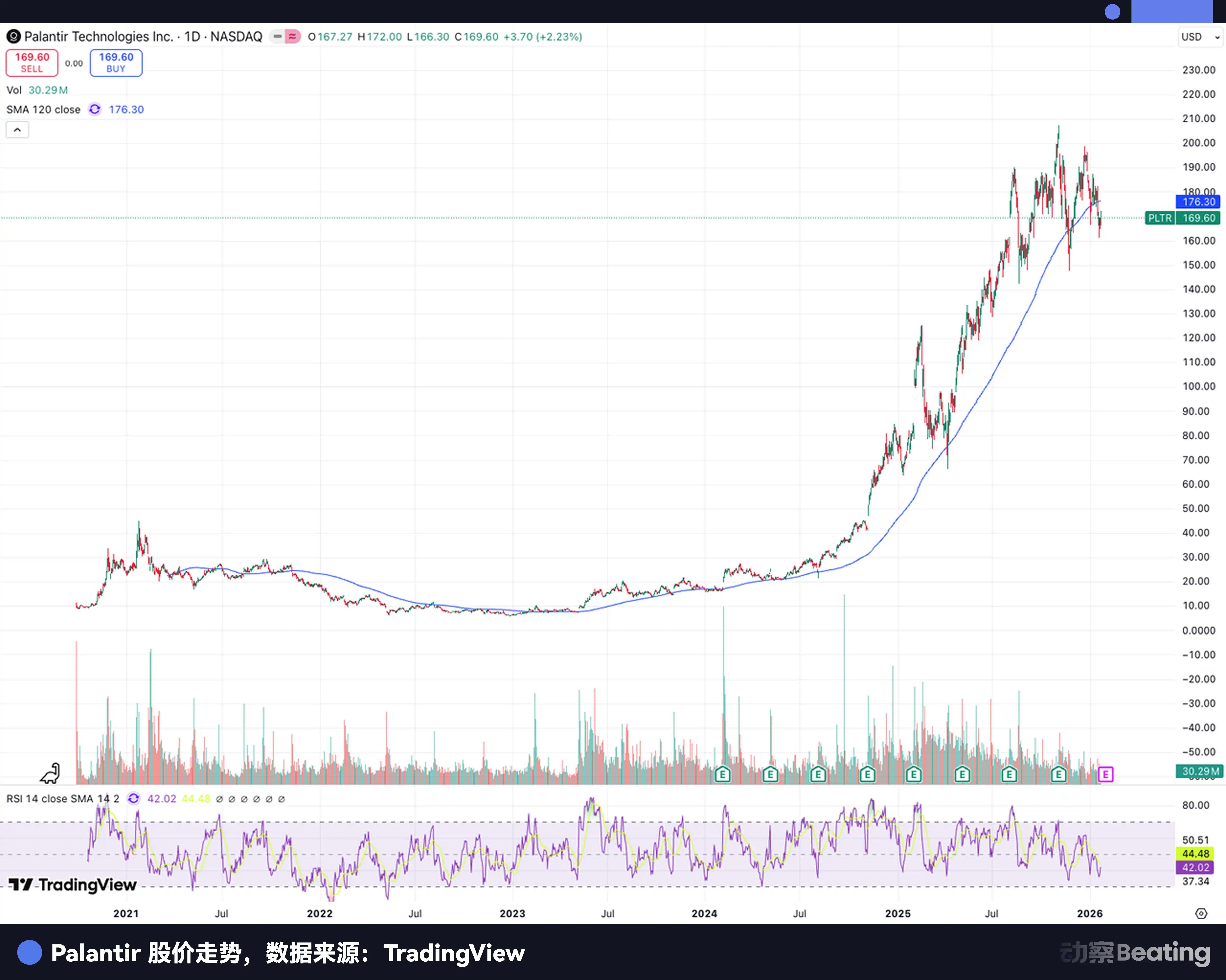
The core driver of growth comes from the explosion of its commercial business. In the third quarter of 2025, Palantir's U.S. commercial revenue surged 121% year-over-year. This astounding data completely shattered the market's traditional perception of its "government reliance." On Reddit, retail investors hailed it as an "AI faith stock," lauding Palantir for building the underlying digital operating system for modern civilization. In 2025, retail investors net purchased nearly $8 billion of Palantir stock, making it the fifth-largest security in terms of retail purchase volume that year, directly driving the price-to-sales ratio to over 100 times.
However, beneath the prosperity and euphoria lies Palantir's darkest history of being exiled from the entire Western financial system.
In September 2020, to retaliate against investment banks' suppression of its valuation, Palantir CEO Alex Karp and co-founder Peter Thiel chose a highly provocative direct listing model. They bypassed the traditional bank underwriting process, not paying massive underwriting fees to banks. This meant that Palantir was launching a comprehensive war on the entire Wall Street system.
Palantir's "original sin" is rooted in its founding gene, as it was one of the first startups funded by In-Q-Tel, the venture capital fund under the Central Intelligence Agency (CIA), in 2005. Despite only receiving $2 million in seed funding at the time, this intelligence agency background integrated Palantir's business deeply with the government and the military. Its collaboration with ICE is particularly profound.
Since 2014, Palantir has developed the ICM Investigative Case Management system and the FALCON mobile application for the U.S. Immigration and Customs Enforcement (ICE) through a $41 million contract, allowing federal agents to track targets' geographical trajectories in real-time using cell tower data to identify and track illegal immigrants.
Palantir's long-term collaboration with ICE has classified it in the ESG framework as a company with "potential human rights violations" and "monitoring social risks." Palantir's scores in major ESG rating agencies have long been at the bottom level. Ethos ESG once gave Palantir an F-rating, with a composite score of only 18.1 points (out of 100), ranking it in the bottom 1% of the entire software industry. In social dimensions such as "Accountability" and "LGBTQ+ Equality," Palantir's scores are all 0.
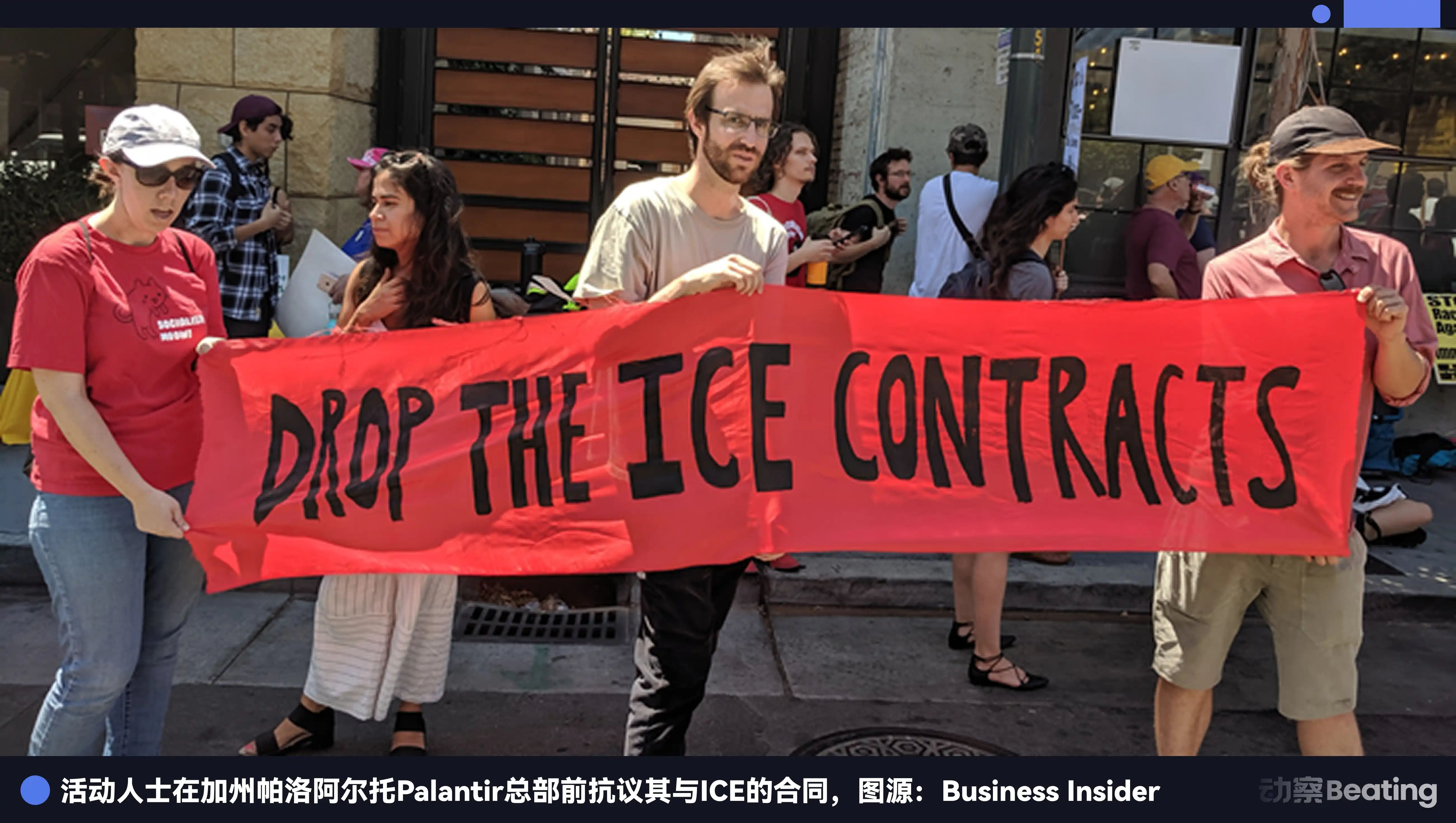
This directly led to Palantir being excluded by a large number of ESG funds and banking institutions. In the modern financial system, ESG assessment is no longer a marginal ethical reference, but a core gatekeeper for banks to assess credit risks, allocate capital, and determine business access. For mainstream banks, supporting a company with a bottom-ranking ESG rating not only implies regulatory compliance pressure but may also trigger collective protests from its own employees and shareholders.
Amid ongoing social animosity, ESG standards have become the most effective financial shackle that is choking Palantir.
JPMorgan Chase was Palantir's first large corporate client, investing $120 million in 2009 to use its software to monitor internal fraud. However, as this project was stigmatized by the public as "monitoring employees," JPMorgan Chase quickly terminated its partnership with Palantir and swiftly cut ties in its financial dealings. Meanwhile, Morgan Stanley, as Palantir's long-time financial advisor, slashed its valuation from $20 billion to $4.4 billion in 2018.
Palantir also faced financing difficulties in Western financial markets. Due to very low ESG scores, Norway's largest asset management company, Storebrand Asset Management, and Norway's public pension fund, KLP, implemented a strategy of divesting and refusing to invest in Palantir, with large European banks beginning to subtly shun Palantir financially.
In order to survive, Palantir had to turn to non-Western traditional financial powers like Malaysia's sovereign wealth fund, Khazanah Nasional, for a lifeline. This left CEO Karp thoroughly disillusioned with Western traditional finance. He has repeatedly criticized the "awakening culture" in public, denouncing the hypocrisy between Silicon Valley, Wall Street, and their enjoyment of the dividends of democracy while refusing to support the technology that upholds order.
From its founding in 2003 to the end of 2022, Palantir has never achieved any year of GAAP profitability. The gears of fate did not truly begin to turn until 2022, thanks to two "explosions" from different dimensions: one erupting on the plains of Eastern Europe, and the other hidden in the heart of the computational power center - the revolution of large language models.
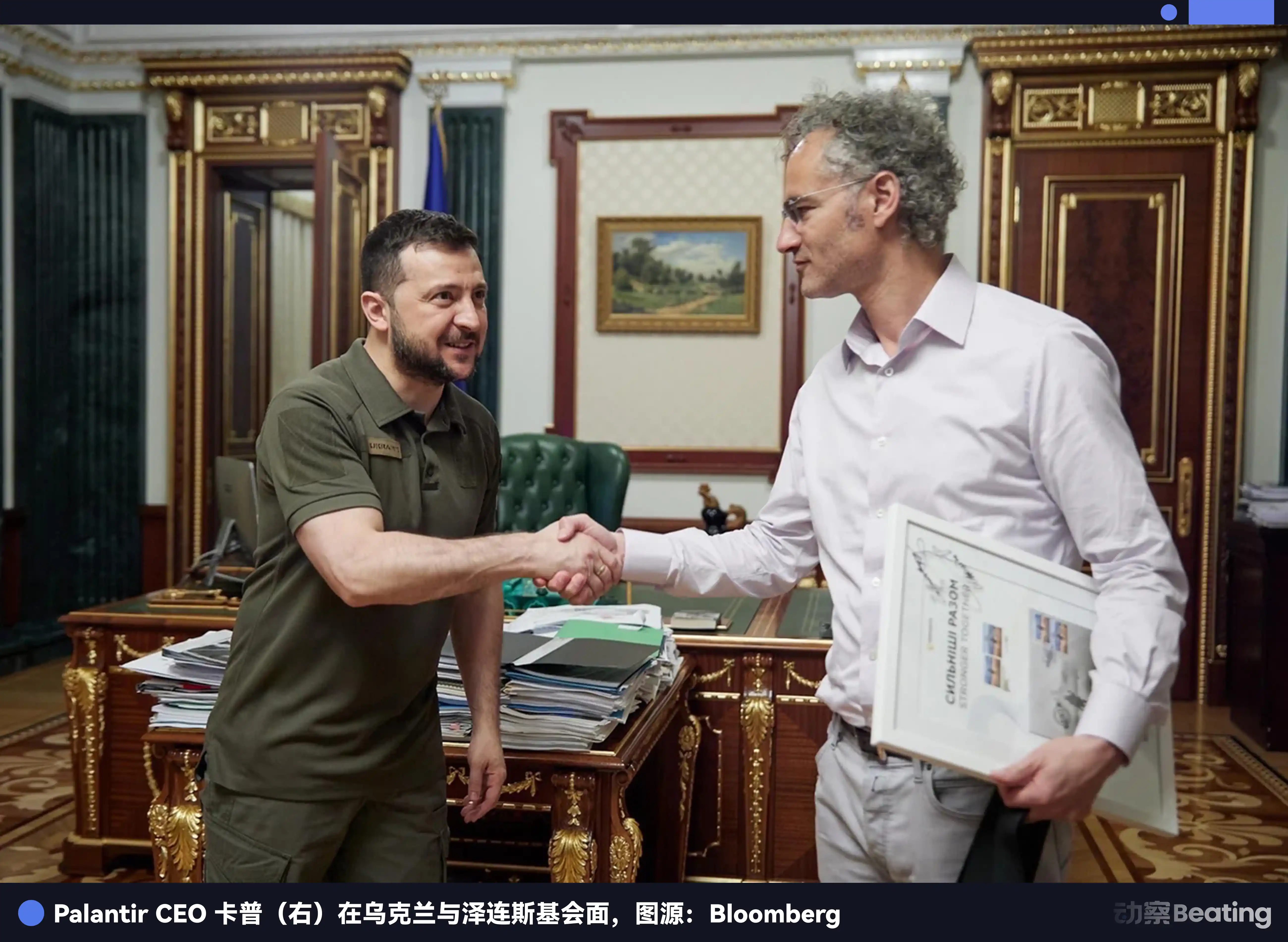
The Russia-Ukraine war became Palantir's best commercial advertisement. Due to its technology being heavily used on the Ukrainian battlefield for target tracking, refugee placement, and battle damage assessment, Zelensky personally praised Palantir vigorously on social media. Suddenly, European politicians realized that in the face of a brutal survival crisis, the moral squeamishness of ESG appeared weak and powerless.
On the other hand, the language model revolution sparked by ChatGPT directly provided the fuel for the launch of the Palantir AIP AI platform. Palantir's core team realized that a once-in-a-lifetime "whitewashing" opportunity had arrived. CEO Alex Karp admitted in an interview in 2023, "This moment we have been waiting for twenty years."
The AIP released in 2023 is Palantir's strategic core in response to the large language model wave. It connects the enterprise's chaotic internal data with classification labels to the large model, providing it with a "logical exoskeleton." At the same time, the highly aggressive Bootcamp sales model has shortened the sales cycle from one year to just a few weeks. In the first half of 2025 alone, Palantir held over 500 bootcamps, driving a 65% year-on-year surge in its commercial customer base, with adjusted operating profit margins soaring to an astounding 51%.
In September 2024, Palantir was officially included in the S&P 500 Index, meaning that passive funds tracking the index, whether they include ESG screening or not, must buy its stock. Once stigmatized Palantir and Wall Street majors who held a reserved attitude towards it have now become key partners in promoting AIP or research supporters.
The victory in the public markets allowed Palantir to escape the suffocation of "de-banking," but this brutal game revealed a profound institutional crack. Palantir's breakout is a heroic exception, and in Silicon Valley, there are still many deep-tech startups, desperate in the "Valley of Death" due to the ESG mantra and the traditional banks' politically correct tendencies.
What they need is a new financial infrastructure, a capital force that dares to ignore the "Awakening Culture" and can profoundly understand its own value.
The Rise of Lonely Mountain: From "Palantir Mafia" to Financial Neo-Sovereignty
In July 2020, just on the eve of Palantir's direct listing, a name that had been missing for a decade reappeared on the company's board of directors: Alexander Moore.
In Palantir's internal epic, Moore is a symbol with totemic significance; he is the company's "Employee Number One." In 2005, when Peter Thiel was still hustling for the CIA's meager $2 million investment, Moore, carrying the title of Chief Operating Officer, built the initial framework of Palantir in a rudimentary office in Silicon Valley. In 2010, on the eve of Palantir stunning the Afghan battlefield, he chose to leave, steering into the venture capital circle, and eventually becoming a partner at 8VC.
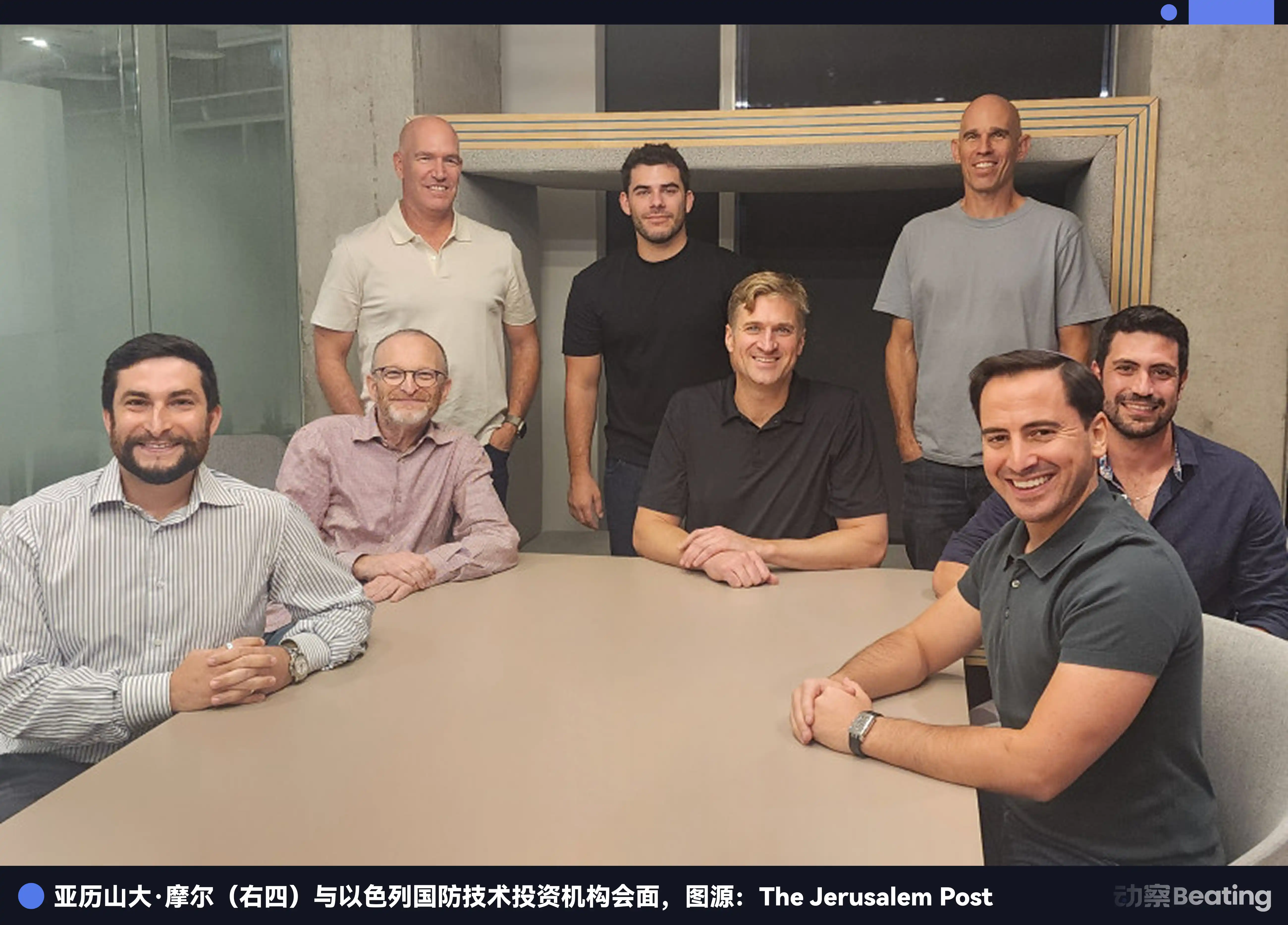
In 2020, Moore's repositioning seemed more like a convergence of power. Behind him, 8VC was led by none other than Joe Lonsdale, Palantir's co-founder and one of the most industrially ambitious in the "PayPal Mafia." This return seemed to convey a strong signal: the group of young people who once reshaped the intelligence community with code was now coming back to reshape America's industrial core.
In the unstoppable public market of 2025, the "Palantir Mafia" once again joined forces. Lonsdale, Anduril's founder Palmer Luckey, and their godfather Peter Thiel embarked on a more audacious plan in the power gap between Washington and Silicon Valley—to establish Galt's Bank. This was not a traditional commercial bank; its birth itself was a public rebellion against the existing financial order. In the regulatory winter following the collapse of Silicon Valley Bank, Galt's Bank, at a near-"privileged" speed, obtained approval and endorsement from the Office of the Comptroller of the Currency (OCC) and the Federal Deposit Insurance Corporation (FDIC) in just four months.
Behind this "special treatment" was a dramatic shift in power between Washington and Silicon Valley. In the face of change, bureaucracy had to make way for the "Thiel Network."
Lonsdale presented a grand vision for Galt's Bank: to become America's "conglomerate." This concept was rooted in his practical lessons from leaving Palantir to found 8VC. During his tenure at 8VC, Lonsdale focused on hard technology areas such as national defense, government, and industrial infrastructure, incubating and investing in a large number of hard technology companies including Anduril and Epirus. However, this experience plunged him into a profound "structural despair," which he summed up as a misalignment of the "capital geometry".
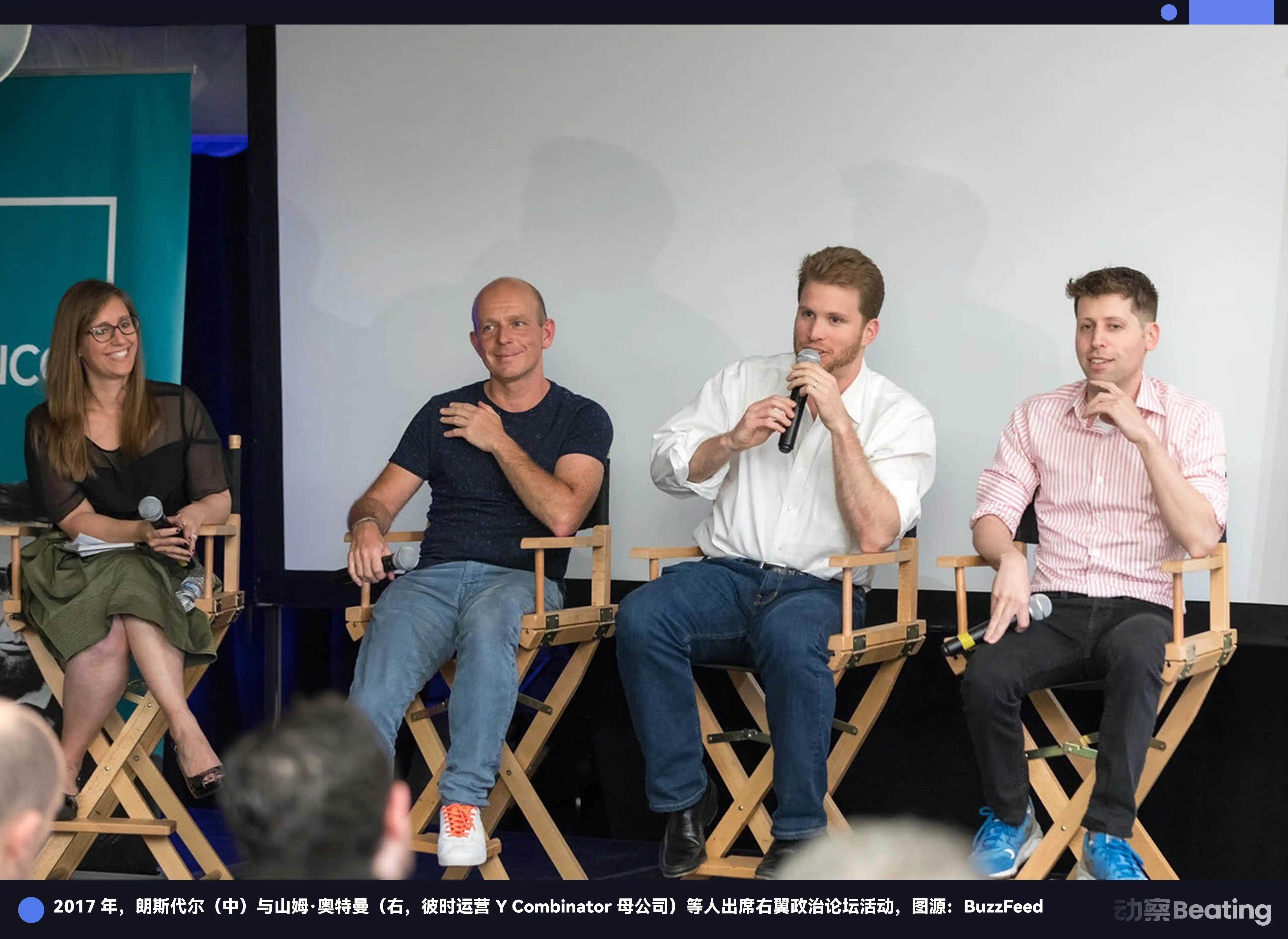
In the traditional Silicon Valley venture capital context, software companies are light on assets and provide quick returns, while national defense hard technology companies like Anduril require massive upfront capital investment, often burning billions of dollars from establishment to IPO. Hard technology startups must face the "trinity" of execution pressure: simultaneously operating hardware manufacturing, software integration, and complex Washington political-business relationships. More cruel is the insurmountable "valley of death"; the U.S. Department of Defense's budget cycle lasts 2 to 3 years, and many startups die in the budget process black hole due to cash flow interruption before receiving their first formal procurement contract.
Galt's Bank rejected the traditional financial credit mindset, heavily absorbing former Navy SEALs and SpaceX senior engineers from 8VC's "Artisanal Colony" program to unprecedentedly scrutinize the underlying data of hard technology companies, giving it asset pricing capabilities that traditional banks could not possess. When Anduril presented test data for a hypersonic missile, JPMorgan saw high-risk R&D expenses, while Galt's Bank saw five years of future defense orders.
This model directly eliminates the bottleneck of financial capital flowing to the real economy and the credit void. Based on this deep hard technology background, and its unique government accounts receivable financing model, Solitude Bank can accurately assess the default risk of a pending contract and provide asset-backed loans accordingly. This means Anduril can use future missile orders and its manufacturing equipment as collateral to obtain working capital now, without the need to exchange equity for cash.
However, the most secretive core moat of Solitude Bank lies in its deep "relationship banking" approach. Over the past decade, Peter Thiel's network with Palantir has quietly infiltrated the U.S. federal government and military. Today, this web of relationships has transformed from a behind-the-scenes advisory list to a forefront decision hub, providing Solitude Bank's clients with a fast lane to government contracts.
At the Pentagon, Deputy Secretary of the Army Michael Abernathy controls the Army's budget and procurement strategy. Despite signing non-compete agreements, as a former Senior Director at Anduril, his advocacy for "rapid procurement" reform directly benefits those non-traditional defense contractors served by Solitude Bank. The newly established Army "Task Force 201" directly appoints Palantir's Chief Technologist Shyam Sankar as an Army Reserve Lieutenant Colonel. Jacob Helberg, formerly a senior advisor to the Palantir CEO, is now the Deputy Secretary of Economic Growth, leading the "Pax Silica" Silicon Valley peace initiative that is forcibly reshaping the global supply chain to eliminate geopolitical barriers for the mineral and chip companies invested in by Solitude Bank.
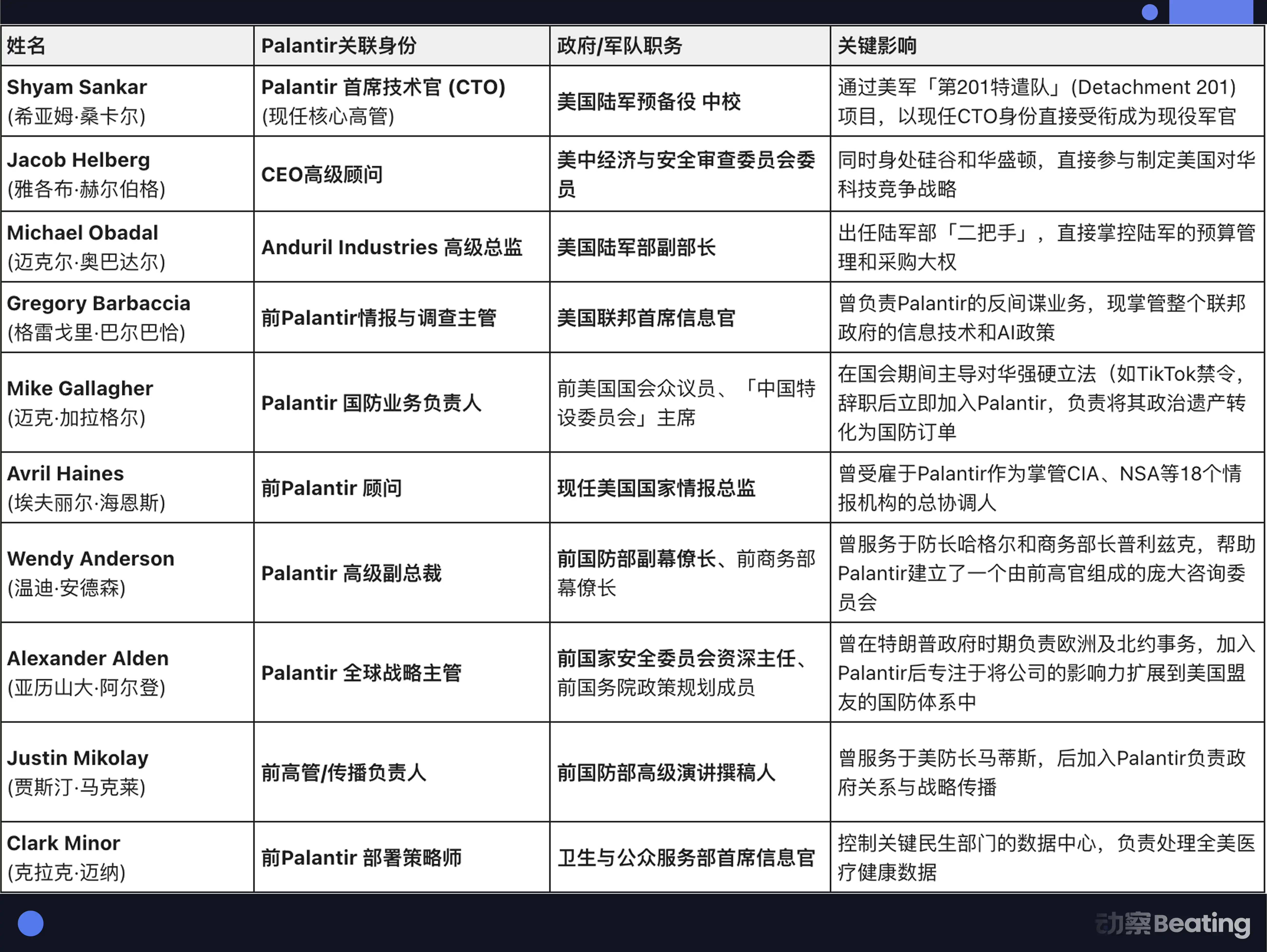
In the future, Solitude Bank's clients will no longer face the bureaucratic black box but rather their own people sitting across the decision table.
Sheltered by a vast network of power, Solitude Bank's internal architecture exhibits a stark contrast of calmness. To stand firm in the ruins of financial regulation, Solitude Bank has adopted an extremely conservative strategy called the "fortress model," maintaining a primary leverage ratio of no less than 12%, a risk control standard nearly double that of traditional commercial banks. The massive deposits it absorbs are strictly prohibited from high-risk lending and are instead forcibly locked in a safe containing highly liquid assets such as U.S. Treasury bonds.
Meanwhile, Solitude Bank has also built an extremely aggressive payment engine. With the compliance endorsement of former DOJ prosecutor Katie Haun and her crypto venture firm Haun Ventures, Solitude Bank merged with the stablecoin company Atticus and positioned itself as the "most regulated stablecoin trading hub." For defense technology companies operating globally, war does not abide by banking hours. Using stablecoins as a settlement layer can help the bank provide 24/7 fund settlement services during legal holidays, ensuring supply chains located on the Poland border or Pacific bases can achieve real-time payments.
At this point, Langdell's "American Conglomerate" puzzle finally comes full circle. This conglomerate structure, which played a core role in Japan's post-war rise, is rooted in the mutual integration of financial capital and industrial capital. Today, the "Palantir Gang" is playing a game far beyond the logic of venture capital. In this scenario, finance has been reconfigured into the "financial fuel" of hard technology, used to drive the long-stagnant heavy industry of the United States.
However, the geographical center of this transformation is no longer Silicon Valley but now points to a more weighty and realistic coordinate. There, the former "Rust Belt" is being reshaped by this new financial force into America's "New Defense Industrial Corridor."
American Power, Silicon Valley's "Reindustrialization" Dream
If you were to drive through the southern outskirts of Columbus in the winter of 2026, you would see an extremely cyberpunk scene: next to the Rickenbacker International Airport, a super factory codenamed "Arsenal-1" is breathing like a giant beast.
This factory, with a planned area of 5 million square feet, is the crown jewel of Anduril and the largest single defense manufacturing project in Ohio's history. Its exterior walls shimmer with cold signal lights, and thousands of engineers and technicians here are producing autonomous jet fighters named "Fury," with all equipment being dynamically scheduled by an operating system called "Arsenal OS." There is no noisy traditional assembly line here, only the quiet flow of data and deadly efficiency.
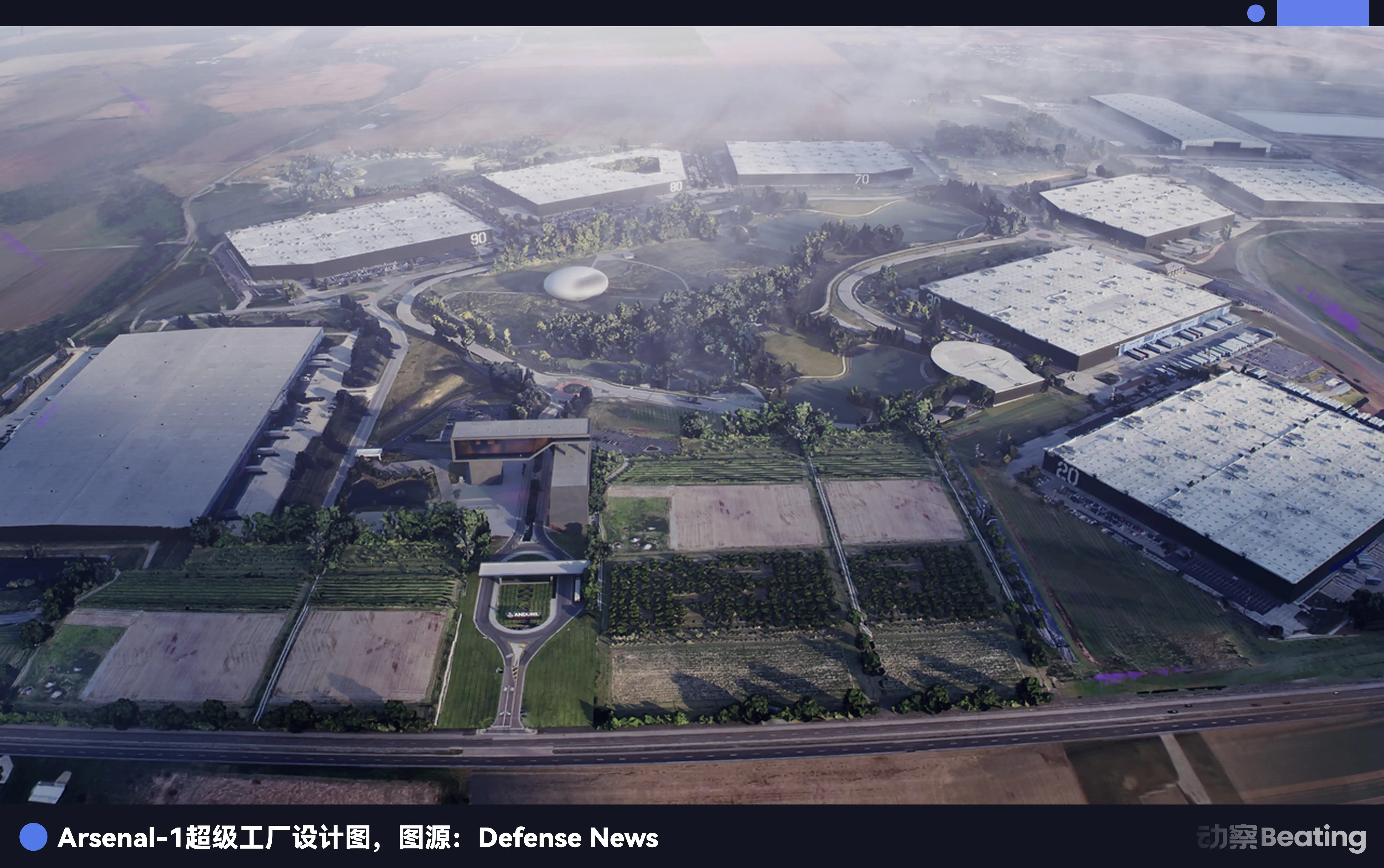
This land was once the heart of American industry, with Cleveland's steel, Akron's rubber, and Dayton's aviation parts jointly forging the foundation of the "Arsenal of Democracy" during World War II. However, with the tide of globalization and deindustrialization, it became the infamous "Rust Belt," where factory closures left swathes of ruins and towns corroded by opioid drugs, becoming scars of America's decline.
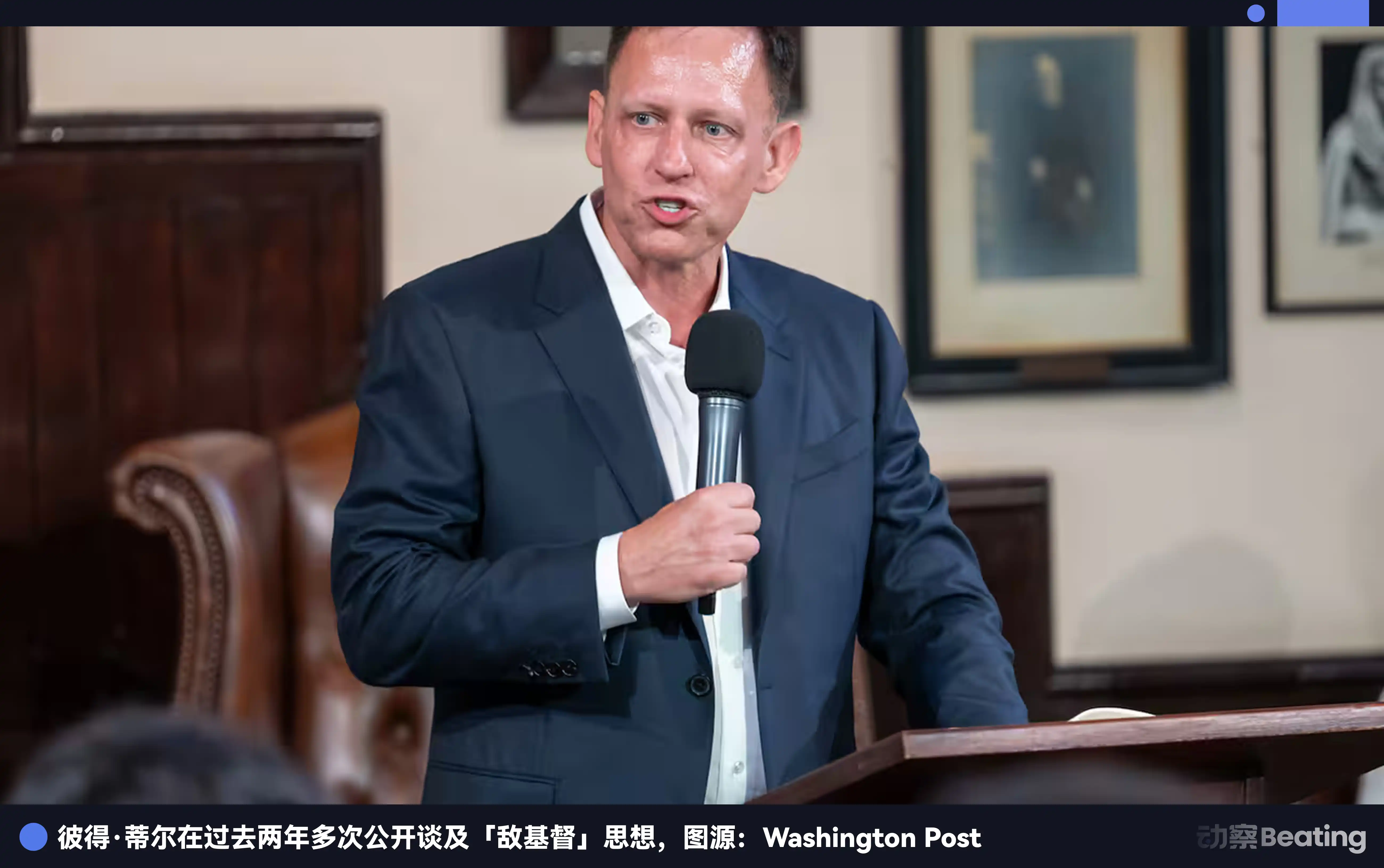
But around 2024, there was a dramatic reversal in fortunes. Silicon Valley core capital, including Peter Thiel and A16Z, began to massively shift their focus from software companies in the San Francisco Bay Area to the hard technology sector in the American Midwest. This was a philosophical settlement initiated by Peter Thiel aimed at the development logic of Silicon Valley over the past two decades.
The origin of this settlement can be traced back to Thiel's deafening curse: "We wanted flying cars, instead we got 140 characters." In Thiel's view, the so-called "technological prosperity" since the 1970s has been a massive lie. Silicon Valley elites were obsessed with the false prosperity of the digital world, addicting people to screen clicks through optimized advertising algorithms and social media, while experiencing a fifty-year stagnation in the atomic world.
Thiel believes that this escapism from the physical world has not only led to the hollowing out of economic growth but has also made Western civilization dangerously fragile in the face of geopolitical challenges. Therefore, he established within Founders Fund an investment creed with apocalyptic undertones: if technology cannot solve the "hard problems" of nuclear fusion, space transport, and hypersonic defense, then all unicorn companies will ultimately be meaningless.
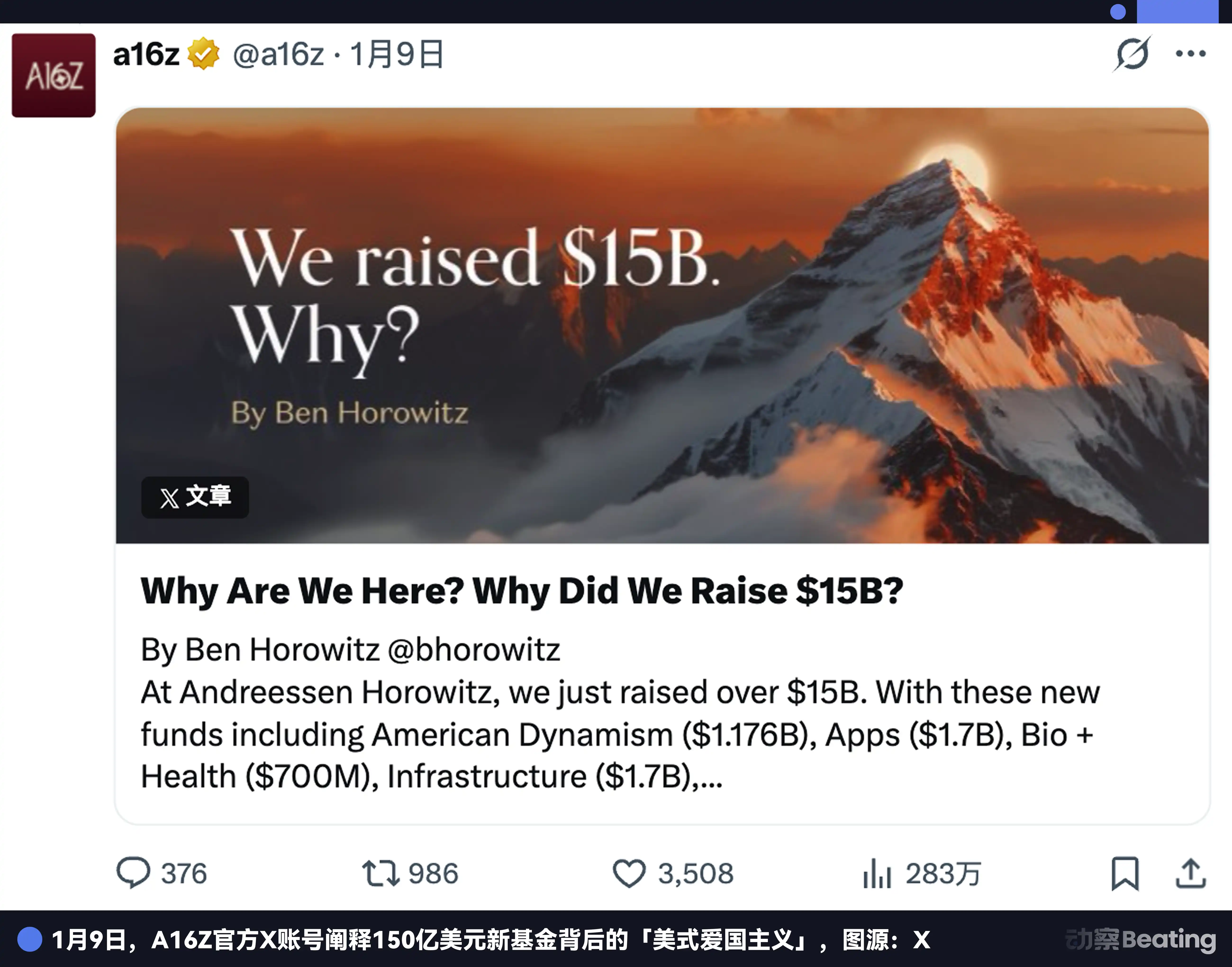
To ground the philosophical vision of returning to the atomic world, Silicon Valley elites have displayed an unprecedented level of political aggression. A16Z packaged this as the "American Dynamism" movement, whose core is to use Silicon Valley venture capital to reshape those ossified national-level infrastructures.
To achieve this, A16Z broke the tradition of venture capital firms avoiding direct involvement in politics, established a high-profile office in Washington, D.C., and assembled a lobbying team consisting of former senior Pentagon officials and seasoned lobbyists. According to public records, A16Z's federal lobbying expenditure exceeded $1.8 million in 2025, surpassing even the total sum of the National Venture Capital Association. Their sole mission is to help hard technology companies like Anduril and Hadrian cross the "Valley of Death."
Within the walls of the Arsenal-1 factory, this philosophical movement is being transformed into productivity that disrupts the traditional military-industrial complex.
Traditional defense giants like Lockheed Martin are accustomed to cost-plus contracts, where regardless of how long R&D is delayed or how much cost overrun occurs, the government foots the bill, essentially rewarding inefficiency. The Anduril model, on the other hand, is a typical "Thielian" approach—using venture capital funding to develop products in-house, iterate quickly, and only sell to the military once the product is mature.
Meanwhile, the "American Dynamism" camp emphasizes absolute supply chain sovereignty, with SpaceX being the prime example. Unlike traditional defense contractors who outsource components to a global supply chain, Anduril has its own solid rocket engine factory to ensure that America's missiles can still launch from the warehouse even if global shipping routes are severed in war. Here, the production line itself is part of the software, and through "Arsenal OS," the factory can seamlessly switch from producing reconnaissance drones to cruise missiles in a matter of weeks based on battlefield needs, a level of flexibility unimaginable to traditional rigid production lines.
This "reindustrialization" movement also has the ultimate political umbrella—Vice President J.D. Vance from Ohio. As a former disciple of Peter Thiel, Vance is the perfect link between Silicon Valley capital and Rust Belt workers. Upon assuming the vice presidency, he became the top advocate for "American Dynamism" in the White House, vigorously promoting an upgraded version of "Buy American" clauses and providing massive tax breaks for tech companies building factories in the Rust Belt.
The data seems to be validating the madness and success of this strategy. By early 2026, Ohio's manufacturing output had seen double-digit growth for four consecutive quarters, with over 15,000 new high-end manufacturing jobs added. Anduril is not alone in this endeavor; Intel's wafer fab in Licking County, and the fusion startup Helion Energy backed by Lone Pine Bank, have all put down roots in this land.
After the alliance of Silicon Valley elites and Washington power, this is no longer Till's personal philosophical utopia. America's "reindustrialization" seems to be transforming from a hollow slogan into a reality woven with steel and code.
The Leviathan's Achilles Heel
As we shift our gaze from Ohio's bustling arsenal factory and zoom out to the global supply chain landscape, the revival fervor of Silicon Valley elites will soon be extinguished by cold facts. The American reindustrialization machine, which is attempting to defy historical gravity, is now speeding full throttle towards an invisible reef composed of physical limits and economic laws. This is the deepest logic deadlock of geopolitics and macroeconomics.
The most fatal vulnerability is the buried curse of elements. While the Arsenal-1 factory can assemble drones around the clock, the key raw materials that make up the nerves and bones of these machines are not in their control. It's an ironic closed loop. According to the U.S. Geological Survey (USGS), China controls about 90% of the global rare earth refining capacity. The Mountain Pass mine in California is the only rare earth mining site in the U.S., but the ore extracted here still needs to be shipped to China for processing due to a lack of domestic separation technology, only to be bought back at a high price. This means that the new factory in Ohio is essentially using materials from China to manufacture weapons intended to contain China.
Running parallel to the supply chain crisis is the "Kilowatt War" unfolding on the U.S. mainland power grid. While Silicon Valley elites promote "American power," they deliberately ignore an awkward physical fact. Their high-energy AI data centers and new manufacturing face a life-and-death struggle on the same increasingly aged grid.
Palantir's power consumption for training the next generation of large models is growing exponentially, with the energy consumption of a single data center approaching that of a medium-sized city. According to projections by the Boston Consulting Group, by 2030, the electricity consumption of U.S. data centers alone will reach 7.5% of the total electricity usage, further squeezing the remaining space for manufacturing resurgence. Before Helion Energy's fusion technology, backed by Lone Pine Bank, is commercially viable, the U.S. is facing a zero-sum game: as the digital brain and industrial body simultaneously vie for limited energy blood supply, this giant's movement is destined to suffer a fatal rigidity due to inadequate blood supply.
At the deepest level, and also the most difficult knot to untie, lies hidden within the genealogy paradox of the US dollar hegemony. Historically, no country has ever been able to simultaneously hold the titles of the "world's largest industrial exporter" and the "global financial overlord" because it requires two fundamentally opposing monetary policies. To revitalize its manufacturing industry, secure market share through export of weapons and industrial goods, the US needs a weakened dollar to lower production costs. However, to maintain Wall Street's financial supremacy, attract global capital inflows to support financial prosperity, it must uphold the strong dollar status.
This is the modern version of the famous "Triffin Dilemma."
Vance and Till are attempting to forcefully reverse this course through executive actions, transforming the US dollar from a public good serving the global financial cycle into a national tool serving the domestic industry. This implies that the US may need to tolerate long-term inflation, and even resort to administrative intervention to compel Wall Street to sacrifice profits to subsidize the Ohio assembly line. This is a political gamble that strikes at the core of the nation. Will the financial capitalists of Manhattan truly be willing to sacrifice their own global financial scepter for the workers of the Rust Belt?
From the icy hunt in Minneapolis to the clandestine convergence in the Washington power corridor, a group of "hackers" who once reshaped the intelligence community with code are now attempting to rewrite the physical world with the same logic. They are wagering money, reputation, and even the fate of America, trying to prove that the "Silicon Valley model" can save an empire from dusk. Perhaps the answer is not found in those exquisite pitch decks, but in whether the fragile supply chain can still operate amidst the next winter storm.
You may also like

IOSG: Making Probability an Asset, Forecasting Market Intelligence Agent

Key Market Intelligence on March 3rd, how much did you miss?

Interpreting the Anthropic vs. War Department Conflict: What Does Trump Intend to Do?

Nasdaq Moves In, Predicts Market Has Reached Mainstream Inflection Point

After a 48-hour ban, Claude reached the top of the App Store

If this is the beginning of the triple halving, what are top investors saying about what to expect?

After Iran's Political Risk Rises, Cryptocurrency Sees Massive Outflow

Pantera Capital Partner: The Financial Trajectory of AI Agents
In the next 5 years, Vitalik will scale Ethereum like this
Sam Altman and the End of the World Capitalism

Wall Street Rings Inflation Alarm Bells Amid Iran Tensions, What Does It Mean for Cryptocurrency?
Qwen Open Source Model Enters Mobile, Nasdaq Tests Water Prediction Market, What's the Overseas Crypto Community Talking About Today?

MegaETH Co-founder: 48 Hours After Escaping Dubai, I Reassess the Entire Crypto Scene
Morning Report | Strategy increased its holdings by 3,015 bitcoins last week; BitMine increased its holdings by 50,928 ETH last week; Vitalik elaborated on the Ethereum execution layer roadmap

Why is it said that there are structural opportunities in encrypted AI?

Make Probability an Asset: A Forward-Looking Perspective on Predictive Market Agents

Consumer application issues



 App
App