
- Buy Crypto
- Markets
 Futures
- Spot
- Copy Trade
 Earn
Earn- More
Tokenomics Report: Nearly $70 Billion in Tokens Set to Unlock in 2025, with an Average Meme Lifespan of Only One Year

Original Title: Tokenomist Annual Report 2024
Original Source: Tokenomist
Original Translation: Nancy, PANews
In late January, Tokenomist released the "Tokenomist Annual Report 2024," covering key trends such as token unlocks, low circulating supply high FDV tokens, Memecoins, and AI proxies, revealing their impact on market liquidity, investor sentiment, and long-term value capture.
The report highlighted that 2024 began with the issuance of some significant projects with low circulating supply and high FDV (Fully Diluted Value), setting the tone for the industry's development trajectory. However, there was a shift in market sentiment mid-year. From short-term, low-cap tokens with vesting schedules to fully unlocked, community-driven meme coins, reflecting a divergence in investor preferences. By year-end, the "super MEME cycle" emerged as the dominant narrative, attracting widespread attention.
Key Highlights:
· It is expected that over $150 billion in tokens will unlock from 2024 to 2025, with approximately $82 billion absorbed in 2024 alone.
· By the end of 2024, the average circulating supply/FDV ratio at token issuance had risen to 35%;
· The 2024 MEME track had a return rate of up to 536%, far exceeding the performance of Bitcoin and Ethereum.
· The long-term success rate of Memecoins is very low, with 97% eventually "dying," and an average lifespan of about 1 year, with many tokens disappearing much sooner;
· A new crypto trend emerged combining MEME, AI, and social media, with self-sovereign entities, such as Virtuals and ai16z frameworks, leading innovation.
Top 5 Unlocking Events Before 2024
Token unlocking events are key milestones in the crypto market. Releasing locked tokens into circulation according to a preset vesting schedule can affect price and funding rates, especially in the short term. Therefore, this section analyzes the five largest unlocking events in 2024, focusing on the price impact and funding rate trends within a 60-day window (-30 to +30 days). By analyzing the relationship between funding rates and price changes, we can assess whether the market's expectations (as reflected in derivative positions) align with actual price trends. This provides valuable insights into market sentiment, particularly in critical events like token unlocks.
1. Arbitrum (ARB): $22.2 Billion Token Unlocking
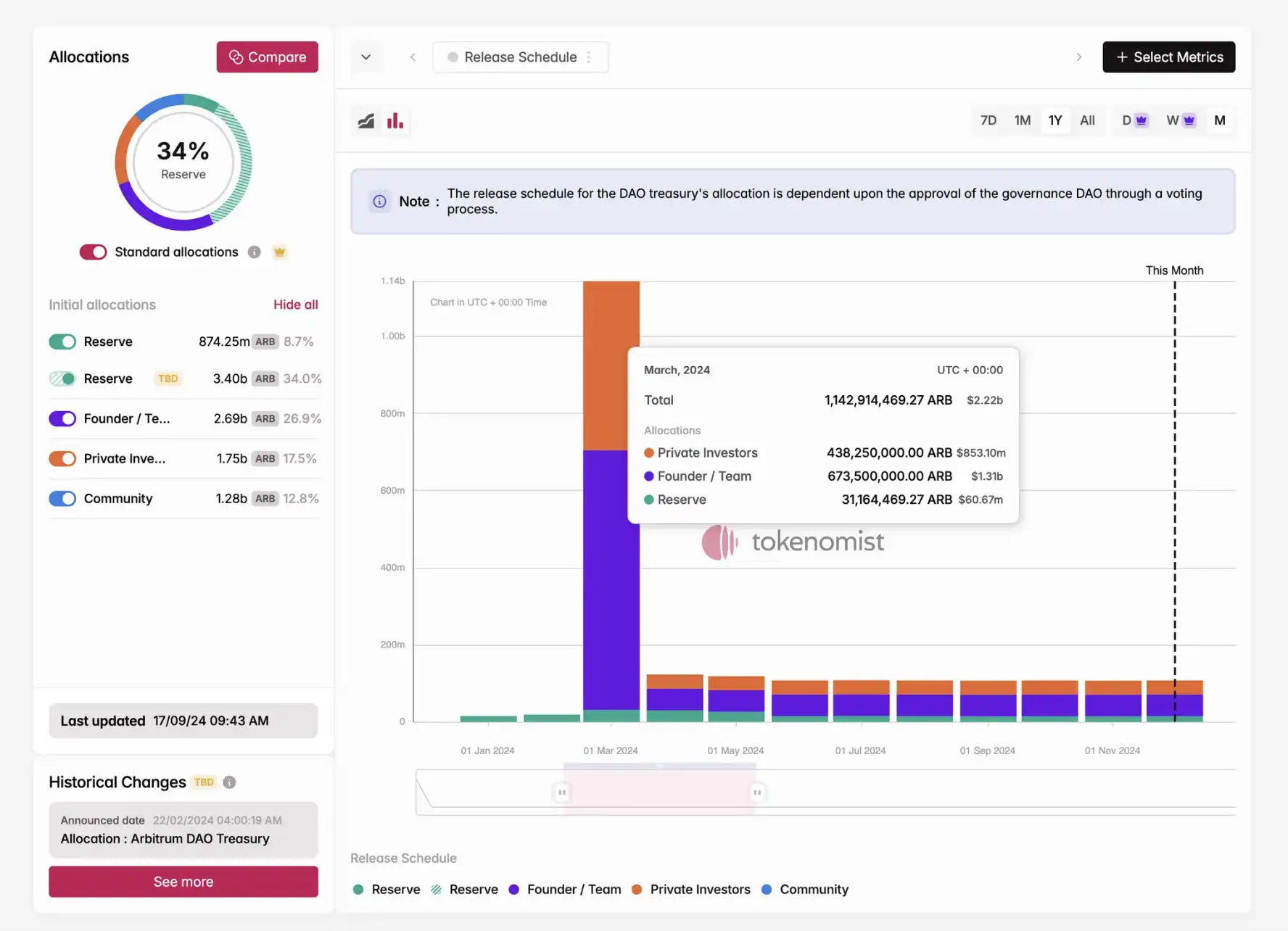
In March 2024, when Bitcoin hit a new all-time high of $74,000, Arbitrum (ARB) conducted the largest token unlocking event of the month, unlocking tokens worth $22.2 billion. This was the first unlocking for Arbitrum's private investors and founders/ team, introducing a significant amount of new token supply to the market.
In terms of price impact, leading up to the unlocking date, ARB's price impact steadily declined, possibly reflecting cautious trading behavior anticipating the supply increase. In the 30 days post-unlocking, ARB's price impact continued to decrease by 33.8%, possibly due to more supply entering the market.
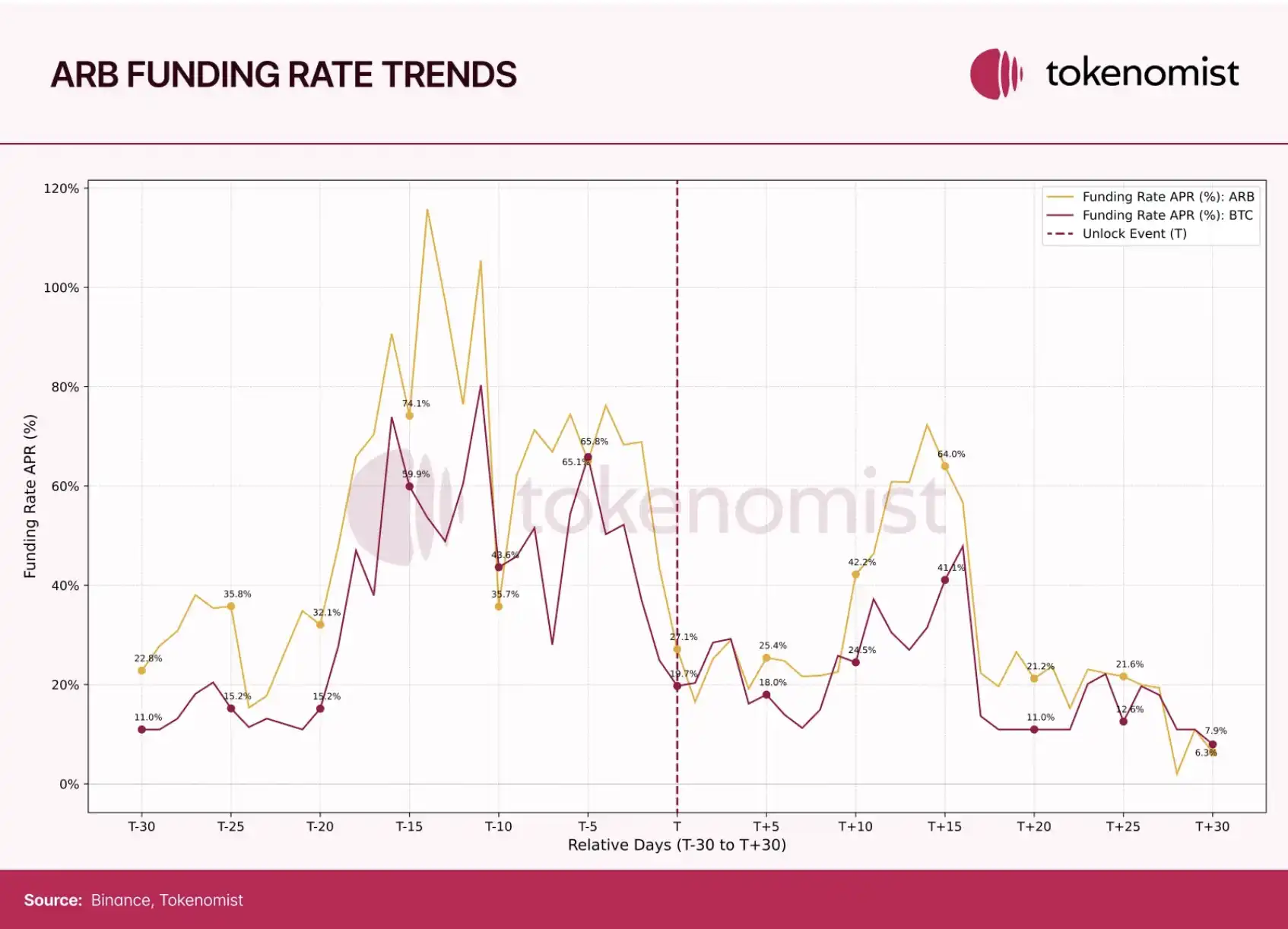
Regarding the funding rate, ARB's funding rate closely tracked Bitcoin's funding rate over a 60-day period but remained higher than Bitcoin, indicating relatively high demand for leveraged positions during that time.
2. Sui (SUI): $12.1 Billion Token Unlocking
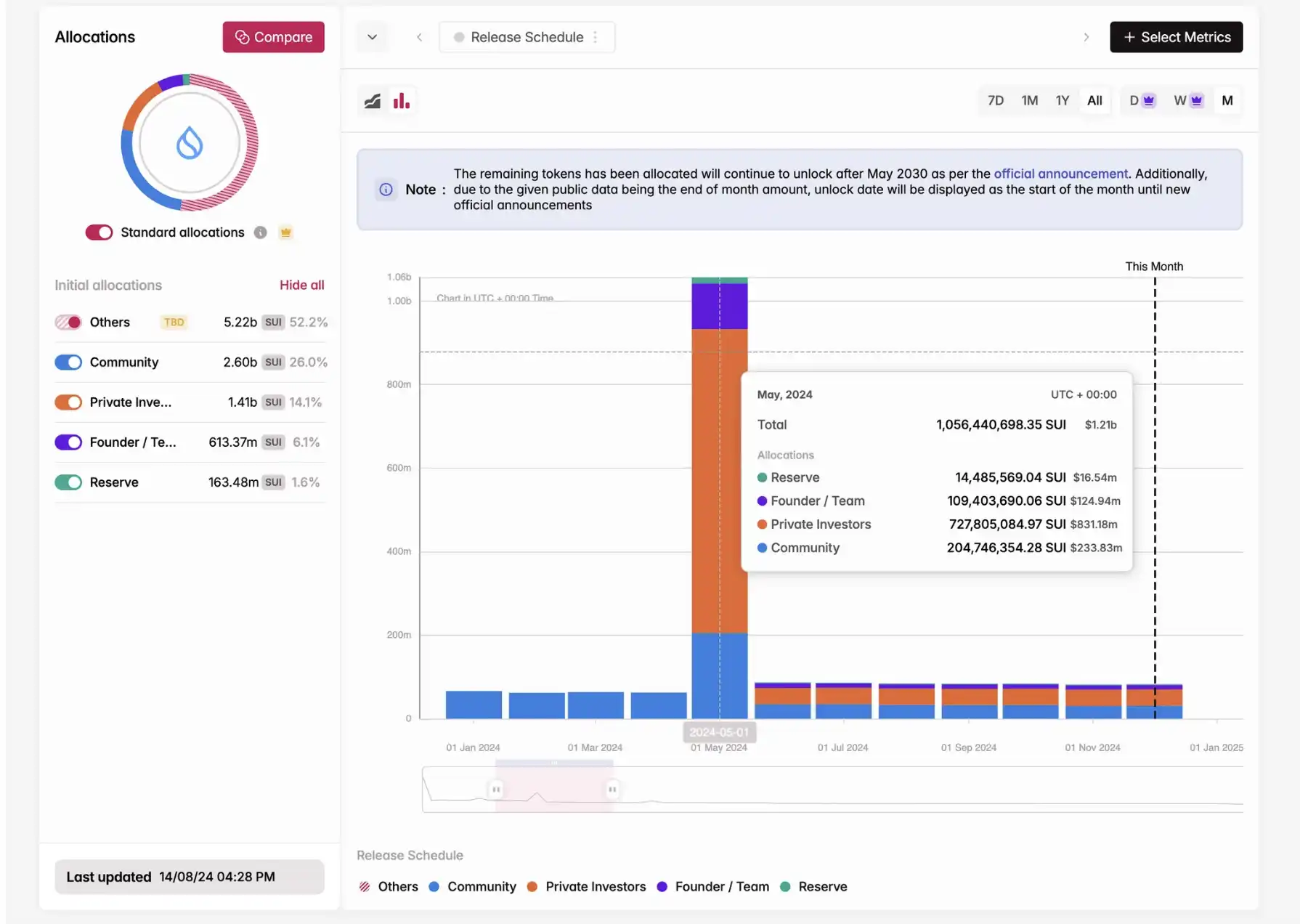
In May 2024, Sui (SUI) witnessed the second-largest unlocking event of the year, unlocking tokens worth $12.1 billion. This unlocking released a significant token supply, with the majority allocated to private investors.
Analyzing the price impact, SUI's price surged by 39.6% in the 30 days before the unlocking but dropped by 20.3% in the 30 days post-unlocking.

Regarding the funding rate, in the 20 days leading up to the unlocking, SUI's funding rate turned negative, reaching -34.1% on the unlocking day, displaying a pessimistic sentiment ahead of the unlocking event. Around 20 days after the unlocking, SUI's funding rate recovered and aligned with Bitcoin's funding rate (approximately 11.0%).
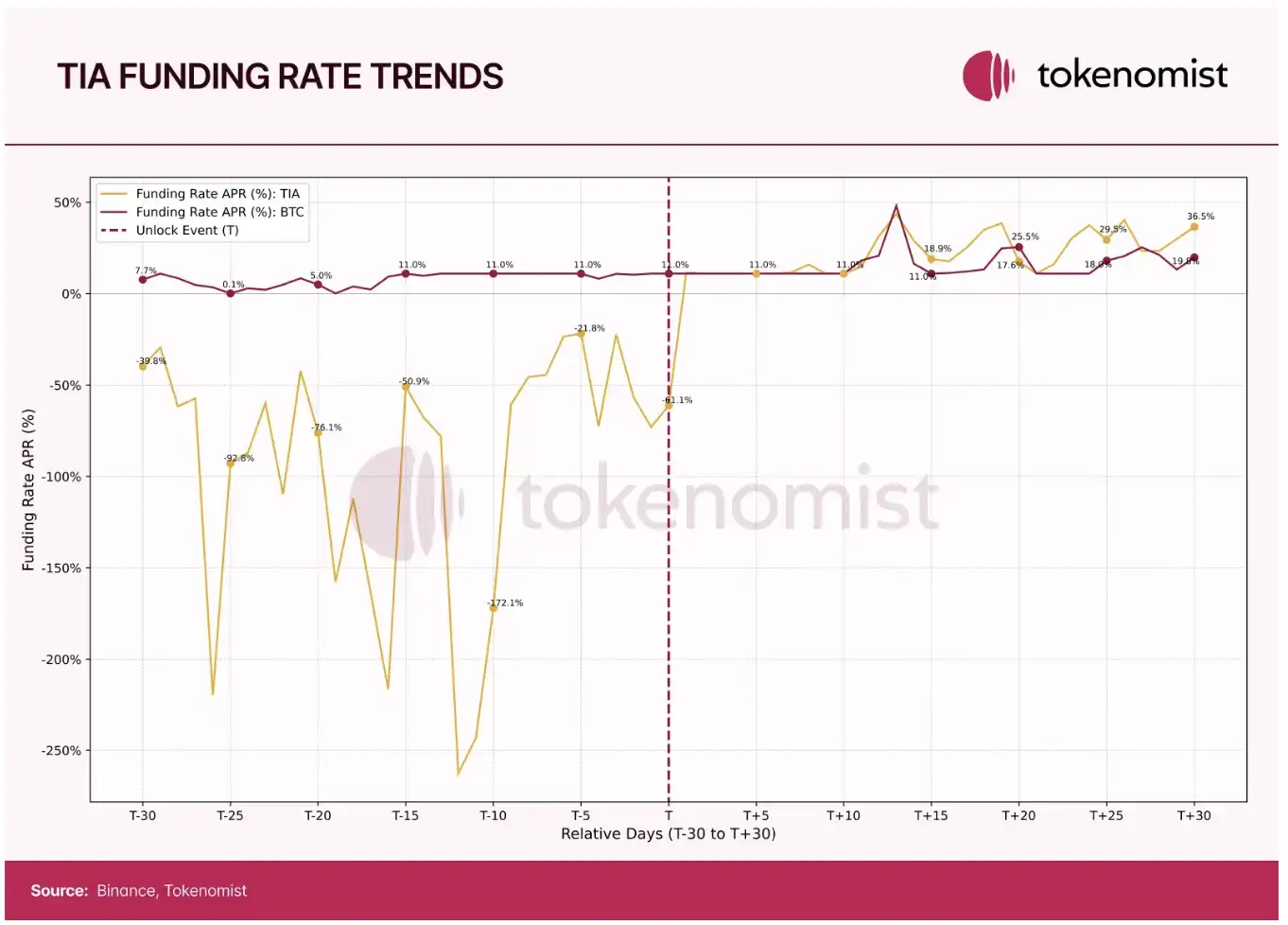
3. Celestia (TIA): $9.7744 Billion Token Unlocking
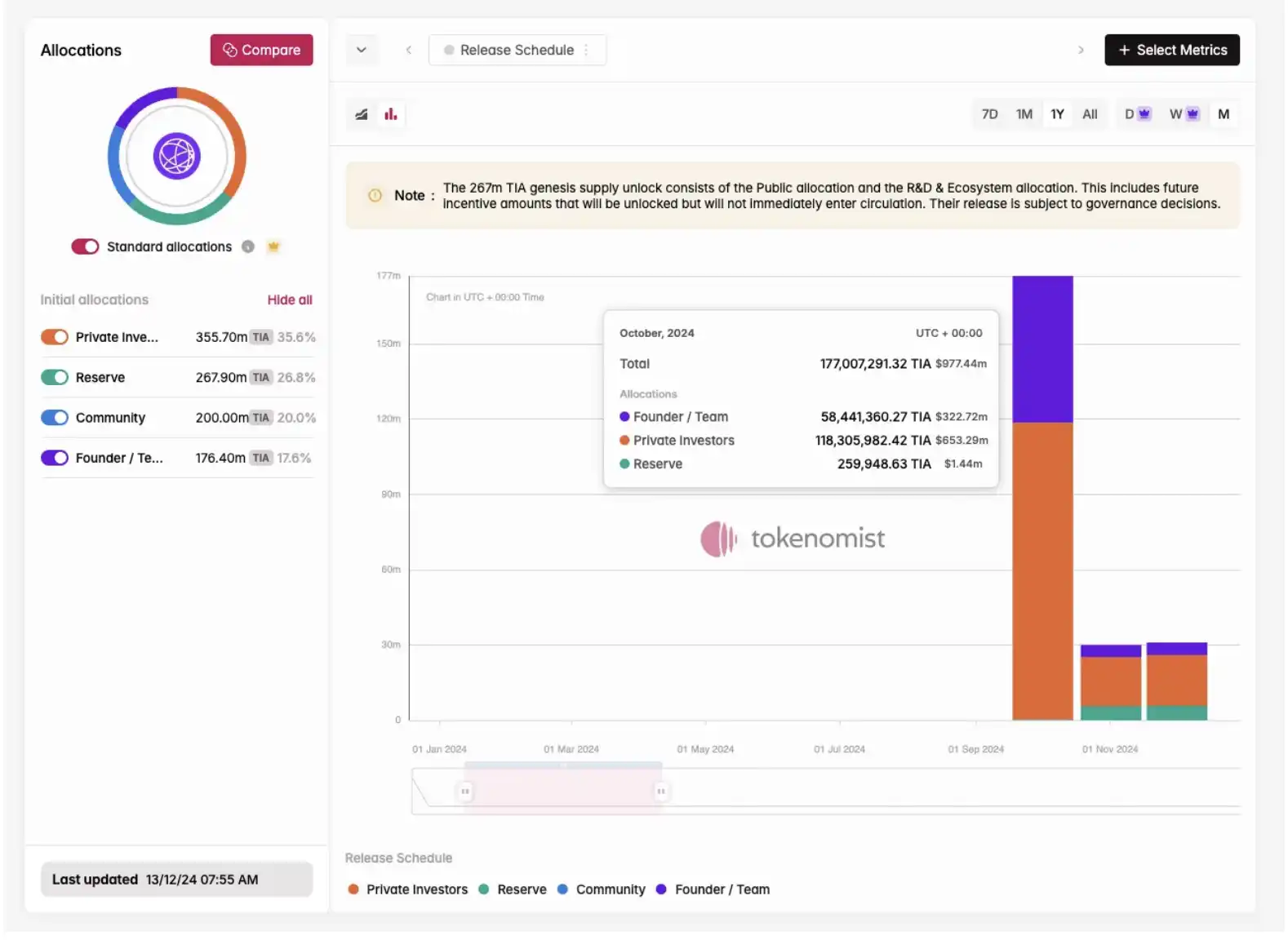
In October 2024, Celestia (TIA) kicked off a significant unlocking event worth $9.7744 billion. This marked the first major unlocking for TIA post its TGE event, becoming one of the largest token unlockings of the year, with the vast majority distributed to private investors and founders/ team. The dominance of private investors and founders/ team in the unlocking ensured continued incentives for long-term contributors and early supporters.
Regarding price impact, prior to unlocking, TIA's price continued to drop and fell by 25% within 20 days after unlocking. However, it quickly rebounded, surpassing BTC by 19.2% after 30 days of unlocking.
TIA's funding rate chart is more volatile compared to other tokens. On the unlocking day, TIA's funding rate remained in the negative territory (-61.1%); however, a few days after unlocking, it returned to a positive value, quickly aligning with BTC's funding rate.
4. Jito (JTO): Unlocking Value $5.6391 Billion
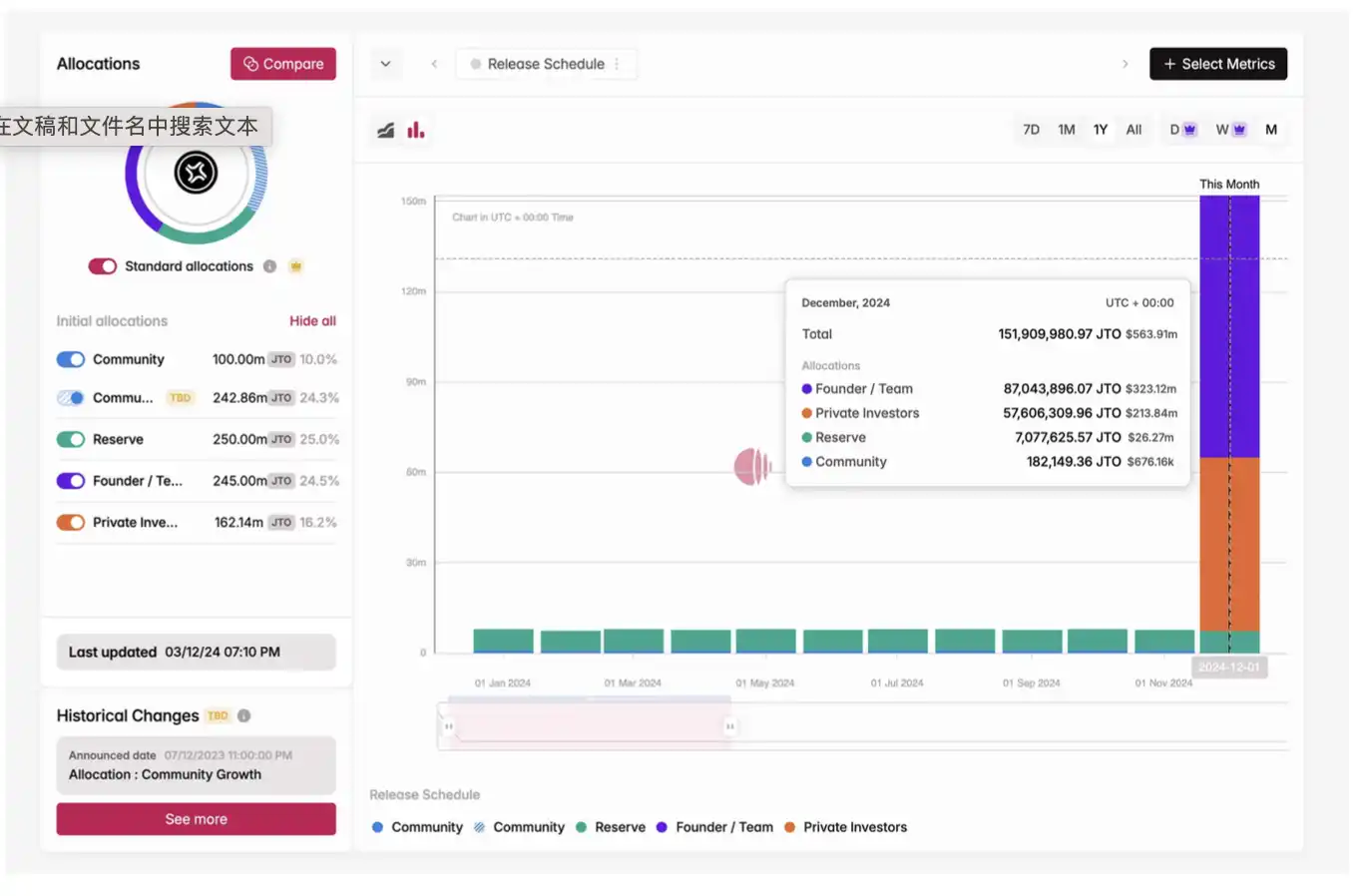
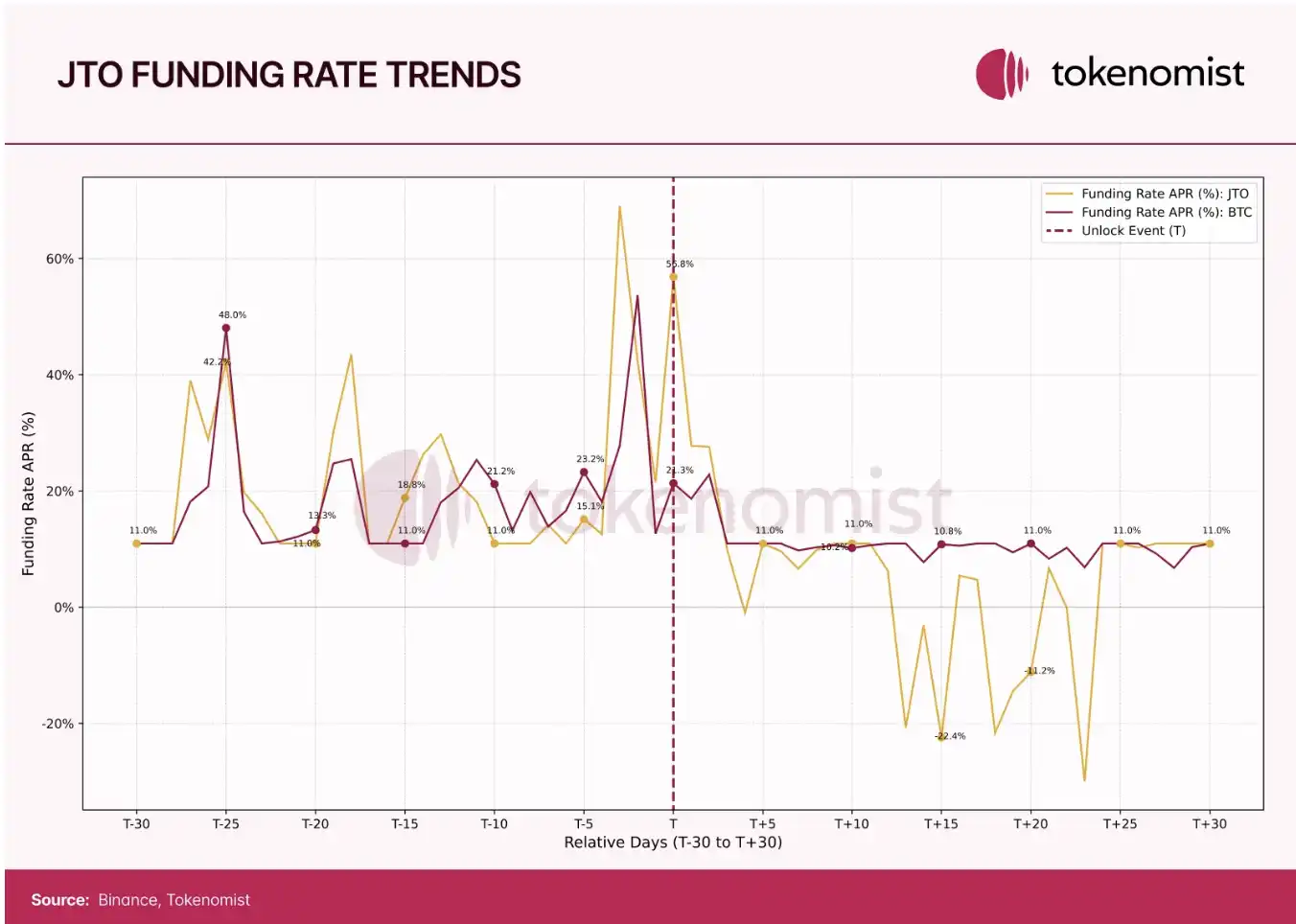
In December 2024, JTO concluded the year with a significant unlocking event valued at $5.6391 billion, releasing 151,909,981 JTO into circulation. The unlocking was led by the founding team, holding 57.3%, followed by private investors at 37.9%. This was not surprising.
Due to significant market volatility at that time, when observing price impact, we saw JTO's price impact shift from negative to positive twice before unlocking. Post unlocking, the price impact continued to rise, then sharply dropped to around -15%. By the end of 30 days, it shifted back from positive to negative.
The funding rate trend also reflected this volatility. In the 30 days before unlocking, JTO's funding rate roughly matched that of BTC, sometimes surpassing it and sometimes falling below. However, in the 30 days after unlocking, we observed continuous fluctuation in JTO's funding rate while BTC remained relatively stable.
5. Aptos (APT): Unlocking Value $4.236 Billion
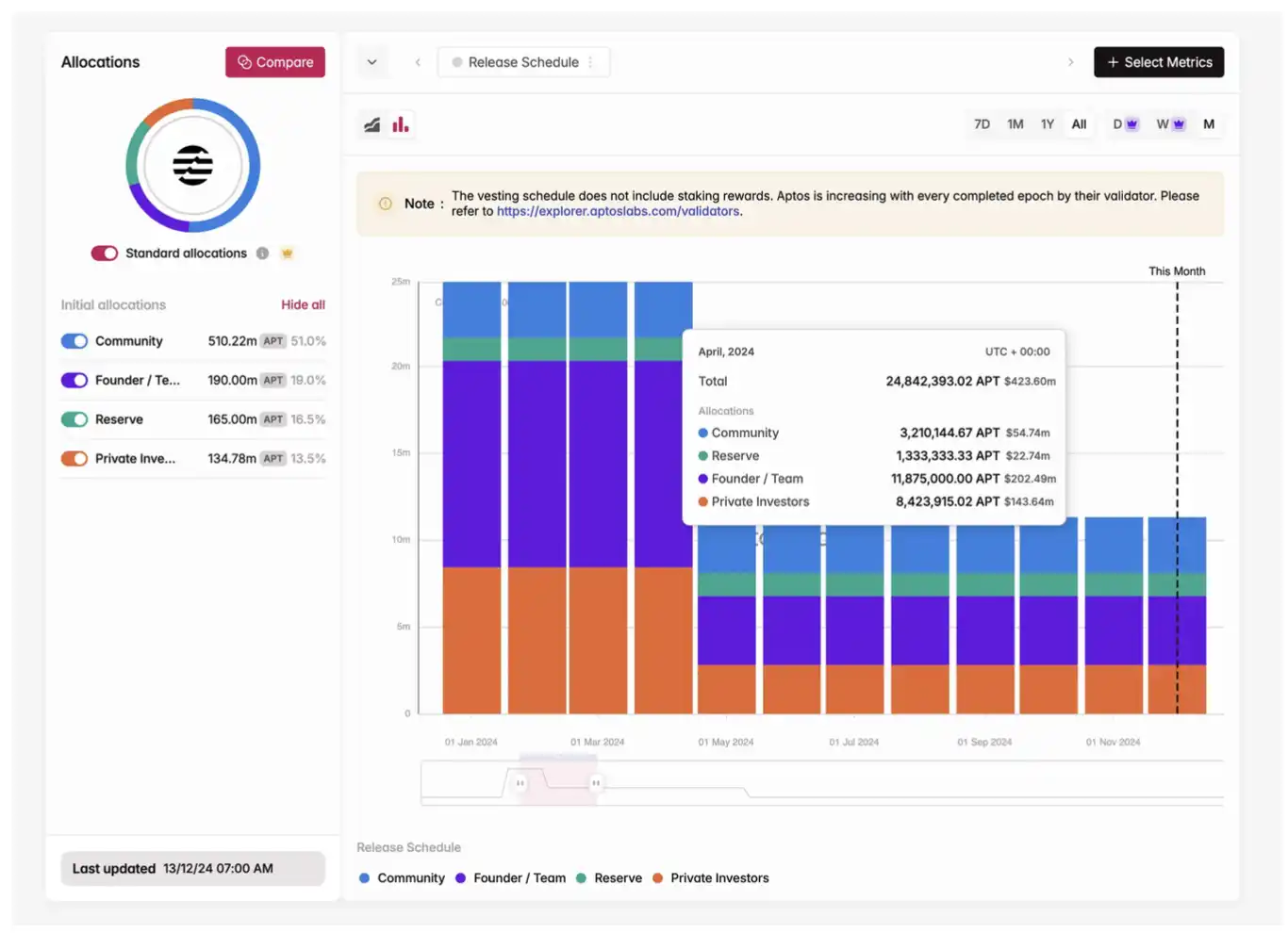
The fifth-largest unlocking event of the year occurred in April 2024, where Aptos (APT) underwent a $4.236 billion unlocking event. The largest share in the unlocking was held by the founders/teams and private investors, with approximately 13% allocated to the community.
APT's price impact surged by approximately 51.7% in the 5 days before unlocking (from day 20 to day 15 before unlocking), driven by increased trading activity and speculation. However, starting from 15 days before unlocking, the price impact began to steadily decline. During the post-unlocking period, the price impact turned negative and remained in that state for the next 30 days. During this time, the entire crypto market also experienced a downward trend.
The funding rate trend of APT is very similar to BTC, similar to the funding rate trend of ARB. This indicates that price impact may be more due to macro factors affecting the overall market.
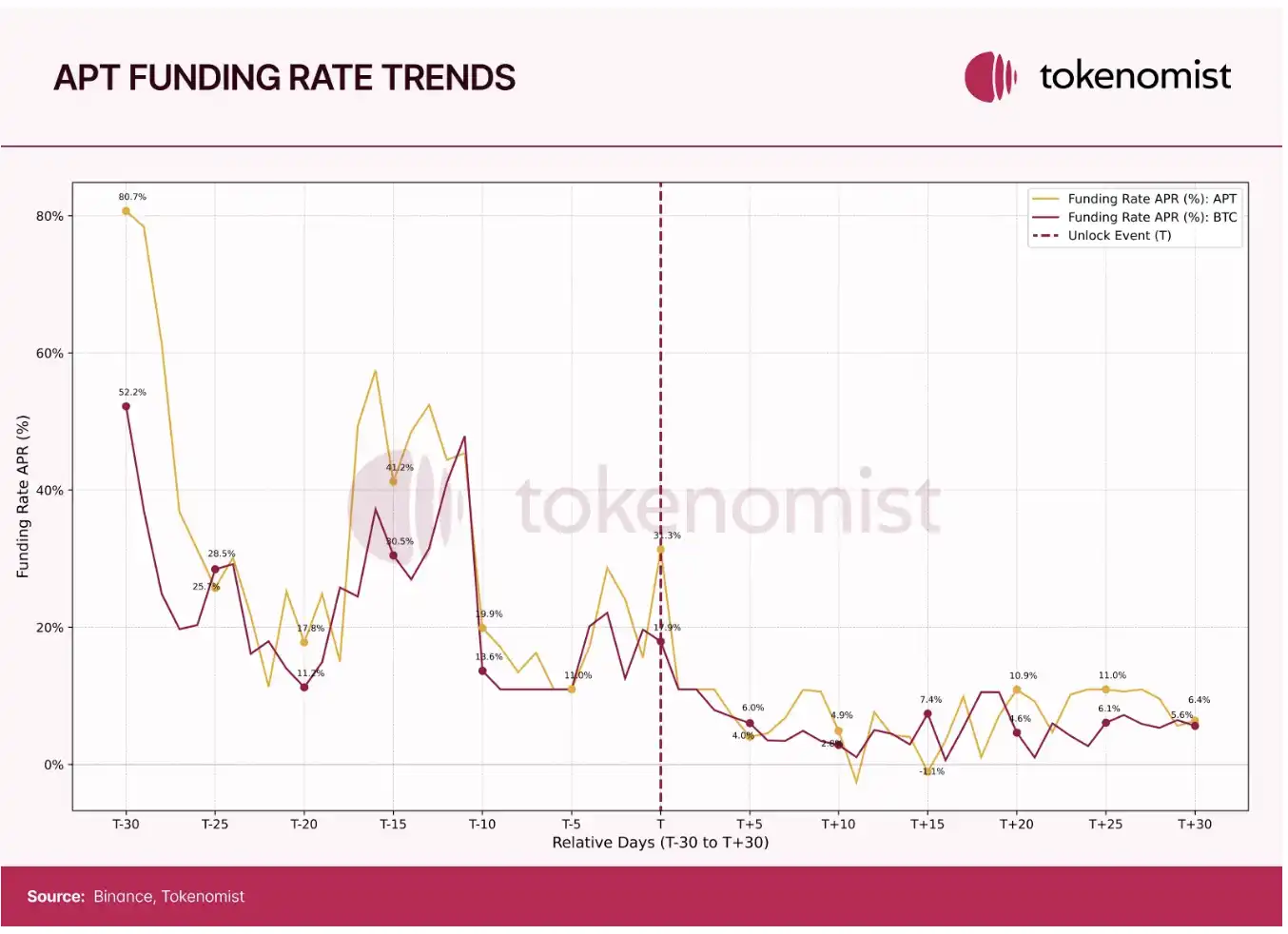
Analysis
By analyzing these token unlock events, it is evident that the market sentiment before and after unlocking can vary due to factors such as unlock size, market expectations, macroeconomic conditions, and other factors. Predicting outcomes based on these factors is inherently complex, but they can provide some observations to help us understand how key driving factors influence market behavior during unlock events.
As these unlock events approach, analyzing market expectations is crucial, which can be observed through price impact and funding rates. A price drop before unlock may reflect market concerns about increased supply, while a price increase may indicate market optimism or speculative behavior. Prior to the unlock in May 2024 for SUI and the unlock in October 2024 for TIA, we observed that their price impact and funding rates both showed a fairly pessimistic sentiment. This aligns with the view that unlock events are generally bearish as they dilute the supply and increase selling pressure. However, sometimes the opposite can occur; an unlock may be a bullish signal, releasing more supply into the market for buyers to snap up. As seen in the case of ARB, the funding rate before unlocking reached a high of +115.8%, indicating increased leverage demand for long positions and optimistic market sentiment.
Although these factors provide valuable insights, we must also consider the overall market conditions. During a market downturn, there may be larger factors driving the price action of a specific token, as seen in the cases of JITO and APT. The funding rates of these two tokens are closely linked to BTC's movement, or experience significant fluctuations when BTC's funding rate remains relatively stable.
Low Circulating Supply High FDV Token
Circulating supply is defined as the ratio of circulating supply to maximum supply, and has become an increasingly important metric when considering supply data. Low circulating supply high FDV (Fully Diluted Valuation) tokens, characterized by a low circulating supply at issuance but a high overall valuation, have become increasingly prominent in recent years. This pattern leads to rapid price appreciation due to limited liquidity at issuance, but often faces long-term sustainability criticism due to subsequent token unlocks putting downward pressure on the market. This section aims to examine the historical background, trends, and impacts of this token economic model, providing a data-driven perspective to assess its viability.
Despite the recent surge in popularity of low circulating supply high FDV tokens, this pattern is not a new phenomenon. It first gained significant attention during the 2020-2021 bull market. A notable example is Curve (CRV), which was issued in August 2020, and prominent crypto investor Jason Choi used CRV to highlight the risks of this pattern. Within seven hours of trading, CRV's market cap increased from $2 million to $6 million. However, the FDV of the token at issuance was almost half of Bitcoin's market cap, demonstrating that this valuation was unsustainable. Early investors faced significant losses as the price dropped by 50% shortly after issuance, attributed to inflation and early sellers exiting their positions leading to dilution.
The CRV case study reveals a key issue: the initial price trend of low circulating supply, high Fully Diluted Value (FDV) tokens may mislead investors who overlook the long-term dilution impact. Despite CRV's exaggerated inflation mechanism, it laid the foundation for a broader trend that would unfold later.
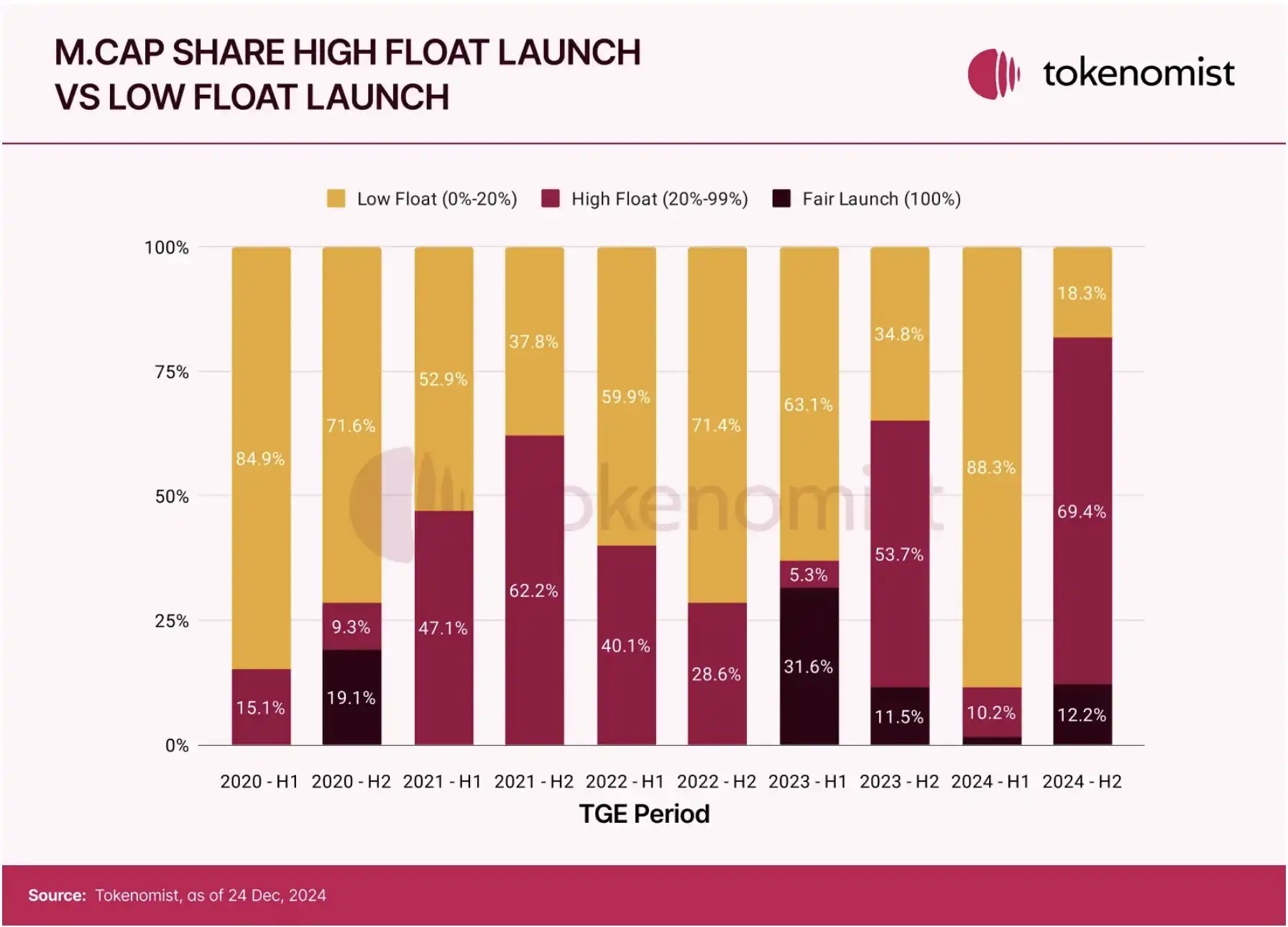
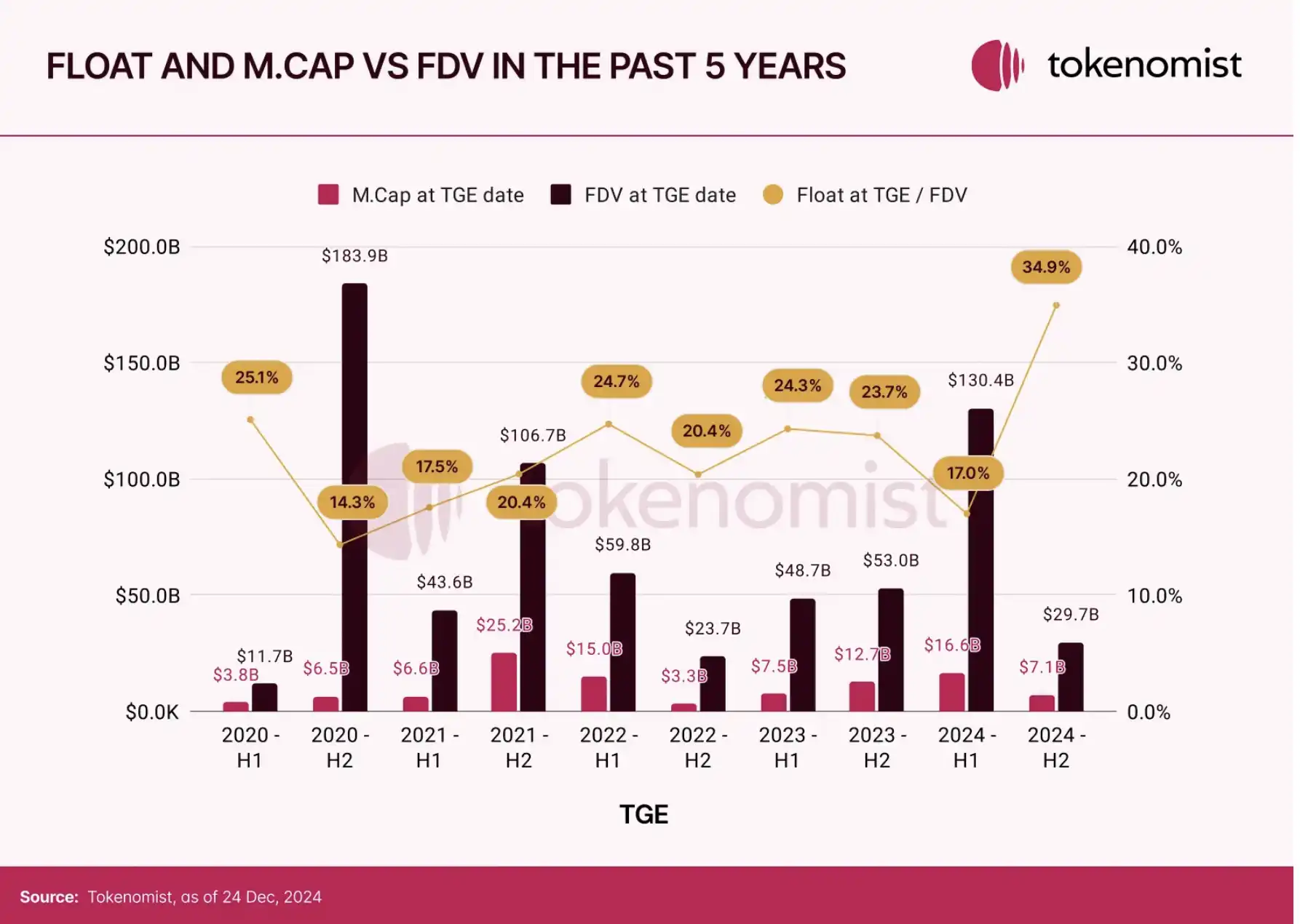
An analysis of token issuance from 2020 to 2024 shows a clear pattern in the adoption of the low circulating supply, high FDV model. These tokens were particularly prevalent at the end of 2020 and the beginning of 2024, coinciding with Bitcoin's halving and the subsequent bull market.
Over time, the crypto community has become increasingly aware of the risks posed by this pattern, prompting recent projects to make adaptive adjustments in tokenomics. One notable trend is the change in the circulating supply/FDV ratio at issuance. By the end of 2024, the average ratio had increased to around 35%, reflecting investors' greater caution. For example, Binance introduced listing criteria that consider the circulating supply at Token Generation Events (TGEs), encouraging projects to prioritize sustainable tokenomics.
To further understand the impact of the low circulating supply, high FDV model, we analyzed the performance of 2024's altcoins at issuance. We aggregated key metrics, including FDV, market cap, circulating supply at TGE, price performance, and price change, for the top 25 FDV-ranked altcoins at TGE dates.
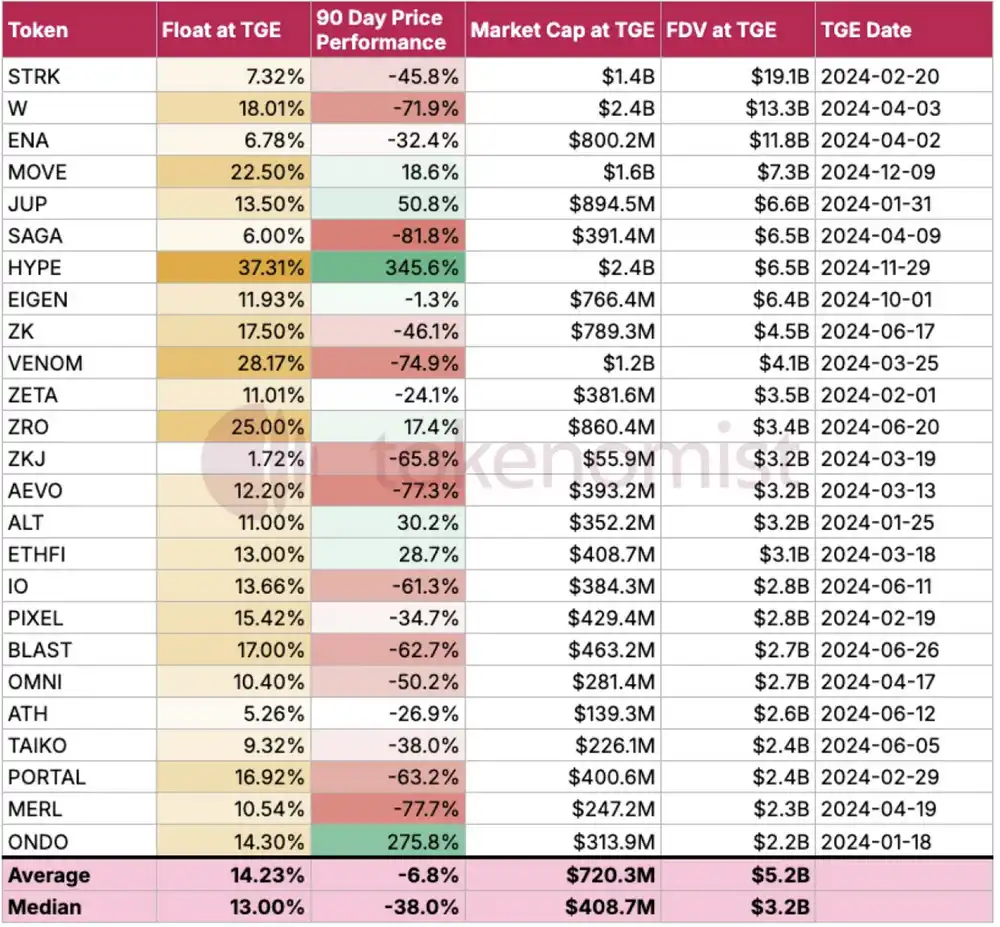
Excluding outliers like Hyperliquid and Ondo Finance, the data shows that there is not a strong correlation between the circulating supply at TGE and this year's price performance, as visualized in the scatter plot below. There are several reasons that could account for this. Most notably, the increase in demand and liquidity, along with a greater focus on hype-driven/emotion-driven narratives in the recent bull market cycle, may have reduced the correlation between circulating supply and price performance. On the other hand, for some tokens, the evolution of tokenomics has introduced new dimensions, such as inflationary or deflationary tokenomics and staking mechanisms, which may have diluted the impact of circulating supply at TGE.
Scatter plot of 90-day price performance versus circulating supply/FDV ratio at initial pricing date. Excluding outliers like HYPE, ONDO, etc.
As mentioned above, there are also exceptions. Hyperliquid conducted a distribution of 33% of its token supply through a community airdrop at issuance, without any VC unlocks. This approach promoted decentralization and community participation, setting a benchmark for fair token distribution.
The following chart shows the total token unlock value from 2020 to 2030, revealing some significant patterns during the past two bull market cycles. The total unlock value peaked in 2021 at $136.7 billion, over eight times the value in 2020 ($16.9 billion). While not as significant, the total unlock value in 2024 ($82 billion) is roughly double that of the previous year ($47 billion). This peak aligns with the peak of the previous bull market when many projects issued large amounts of locked token allocations for future release.
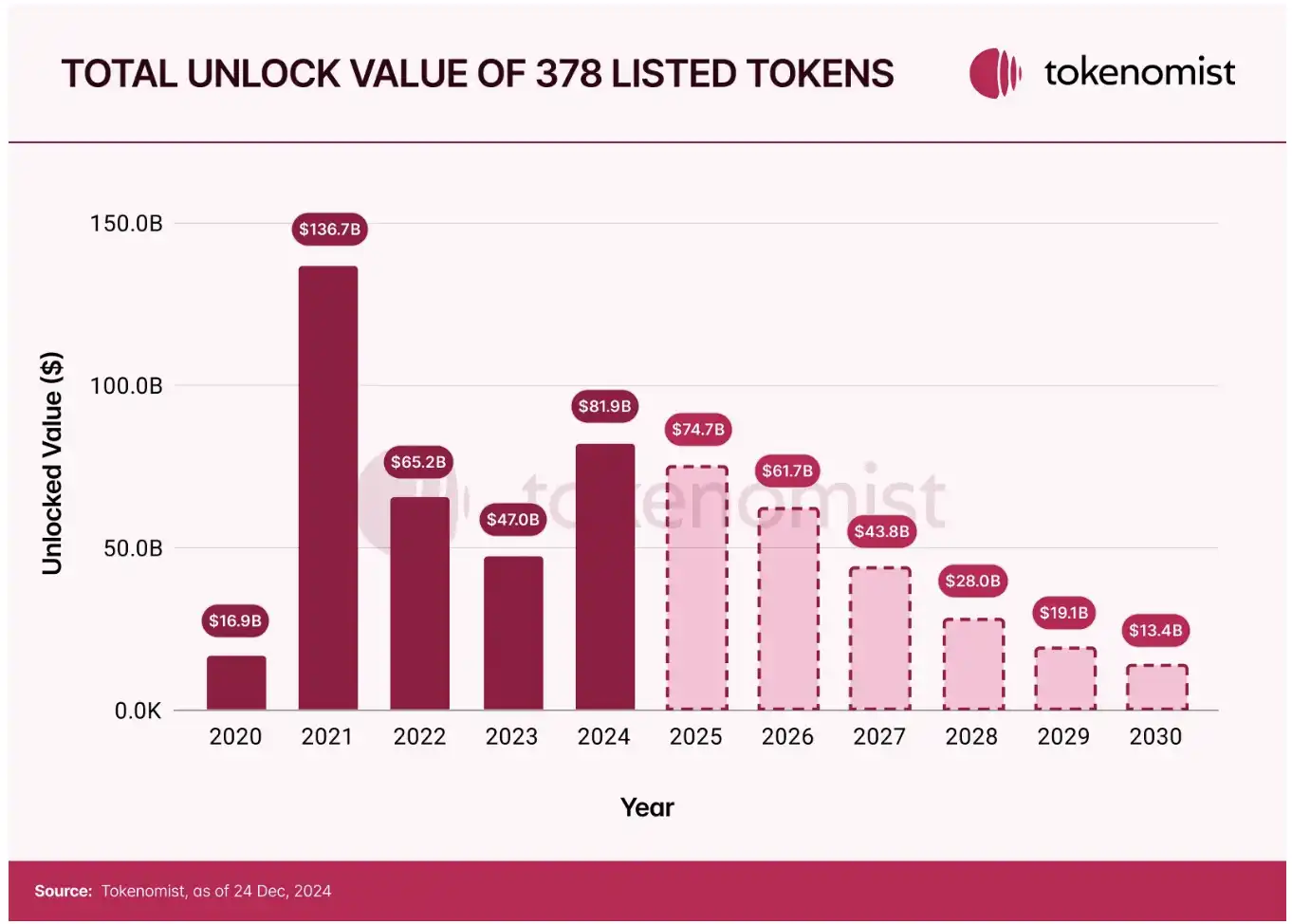
Looking ahead, the market will face significant unlock pressure. From 2024 to 2025, over $150 billion in tokens are expected to unlock, with 2024 alone accounting for approximately $82 billion. This poses a short-term risk to market stability. However, as lock-up plans are completed, the reduction in unlock pressure may contribute to long-term market stability.
The low circulating supply, high FDV (Fully Diluted Valuation) token model has proven to be a double-edged sword. While it can drive rapid price appreciation, it also brings significant risks due to future dilution and unsustainable valuations. As the crypto market matures, investors and projects must carefully assess tokenomics to ensure alignment with long-term goals. Evolutions in token distribution mechanisms like Hyperliquid offer promising alternatives that focus on fairness and sustainability.
It is important to note that these forecasts are based on data from 378 tokens tracked by Tokenomist, representing a portion of the market. New token issuances and changes in existing tokenomics, such as relocking or burning mechanisms, could alter these dynamics.
MEME and AI Agents
Throughout 2024, Bitcoin maintained its dominance in the cryptocurrency market, attracting increasing investment from the traditional financial sector. However, sentiment regarding altcoins underperforming was also growing. Despite a surge in growth towards the end of the year, many altcoins failed to keep pace with Bitcoin.
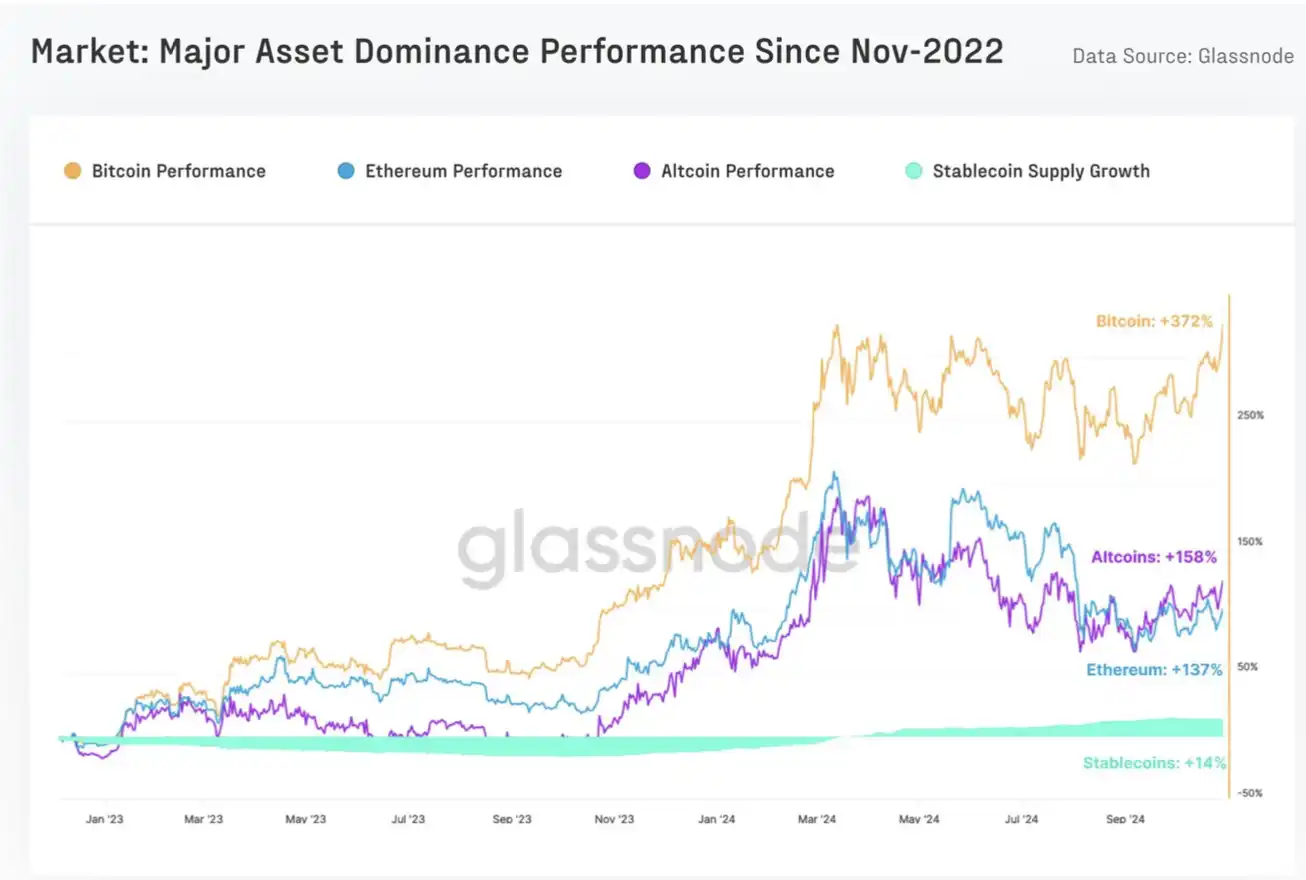
Source: Glassnode x Fasanara_Digital Assets Report Q4 2024
Analysis data shows that among the top 250 market cap-ranked altcoins, only 28.1% outperformed Bitcoin, while 45.5% outperformed Ethereum.
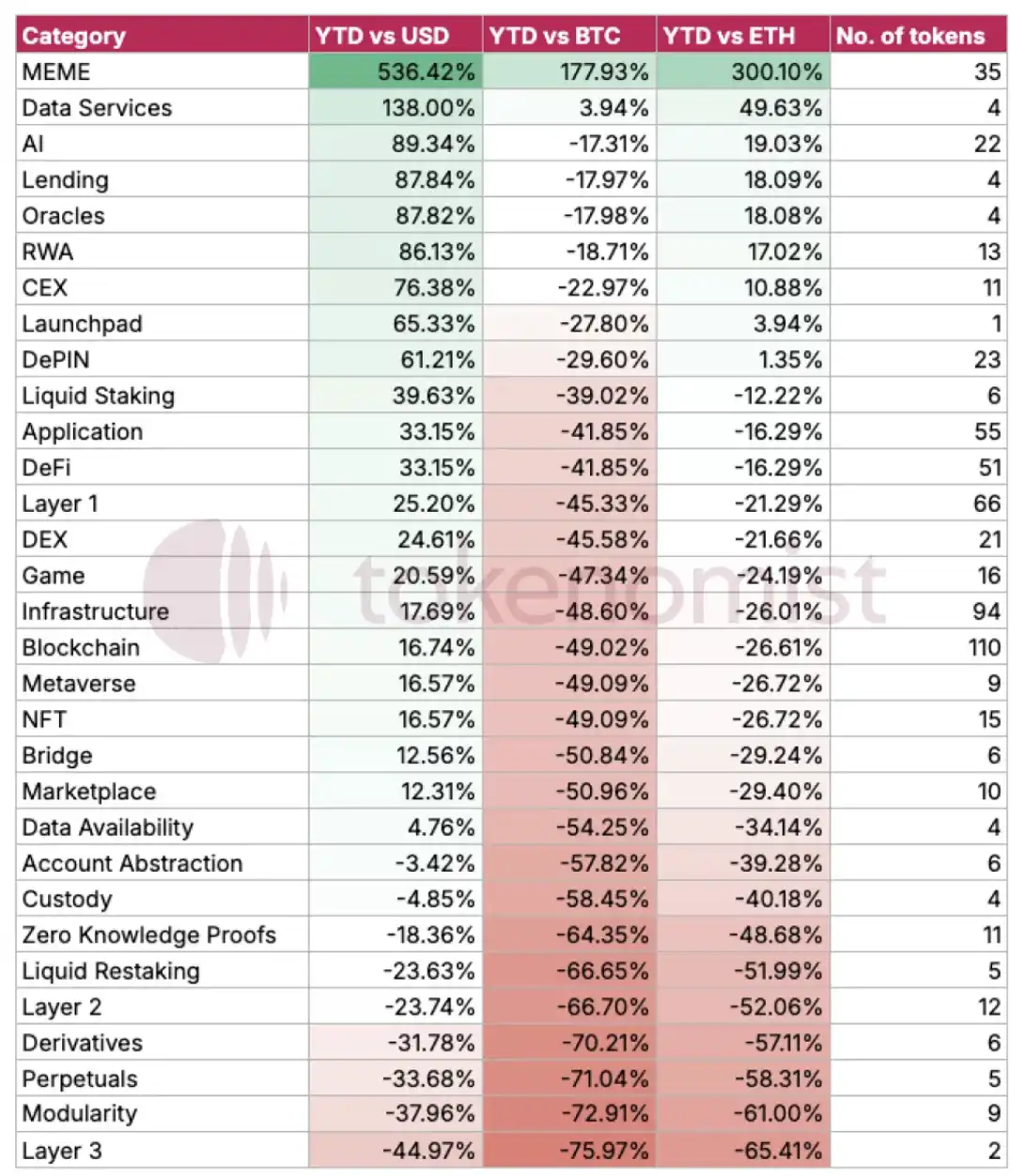
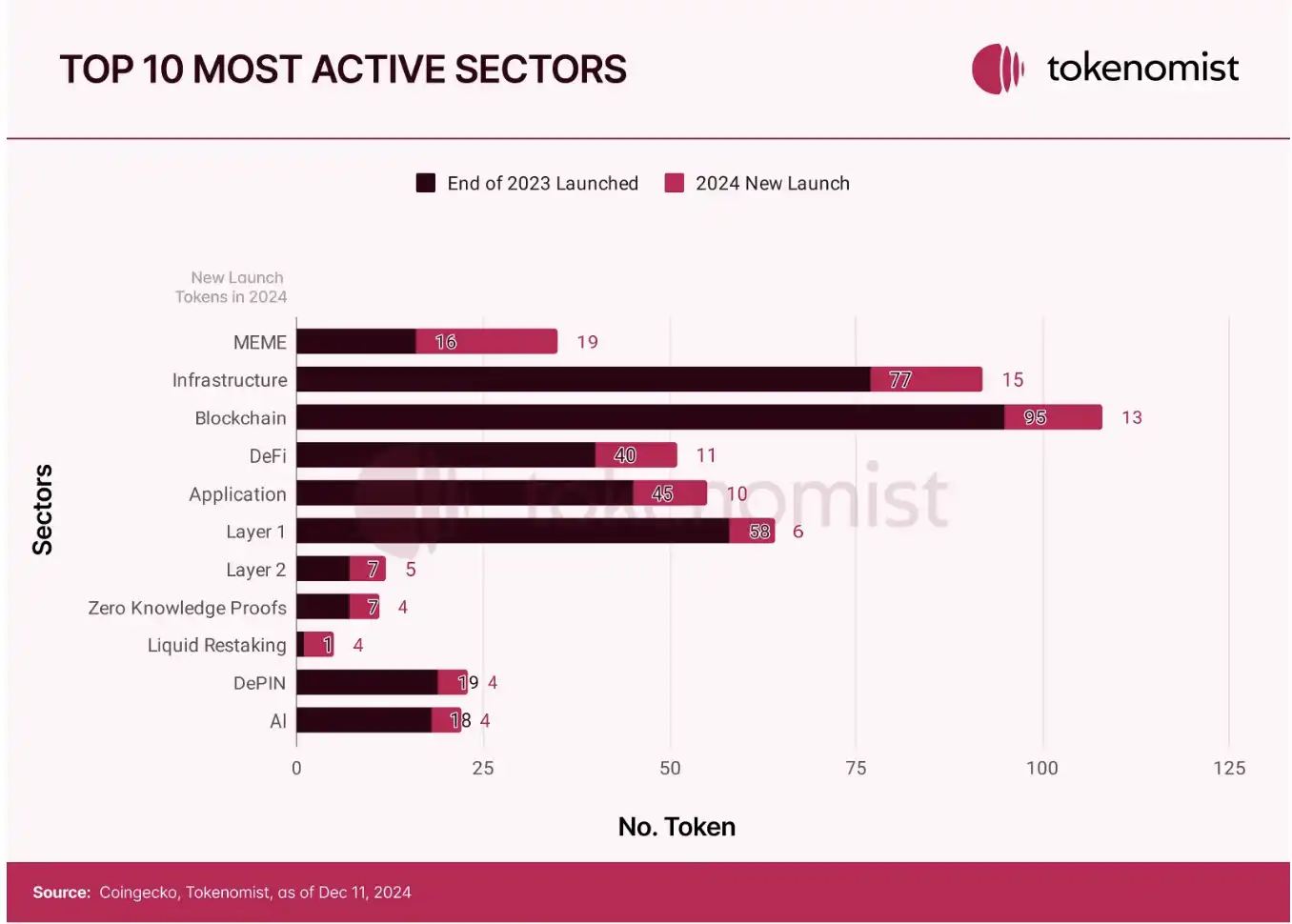
Comparing to the broader altcoin market, one sector has significantly outperformed its peers: Memecoin. This sector showcased extraordinary growth in 2024, achieving a year-to-date return of 536%—a performance that surpasses Bitcoin and Ethereum by 177% and 300%, respectively. Notably, among the top 54 tokens by market cap launched this year, 19 were Memecoins.
Appeal of Memecoin
The remarkable success of Memecoin has raised vital questions about the reasons behind its appeal and ongoing popularity. This section explores the data and motivations behind this unique phenomenon.
· Fair Launch Model
One of the key drivers of Memecoin's appeal is its fair launch model, which allocated its entire token supply to the community from day one. This approach ensured 100% circulation, aligning with the core tenets of cryptocurrency: fairness, transparency, and decentralization. In contrast to many other projects, Memecoin avoided excessive team allocations or early investor privileges, promoting equitable participation.
This fair launch model resonated strongly with investors, especially as sentiments grew against projects with heavy venture capital backing. These projects are sometimes criticized for having convoluted tokenomics and distribution structures that may seem skewed towards early insiders.
Furthermore, Memecoin offers a simpler and more straightforward narrative compared to other altcoins, which often require significant technical expertise to assess. Memecoin focuses on community engagement and cultural relevance, making it an effective tool for attracting new cryptocurrency users.
· Community Long-Term Incentive Alignment
The traditional approach to Web3 community building heavily relies on token airdrops to incentivize early contributors. These rewards typically target individuals creating content, participating in Discord, or engaging in protocol-specific activities. While this model effectively sparks initial interest, our analysis revealed significant shortcomings in long-term community retention. Studies show that airdrop hunters often immediately sell the received tokens, especially when the distribution does not meet expectations, leading to decreased community engagement and potential negative sentiment towards the protocol.
Our research indicates that Memecoin projects have shown significant success in building sustainable communities through an innovative incentive alignment approach. These projects effectively merge the interests of the team and the community, creating a situation described by market participants as "the best marketing is price appreciation." Drawing on Murad's framework, successful crypto communities often exhibit characteristics akin to fervent followers, possessing loyal supporters and a unique common belief. This phenomenon fosters intense shared enthusiasm among participants, enhancing retention, and driving organic growth through community-driven initiatives. This approach creates a gamified environment where users feel directly tied to the project's success, motivating them to maintain long-term engagement.
· Community Takeover: A New Paradigm
A emerging trend in protocol governance is Community Takeover (CTO). When a project's original developers abandon the project, community users and token holders take over the project's future direction and management, leading to a community takeover. As the project transitions to community ownership, token holders become both owners and operators. This dual role fundamentally changes their relationship with the project. Community members must actively participate in governance, development, and marketing to maintain and enhance the value of their held tokens.
· Growth Catalyst
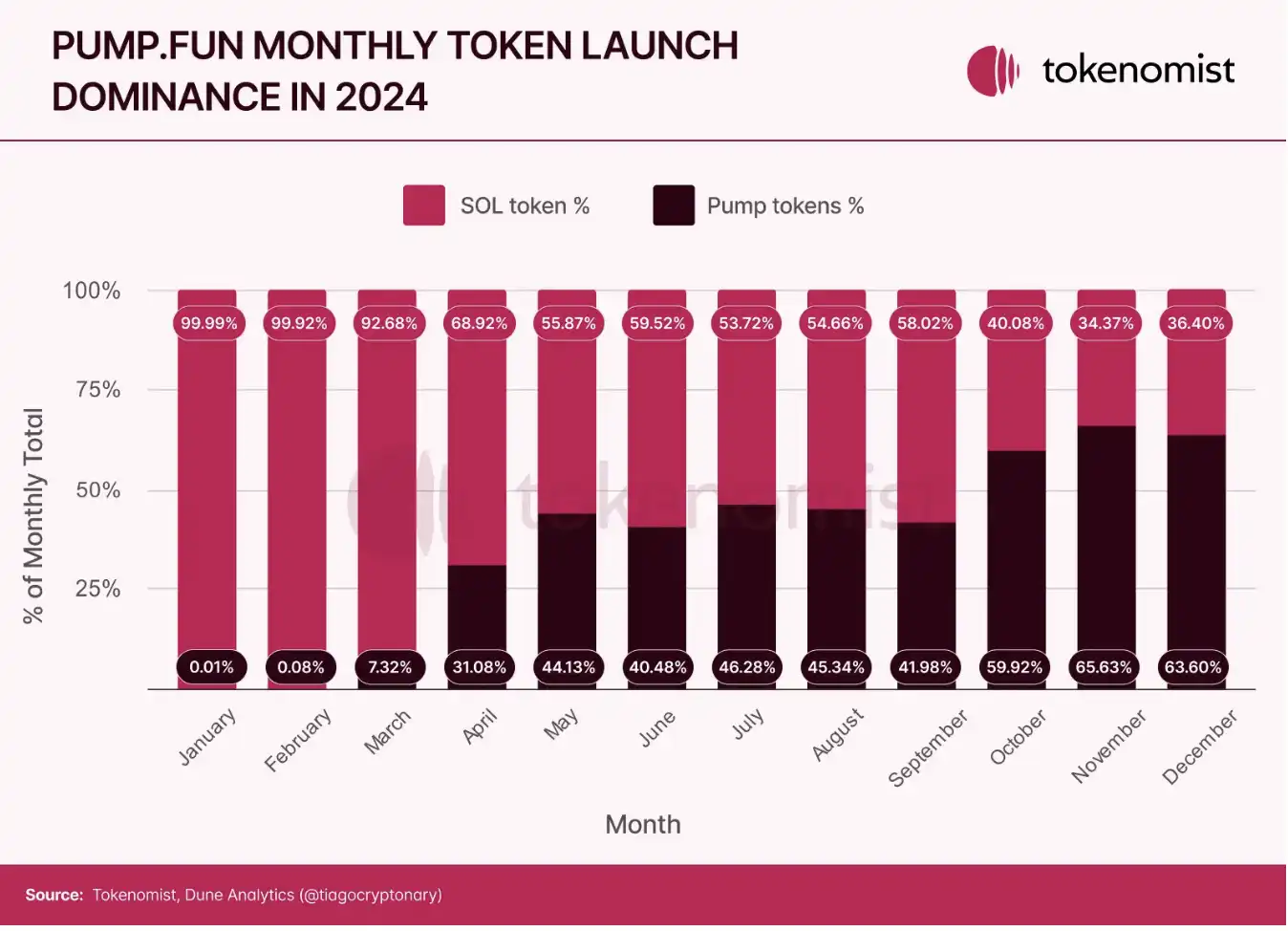
In 2024, a major catalyst for the Memecoin phenomenon was pump.fun, aimed at enabling more people to easily create and trade their own tokens, greatly reducing the entry barrier. Since its launch in January 2024, as of January 6, 2025, over 5,581,665 tokens have been created on pump.fun. As shown in the graph below, most Solana-based tokens are now issued through pump.fun rather than traditional methods. The success of pump.fun has also spurred competition, with other blockchain ecosystems exploring similar platforms to capitalize on the growing interest in fairly launched tokens.
· Risks and Limitations
Despite Memecoins' popularity in 2024, they still come with inherent risks. Like any newly issued token, Memecoins are essentially a trend and often experience rapid popularity and an equally fast decline. Similarly, repeated Memecoin oversaturation can weaken their impact, as illustrated by Murad's "Memecoin Pyramid," where the proportion of successful Memecoins is small compared to those that gradually fade away.
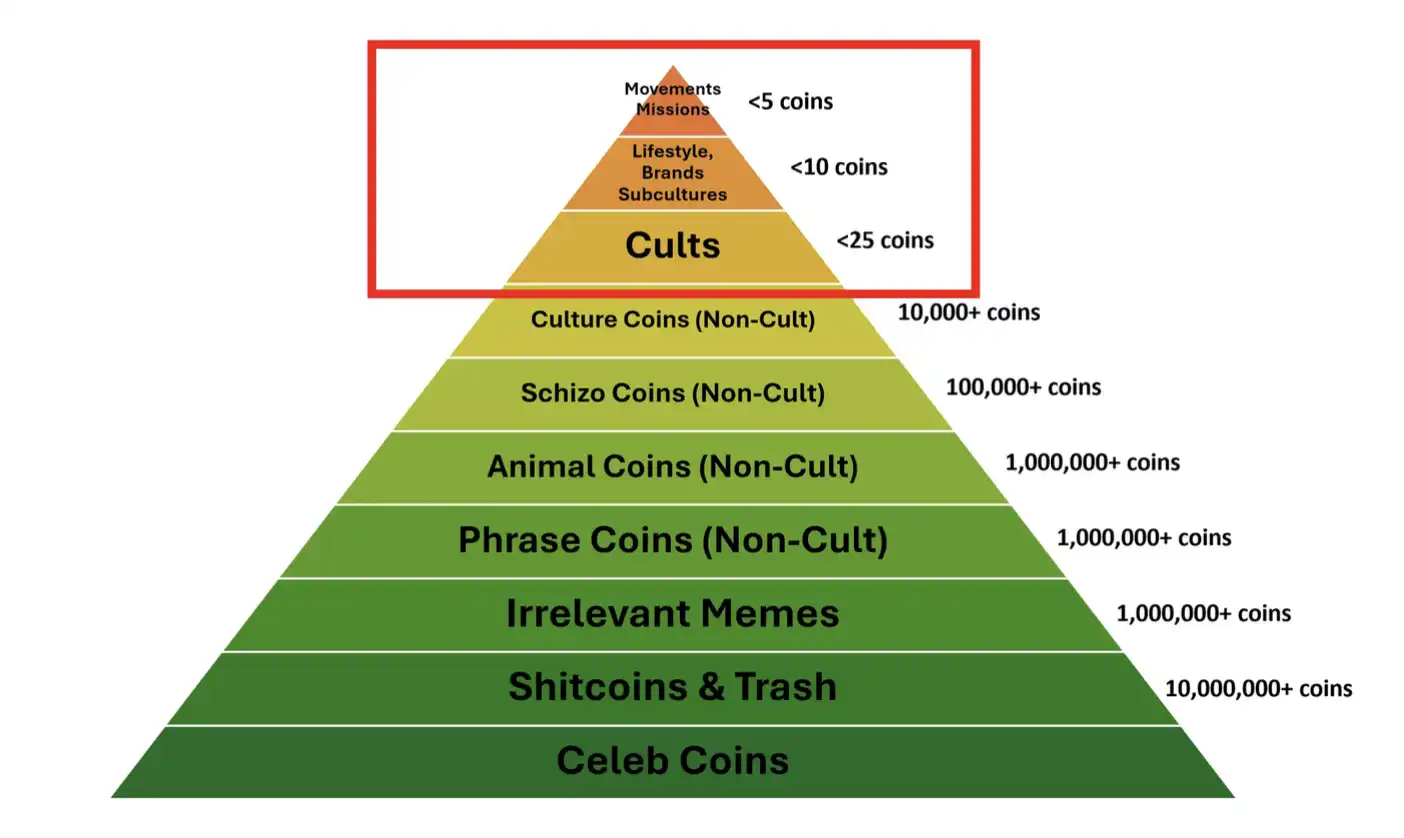
Murad's Memecoin Pyramid Source: The Meme Coin Supercycle - TOKEN2049
The long-term success rate of Memecoins is significantly lower. According to Chainplay's "2024 Memecoin Status" report, the average lifespan of Memecoins is one year, with 97% of Memecoins eventually considered "dead" (defined as having a 24-hour trading volume below $1,000, liquidity below $50,000, and no updates on Twitter within three months). Currently, only one Memecoin on pump.fun has a market capitalization exceeding $1 billion, with eight exceeding $100 million.
Another key risk is the potential for malicious activities. Despite a fair launch, insiders or developers may still control a majority of the tokens, undermining the principle of decentralization and allowing for pump and dumps. Although pump.fun combats this scenario through its bonding curve mechanism and token "graduation" to Raydium, scams may still go undetected. Even with a fair launch Memecoin, there have been cases where teams or insiders use virtual wallets to sniper meme coins. It is worth referring to websites like gmgn.ai for risk analysis indicators such as top 10 token holders, blacklist, developer activity, and a bubble chart.
AI Agents
Another prominent area in 2024 is AI agents. AI agents are essentially autonomous entities capable of performing tasks and interacting with other users/agents, leveraging blockchain technology for on-chain operations. They are likened to an enhanced version of Memecoin because they combine memes, AI, and social media elements to create autonomous entities that can interact with users and self-propagate. In 2024, we saw the emergence of key players like Virtuals and ai16z, providing frameworks for developing and deploying AI agents.
In an article about 2025 crypto predictions, Dragonfly Capital Managing Partner Haseeb Qureshi predicted that tokens related to AI agents will surpass Memecoins in the upcoming year. He believes that unlike Key Opinion Leaders (KOL) and influencers, AI agents never rest, conform to majority opinions, and are less driven by self-interest. They also excel in real-time information aggregation and amplification. Current agents like aixbt, by curating social media data to create alpha information feeds, demonstrate potential incremental improvements in the next year or two.
However, Qureshi predicts that over time, the novelty of these agents may fade. An abundance of AI agents may lead to an emotional backlash, and the crypto community may revert to supporting human preferences. Of course, this is also a natural evolution of trends. Nevertheless, Qureshi suggests that the truly transformative impact in this space will come from software engineering agents, with the potential to fundamentally change the development and security of blockchain projects.
Broader Impact
Furthermore, noteworthy is the continuous innovation in the DeFi space over the past year. OG projects like Aave maintained a strong performance, reaching record highs in deposits this year. Meanwhile, new projects like Ethena have attracted increasing attention from the traditional finance sector. RWA projects like Ondo Finance have also exceeded expectations this year, possibly driven by the increasing demand for the tokenization of financial products.
The success of Memecoins and their community-driven tokenomics has inspired other areas to adopt similar fair launch practices. For example, the DeSci token. Another noticeable trend is that, during token issuance, an increasing number of projects are allocating a larger proportion to the community.
Another anticipated potential trend is the fusion of Memecoins and utility. User @hmalivya9 proposed the concept of "Community Clusters" on X. The model suggests a staking system that would collaborate Memecoin projects with utility token projects, where Memecoin holders can stake tokens to earn rewards from multiple utility token projects. This system would be enhanced through requiring active social media participation, essentially gamifying the branding of utility tokens. hmalivya9 envisions this symbiotic relationship as a blueprint for the future structure of the crypto community, intertwining entertainment with utility, a concept not entirely new. For example, in Hyperliquid, holders of its native spot token $PURR can receive airdrops of other spot tokens within the Hyperliquid ecosystem and earn Hyperliquid Points. $PURR can only be traded within Hyperliquid, significantly expanding its user base.
In the coming year, AI agents will also see continued development. ai16z has put forward a tokenomics model where token staking serves as a validation system, granting platform access, enabling governance participation, and establishing accountability through possible penalty conditions. In this evolved staking model, stakeholders' economic incentives are directly linked to their contributions to the ecosystem's quality and growth.
Undoubtedly, 2025 will be an exciting year, whether through the evolution of existing trends or the emergence of new ones.
You may also like

Token Cannot Compound, Where Is the Real Investment Opportunity?

February 6th Market Key Intelligence, How Much Did You Miss?

China's Central Bank and Eight Other Departments' Latest Regulatory Focus: Key Attention to RWA Tokenized Asset Risk
Foreword: Today, the People's Bank of China's website published the "Notice of the People's Bank of China, National Development and Reform Commission, Ministry of Industry and Information Technology, Ministry of Public Security, State Administration for Market Regulation, China Banking and Insurance Regulatory Commission, China Securities Regulatory Commission, State Administration of Foreign Exchange on Further Preventing and Dealing with Risks Related to Virtual Currency and Others (Yinfa [2026] No. 42)", the latest regulatory requirements from the eight departments including the central bank, which are basically consistent with the regulatory requirements of recent years. The main focus of the regulation is on speculative activities such as virtual currency trading, exchanges, ICOs, overseas platform services, and this time, regulatory oversight of RWA has been added, explicitly prohibiting RWA tokenization, stablecoins (especially those pegged to the RMB). The following is the full text:
To the people's governments of all provinces, autonomous regions, and municipalities directly under the Central Government, the Xinjiang Production and Construction Corps:
Recently, there have been speculative activities related to virtual currency and Real-World Assets (RWA) tokenization, disrupting the economic and financial order and jeopardizing the property security of the people. In order to further prevent and address the risks related to virtual currency and Real-World Assets tokenization, effectively safeguard national security and social stability, in accordance with the "Law of the People's Republic of China on the People's Bank of China," "Law of the People's Republic of China on Commercial Banks," "Securities Law of the People's Republic of China," "Law of the People's Republic of China on Securities Investment Funds," "Law of the People's Republic of China on Futures and Derivatives," "Cybersecurity Law of the People's Republic of China," "Regulations of the People's Republic of China on the Administration of Renminbi," "Regulations on Prevention and Disposal of Illegal Fundraising," "Regulations of the People's Republic of China on Foreign Exchange Administration," "Telecommunications Regulations of the People's Republic of China," and other provisions, after reaching consensus with the Cyberspace Administration of China, the Supreme People's Court, and the Supreme People's Procuratorate, and with the approval of the State Council, the relevant matters are notified as follows:
(I) Virtual currency does not possess the legal status equivalent to fiat currency. Virtual currencies such as Bitcoin, Ether, Tether, etc., have the main characteristics of being issued by non-monetary authorities, using encryption technology and distributed ledger or similar technology, existing in digital form, etc. They do not have legal tender status, should not and cannot be circulated and used as currency in the market.
The business activities related to virtual currency are classified as illegal financial activities. The exchange of fiat currency and virtual currency within the territory, exchange of virtual currencies, acting as a central counterparty in buying and selling virtual currencies, providing information intermediary and pricing services for virtual currency transactions, token issuance financing, and trading of virtual currency-related financial products, etc., fall under illegal financial activities, such as suspected illegal issuance of token vouchers, unauthorized public issuance of securities, illegal operation of securities and futures business, illegal fundraising, etc., are strictly prohibited across the board and resolutely banned in accordance with the law. Overseas entities and individuals are not allowed to provide virtual currency-related services to domestic entities in any form.
A stablecoin pegged to a fiat currency indirectly fulfills some functions of the fiat currency in circulation. Without the consent of relevant authorities in accordance with the law and regulations, any domestic or foreign entity or individual is not allowed to issue a RMB-pegged stablecoin overseas.
(II)Tokenization of Real-World Assets refers to the use of encryption technology and distributed ledger or similar technologies to transform ownership rights, income rights, etc., of assets into tokens (tokens) or other interests or bond certificates with token (token) characteristics, and carry out issuance and trading activities.
Engaging in the tokenization of real-world assets domestically, as well as providing related intermediary, information technology services, etc., which are suspected of illegal issuance of token vouchers, unauthorized public offering of securities, illegal operation of securities and futures business, illegal fundraising, and other illegal financial activities, shall be prohibited; except for relevant business activities carried out with the approval of the competent authorities in accordance with the law and regulations and relying on specific financial infrastructures. Overseas entities and individuals are not allowed to illegally provide services related to the tokenization of real-world assets to domestic entities in any form.
(III) Inter-agency Coordination. The People's Bank of China, together with the National Development and Reform Commission, the Ministry of Industry and Information Technology, the Ministry of Public Security, the State Administration for Market Regulation, the China Banking and Insurance Regulatory Commission, the China Securities Regulatory Commission, the State Administration of Foreign Exchange, and other departments, will improve the work mechanism, strengthen coordination with the Cyberspace Administration of China, the Supreme People's Court, and the Supreme People's Procuratorate, coordinate efforts, and overall guide regions to carry out risk prevention and disposal of virtual currency-related illegal financial activities.
The China Securities Regulatory Commission, together with the National Development and Reform Commission, the Ministry of Industry and Information Technology, the Ministry of Public Security, the People's Bank of China, the State Administration for Market Regulation, the China Banking and Insurance Regulatory Commission, the State Administration of Foreign Exchange, and other departments, will improve the work mechanism, strengthen coordination with the Cyberspace Administration of China, the Supreme People's Court, and the Supreme People's Procuratorate, coordinate efforts, and overall guide regions to carry out risk prevention and disposal of illegal financial activities related to the tokenization of real-world assets.
(IV) Strengthening Local Implementation. The people's governments at the provincial level are overall responsible for the prevention and disposal of risks related to virtual currencies and the tokenization of real-world assets in their respective administrative regions. The specific leading department is the local financial regulatory department, with participation from branches and dispatched institutions of the State Council's financial regulatory department, telecommunications regulators, public security, market supervision, and other departments, in coordination with cyberspace departments, courts, and procuratorates, to improve the normalization of the work mechanism, effectively connect with the relevant work mechanisms of central departments, form a cooperative and coordinated working pattern between central and local governments, effectively prevent and properly handle risks related to virtual currencies and the tokenization of real-world assets, and maintain economic and financial order and social stability.
(5) Enhanced Risk Monitoring. The People's Bank of China, China Securities Regulatory Commission, National Development and Reform Commission, Ministry of Industry and Information Technology, Ministry of Public Security, State Administration of Foreign Exchange, Cyberspace Administration of China, and other departments continue to improve monitoring techniques and system support, enhance cross-departmental data analysis and sharing, establish sound information sharing and cross-validation mechanisms, promptly grasp the risk situation of activities related to virtual currency and real-world asset tokenization. Local governments at all levels give full play to the role of local monitoring and early warning mechanisms. Local financial regulatory authorities, together with branches and agencies of the State Council's financial regulatory authorities, as well as departments of cyberspace and public security, ensure effective connection between online monitoring, offline investigation, and fund tracking, efficiently and accurately identify activities related to virtual currency and real-world asset tokenization, promptly share risk information, improve early warning information dissemination, verification, and rapid response mechanisms.
(6) Strengthened Oversight of Financial Institutions, Intermediaries, and Technology Service Providers. Financial institutions (including non-bank payment institutions) are prohibited from providing account opening, fund transfer, and clearing services for virtual currency-related business activities, issuing and selling financial products related to virtual currency, including virtual currency and related financial products in the scope of collateral, conducting insurance business related to virtual currency, or including virtual currency in the scope of insurance liability. Financial institutions (including non-bank payment institutions) are prohibited from providing custody, clearing, and settlement services for unauthorized real-world asset tokenization-related business and related financial products. Relevant intermediary institutions and information technology service providers are prohibited from providing intermediary, technical, or other services for unauthorized real-world asset tokenization-related businesses and related financial products.
(7) Enhanced Management of Internet Information Content and Access. Internet enterprises are prohibited from providing online business venues, commercial displays, marketing, advertising, or paid traffic diversion services for virtual currency and real-world asset tokenization-related business activities. Upon discovering clues of illegal activities, they should promptly report to relevant departments and provide technical support and assistance for related investigations and inquiries. Based on the clues transferred by the financial regulatory authorities, the cyberspace administration, telecommunications authorities, and public security departments should promptly close and deal with websites, mobile applications (including mini-programs), and public accounts engaged in virtual currency and real-world asset tokenization-related business activities in accordance with the law.
(8) Strengthened Entity Registration and Advertisement Management. Market supervision departments strengthen entity registration and management, and enterprise and individual business registrations must not contain terms such as "virtual currency," "virtual asset," "cryptocurrency," "crypto asset," "stablecoin," "real-world asset tokenization," or "RWA" in their names or business scopes. Market supervision departments, together with financial regulatory authorities, legally enhance the supervision of advertisements related to virtual currency and real-world asset tokenization, promptly investigating and handling relevant illegal advertisements.
(IX) Continued Rectification of Virtual Currency Mining Activities. The National Development and Reform Commission, together with relevant departments, strictly controls virtual currency mining activities, continuously promotes the rectification of virtual currency mining activities. The people's governments of various provinces take overall responsibility for the rectification of "mining" within their respective administrative regions. In accordance with the requirements of the National Development and Reform Commission and other departments in the "Notice on the Rectification of Virtual Currency Mining Activities" (NDRC Energy-saving Building [2021] No. 1283) and the provisions of the "Guidance Catalog for Industrial Structure Adjustment (2024 Edition)," a comprehensive review, investigation, and closure of existing virtual currency mining projects are conducted, new mining projects are strictly prohibited, and mining machine production enterprises are strictly prohibited from providing mining machine sales and other services within the country.
(X) Severe Crackdown on Related Illegal Financial Activities. Upon discovering clues to illegal financial activities related to virtual currency and the tokenization of real-world assets, local financial regulatory authorities, branches of the State Council's financial regulatory authorities, and other relevant departments promptly investigate, determine, and properly handle the issues in accordance with the law, and seriously hold the relevant entities and individuals legally responsible. Those suspected of crimes are transferred to the judicial authorities for processing according to the law.
(XI) Severe Crackdown on Related Illegal and Criminal Activities. The Ministry of Public Security, the People's Bank of China, the State Administration for Market Regulation, the China Banking and Insurance Regulatory Commission, the China Securities Regulatory Commission, as well as judicial and procuratorial organs, in accordance with their respective responsibilities, rigorously crack down on illegal and criminal activities related to virtual currency, the tokenization of real-world assets, such as fraud, money laundering, illegal business operations, pyramid schemes, illegal fundraising, and other illegal and criminal activities carried out under the guise of virtual currency, the tokenization of real-world assets, etc.
(XII) Strengthen Industry Self-discipline. Relevant industry associations should enhance membership management and policy advocacy, based on their own responsibilities, advocate and urge member units to resist illegal financial activities related to virtual currency and the tokenization of real-world assets. Member units that violate regulatory policies and industry self-discipline rules are to be disciplined in accordance with relevant self-regulatory management regulations. By leveraging various industry infrastructure, conduct risk monitoring related to virtual currency, the tokenization of real-world assets, and promptly transfer issue clues to relevant departments.
(XIII) Without the approval of relevant departments in accordance with the law and regulations, domestic entities and foreign entities controlled by them may not issue virtual currency overseas.
(XIV) Domestic entities engaging directly or indirectly in overseas external debt-based tokenization of real-world assets, or conducting asset securitization activities abroad based on domestic ownership rights, income rights, etc. (hereinafter referred to as domestic equity), should be strictly regulated in accordance with the principles of "same business, same risk, same rules." The National Development and Reform Commission, the China Securities Regulatory Commission, the State Administration of Foreign Exchange, and other relevant departments regulate it according to their respective responsibilities. For other forms of overseas real-world asset tokenization activities based on domestic equity by domestic entities, the China Securities Regulatory Commission, together with relevant departments, supervise according to their division of responsibilities. Without the consent and filing of relevant departments, no unit or individual may engage in the above-mentioned business.
(15) Overseas subsidiaries and branches of domestic financial institutions providing Real World Asset Tokenization-related services overseas shall do so legally and prudently. They shall have professional personnel and systems in place to effectively mitigate business risks, strictly implement customer onboarding, suitability management, anti-money laundering requirements, and incorporate them into the domestic financial institutions' compliance and risk management system. Intermediaries and information technology service providers offering Real World Asset Tokenization services abroad based on domestic equity or conducting Real World Asset Tokenization business in the form of overseas debt for domestic entities directly or indirectly venturing abroad must strictly comply with relevant laws and regulations. They should establish and improve relevant compliance and internal control systems in accordance with relevant normative requirements, strengthen business and risk control, and report the business developments to the relevant regulatory authorities for approval or filing.
(16) Strengthen organizational leadership and overall coordination. All departments and regions should attach great importance to the prevention of risks related to virtual currencies and Real World Asset Tokenization, strengthen organizational leadership, clarify work responsibilities, form a long-term effective working mechanism with centralized coordination, local implementation, and shared responsibilities, maintain high pressure, dynamically monitor risks, effectively prevent and mitigate risks in an orderly and efficient manner, legally protect the property security of the people, and make every effort to maintain economic and financial order and social stability.
(17) Widely carry out publicity and education. All departments, regions, and industry associations should make full use of various media and other communication channels to disseminate information through legal and policy interpretation, analysis of typical cases, and education on investment risks, etc. They should promote the illegality and harm of virtual currencies and Real World Asset Tokenization-related businesses and their manifestations, fully alert to potential risks and hidden dangers, and enhance public awareness and identification capabilities for risk prevention.
(18) Engaging in illegal financial activities related to virtual currencies and Real World Asset Tokenization in violation of this notice, as well as providing services for virtual currencies and Real World Asset Tokenization-related businesses, shall be punished in accordance with relevant regulations. If it constitutes a crime, criminal liability shall be pursued according to the law. For domestic entities and individuals who knowingly or should have known that overseas entities illegally provided virtual currency or Real World Asset Tokenization-related services to domestic entities and still assisted them, relevant responsibilities shall be pursued according to the law. If it constitutes a crime, criminal liability shall be pursued according to the law.
(19) If any unit or individual invests in virtual currencies, Real World Asset Tokens, and related financial products against public order and good customs, the relevant civil legal actions shall be invalid, and any resulting losses shall be borne by them. If there are suspicions of disrupting financial order and jeopardizing financial security, the relevant departments shall deal with them according to the law.
This notice shall enter into force upon the date of its issuance. The People's Bank of China and ten other departments' "Notice on Further Preventing and Dealing with the Risks of Virtual Currency Trading Speculation" (Yinfa [2021] No. 237) is hereby repealed.

Former Partner's Perspective on Multicoin: Kyle's Exit, But the Game He Left Behind Just Getting Started
Why Bitcoin Is Falling Now: The Real Reasons Behind BTC's Crash & WEEX's Smart Profit Playbook
Bitcoin's ongoing crash explained: Discover the 5 hidden triggers behind BTC's plunge & how WEEX's Auto Earn and Trade to Earn strategies help traders profit from crypto market volatility.

Wall Street's Hottest Trades See Exodus

Vitalik Discusses Ethereum Scaling Path, Circle Announces Partnership with Polymarket, What's the Overseas Crypto Community Talking About Today?

Believing in the Capital Markets - The Essence and Core Value of Cryptocurrency

Polymarket's 'Weatherman': Predict Temperature, Win Million-Dollar Payout

$15K+ Profits: The 4 AI Trading Secrets WEEX Hackathon Prelim Winners Used to Dominate Volatile Crypto Markets
How WEEX Hackathon's top AI trading strategies made $15K+ in crypto markets: 4 proven rules for ETH/BTC trading, market structure analysis, and risk management in volatile conditions.

A nearly 20% one-day plunge, how long has it been since you last saw a $60,000 Bitcoin?

Raoul Pal: I've seen every single panic, and they are never the end.

Key Market Information Discrepancy on February 6th - A Must-Read! | Alpha Morning Report

2026 Crypto Industry's First Snowfall
The Harsh Reality Behind the $26 Billion Crypto Liquidation: Liquidity Is Killing the Market
Why Is Gold, US Stocks, Bitcoin All Falling?

Key Market Intelligence for February 5th, how much did you miss out on?

Wintermute: By 2026, crypto had gradually become the settlement layer of the Internet economy
Token Cannot Compound, Where Is the Real Investment Opportunity?
February 6th Market Key Intelligence, How Much Did You Miss?
China's Central Bank and Eight Other Departments' Latest Regulatory Focus: Key Attention to RWA Tokenized Asset Risk
Foreword: Today, the People's Bank of China's website published the "Notice of the People's Bank of China, National Development and Reform Commission, Ministry of Industry and Information Technology, Ministry of Public Security, State Administration for Market Regulation, China Banking and Insurance Regulatory Commission, China Securities Regulatory Commission, State Administration of Foreign Exchange on Further Preventing and Dealing with Risks Related to Virtual Currency and Others (Yinfa [2026] No. 42)", the latest regulatory requirements from the eight departments including the central bank, which are basically consistent with the regulatory requirements of recent years. The main focus of the regulation is on speculative activities such as virtual currency trading, exchanges, ICOs, overseas platform services, and this time, regulatory oversight of RWA has been added, explicitly prohibiting RWA tokenization, stablecoins (especially those pegged to the RMB). The following is the full text:
To the people's governments of all provinces, autonomous regions, and municipalities directly under the Central Government, the Xinjiang Production and Construction Corps:
Recently, there have been speculative activities related to virtual currency and Real-World Assets (RWA) tokenization, disrupting the economic and financial order and jeopardizing the property security of the people. In order to further prevent and address the risks related to virtual currency and Real-World Assets tokenization, effectively safeguard national security and social stability, in accordance with the "Law of the People's Republic of China on the People's Bank of China," "Law of the People's Republic of China on Commercial Banks," "Securities Law of the People's Republic of China," "Law of the People's Republic of China on Securities Investment Funds," "Law of the People's Republic of China on Futures and Derivatives," "Cybersecurity Law of the People's Republic of China," "Regulations of the People's Republic of China on the Administration of Renminbi," "Regulations on Prevention and Disposal of Illegal Fundraising," "Regulations of the People's Republic of China on Foreign Exchange Administration," "Telecommunications Regulations of the People's Republic of China," and other provisions, after reaching consensus with the Cyberspace Administration of China, the Supreme People's Court, and the Supreme People's Procuratorate, and with the approval of the State Council, the relevant matters are notified as follows:
(I) Virtual currency does not possess the legal status equivalent to fiat currency. Virtual currencies such as Bitcoin, Ether, Tether, etc., have the main characteristics of being issued by non-monetary authorities, using encryption technology and distributed ledger or similar technology, existing in digital form, etc. They do not have legal tender status, should not and cannot be circulated and used as currency in the market.
The business activities related to virtual currency are classified as illegal financial activities. The exchange of fiat currency and virtual currency within the territory, exchange of virtual currencies, acting as a central counterparty in buying and selling virtual currencies, providing information intermediary and pricing services for virtual currency transactions, token issuance financing, and trading of virtual currency-related financial products, etc., fall under illegal financial activities, such as suspected illegal issuance of token vouchers, unauthorized public issuance of securities, illegal operation of securities and futures business, illegal fundraising, etc., are strictly prohibited across the board and resolutely banned in accordance with the law. Overseas entities and individuals are not allowed to provide virtual currency-related services to domestic entities in any form.
A stablecoin pegged to a fiat currency indirectly fulfills some functions of the fiat currency in circulation. Without the consent of relevant authorities in accordance with the law and regulations, any domestic or foreign entity or individual is not allowed to issue a RMB-pegged stablecoin overseas.
(II)Tokenization of Real-World Assets refers to the use of encryption technology and distributed ledger or similar technologies to transform ownership rights, income rights, etc., of assets into tokens (tokens) or other interests or bond certificates with token (token) characteristics, and carry out issuance and trading activities.
Engaging in the tokenization of real-world assets domestically, as well as providing related intermediary, information technology services, etc., which are suspected of illegal issuance of token vouchers, unauthorized public offering of securities, illegal operation of securities and futures business, illegal fundraising, and other illegal financial activities, shall be prohibited; except for relevant business activities carried out with the approval of the competent authorities in accordance with the law and regulations and relying on specific financial infrastructures. Overseas entities and individuals are not allowed to illegally provide services related to the tokenization of real-world assets to domestic entities in any form.
(III) Inter-agency Coordination. The People's Bank of China, together with the National Development and Reform Commission, the Ministry of Industry and Information Technology, the Ministry of Public Security, the State Administration for Market Regulation, the China Banking and Insurance Regulatory Commission, the China Securities Regulatory Commission, the State Administration of Foreign Exchange, and other departments, will improve the work mechanism, strengthen coordination with the Cyberspace Administration of China, the Supreme People's Court, and the Supreme People's Procuratorate, coordinate efforts, and overall guide regions to carry out risk prevention and disposal of virtual currency-related illegal financial activities.
The China Securities Regulatory Commission, together with the National Development and Reform Commission, the Ministry of Industry and Information Technology, the Ministry of Public Security, the People's Bank of China, the State Administration for Market Regulation, the China Banking and Insurance Regulatory Commission, the State Administration of Foreign Exchange, and other departments, will improve the work mechanism, strengthen coordination with the Cyberspace Administration of China, the Supreme People's Court, and the Supreme People's Procuratorate, coordinate efforts, and overall guide regions to carry out risk prevention and disposal of illegal financial activities related to the tokenization of real-world assets.
(IV) Strengthening Local Implementation. The people's governments at the provincial level are overall responsible for the prevention and disposal of risks related to virtual currencies and the tokenization of real-world assets in their respective administrative regions. The specific leading department is the local financial regulatory department, with participation from branches and dispatched institutions of the State Council's financial regulatory department, telecommunications regulators, public security, market supervision, and other departments, in coordination with cyberspace departments, courts, and procuratorates, to improve the normalization of the work mechanism, effectively connect with the relevant work mechanisms of central departments, form a cooperative and coordinated working pattern between central and local governments, effectively prevent and properly handle risks related to virtual currencies and the tokenization of real-world assets, and maintain economic and financial order and social stability.
(5) Enhanced Risk Monitoring. The People's Bank of China, China Securities Regulatory Commission, National Development and Reform Commission, Ministry of Industry and Information Technology, Ministry of Public Security, State Administration of Foreign Exchange, Cyberspace Administration of China, and other departments continue to improve monitoring techniques and system support, enhance cross-departmental data analysis and sharing, establish sound information sharing and cross-validation mechanisms, promptly grasp the risk situation of activities related to virtual currency and real-world asset tokenization. Local governments at all levels give full play to the role of local monitoring and early warning mechanisms. Local financial regulatory authorities, together with branches and agencies of the State Council's financial regulatory authorities, as well as departments of cyberspace and public security, ensure effective connection between online monitoring, offline investigation, and fund tracking, efficiently and accurately identify activities related to virtual currency and real-world asset tokenization, promptly share risk information, improve early warning information dissemination, verification, and rapid response mechanisms.
(6) Strengthened Oversight of Financial Institutions, Intermediaries, and Technology Service Providers. Financial institutions (including non-bank payment institutions) are prohibited from providing account opening, fund transfer, and clearing services for virtual currency-related business activities, issuing and selling financial products related to virtual currency, including virtual currency and related financial products in the scope of collateral, conducting insurance business related to virtual currency, or including virtual currency in the scope of insurance liability. Financial institutions (including non-bank payment institutions) are prohibited from providing custody, clearing, and settlement services for unauthorized real-world asset tokenization-related business and related financial products. Relevant intermediary institutions and information technology service providers are prohibited from providing intermediary, technical, or other services for unauthorized real-world asset tokenization-related businesses and related financial products.
(7) Enhanced Management of Internet Information Content and Access. Internet enterprises are prohibited from providing online business venues, commercial displays, marketing, advertising, or paid traffic diversion services for virtual currency and real-world asset tokenization-related business activities. Upon discovering clues of illegal activities, they should promptly report to relevant departments and provide technical support and assistance for related investigations and inquiries. Based on the clues transferred by the financial regulatory authorities, the cyberspace administration, telecommunications authorities, and public security departments should promptly close and deal with websites, mobile applications (including mini-programs), and public accounts engaged in virtual currency and real-world asset tokenization-related business activities in accordance with the law.
(8) Strengthened Entity Registration and Advertisement Management. Market supervision departments strengthen entity registration and management, and enterprise and individual business registrations must not contain terms such as "virtual currency," "virtual asset," "cryptocurrency," "crypto asset," "stablecoin," "real-world asset tokenization," or "RWA" in their names or business scopes. Market supervision departments, together with financial regulatory authorities, legally enhance the supervision of advertisements related to virtual currency and real-world asset tokenization, promptly investigating and handling relevant illegal advertisements.
(IX) Continued Rectification of Virtual Currency Mining Activities. The National Development and Reform Commission, together with relevant departments, strictly controls virtual currency mining activities, continuously promotes the rectification of virtual currency mining activities. The people's governments of various provinces take overall responsibility for the rectification of "mining" within their respective administrative regions. In accordance with the requirements of the National Development and Reform Commission and other departments in the "Notice on the Rectification of Virtual Currency Mining Activities" (NDRC Energy-saving Building [2021] No. 1283) and the provisions of the "Guidance Catalog for Industrial Structure Adjustment (2024 Edition)," a comprehensive review, investigation, and closure of existing virtual currency mining projects are conducted, new mining projects are strictly prohibited, and mining machine production enterprises are strictly prohibited from providing mining machine sales and other services within the country.
(X) Severe Crackdown on Related Illegal Financial Activities. Upon discovering clues to illegal financial activities related to virtual currency and the tokenization of real-world assets, local financial regulatory authorities, branches of the State Council's financial regulatory authorities, and other relevant departments promptly investigate, determine, and properly handle the issues in accordance with the law, and seriously hold the relevant entities and individuals legally responsible. Those suspected of crimes are transferred to the judicial authorities for processing according to the law.
(XI) Severe Crackdown on Related Illegal and Criminal Activities. The Ministry of Public Security, the People's Bank of China, the State Administration for Market Regulation, the China Banking and Insurance Regulatory Commission, the China Securities Regulatory Commission, as well as judicial and procuratorial organs, in accordance with their respective responsibilities, rigorously crack down on illegal and criminal activities related to virtual currency, the tokenization of real-world assets, such as fraud, money laundering, illegal business operations, pyramid schemes, illegal fundraising, and other illegal and criminal activities carried out under the guise of virtual currency, the tokenization of real-world assets, etc.
(XII) Strengthen Industry Self-discipline. Relevant industry associations should enhance membership management and policy advocacy, based on their own responsibilities, advocate and urge member units to resist illegal financial activities related to virtual currency and the tokenization of real-world assets. Member units that violate regulatory policies and industry self-discipline rules are to be disciplined in accordance with relevant self-regulatory management regulations. By leveraging various industry infrastructure, conduct risk monitoring related to virtual currency, the tokenization of real-world assets, and promptly transfer issue clues to relevant departments.
(XIII) Without the approval of relevant departments in accordance with the law and regulations, domestic entities and foreign entities controlled by them may not issue virtual currency overseas.
(XIV) Domestic entities engaging directly or indirectly in overseas external debt-based tokenization of real-world assets, or conducting asset securitization activities abroad based on domestic ownership rights, income rights, etc. (hereinafter referred to as domestic equity), should be strictly regulated in accordance with the principles of "same business, same risk, same rules." The National Development and Reform Commission, the China Securities Regulatory Commission, the State Administration of Foreign Exchange, and other relevant departments regulate it according to their respective responsibilities. For other forms of overseas real-world asset tokenization activities based on domestic equity by domestic entities, the China Securities Regulatory Commission, together with relevant departments, supervise according to their division of responsibilities. Without the consent and filing of relevant departments, no unit or individual may engage in the above-mentioned business.
(15) Overseas subsidiaries and branches of domestic financial institutions providing Real World Asset Tokenization-related services overseas shall do so legally and prudently. They shall have professional personnel and systems in place to effectively mitigate business risks, strictly implement customer onboarding, suitability management, anti-money laundering requirements, and incorporate them into the domestic financial institutions' compliance and risk management system. Intermediaries and information technology service providers offering Real World Asset Tokenization services abroad based on domestic equity or conducting Real World Asset Tokenization business in the form of overseas debt for domestic entities directly or indirectly venturing abroad must strictly comply with relevant laws and regulations. They should establish and improve relevant compliance and internal control systems in accordance with relevant normative requirements, strengthen business and risk control, and report the business developments to the relevant regulatory authorities for approval or filing.
(16) Strengthen organizational leadership and overall coordination. All departments and regions should attach great importance to the prevention of risks related to virtual currencies and Real World Asset Tokenization, strengthen organizational leadership, clarify work responsibilities, form a long-term effective working mechanism with centralized coordination, local implementation, and shared responsibilities, maintain high pressure, dynamically monitor risks, effectively prevent and mitigate risks in an orderly and efficient manner, legally protect the property security of the people, and make every effort to maintain economic and financial order and social stability.
(17) Widely carry out publicity and education. All departments, regions, and industry associations should make full use of various media and other communication channels to disseminate information through legal and policy interpretation, analysis of typical cases, and education on investment risks, etc. They should promote the illegality and harm of virtual currencies and Real World Asset Tokenization-related businesses and their manifestations, fully alert to potential risks and hidden dangers, and enhance public awareness and identification capabilities for risk prevention.
(18) Engaging in illegal financial activities related to virtual currencies and Real World Asset Tokenization in violation of this notice, as well as providing services for virtual currencies and Real World Asset Tokenization-related businesses, shall be punished in accordance with relevant regulations. If it constitutes a crime, criminal liability shall be pursued according to the law. For domestic entities and individuals who knowingly or should have known that overseas entities illegally provided virtual currency or Real World Asset Tokenization-related services to domestic entities and still assisted them, relevant responsibilities shall be pursued according to the law. If it constitutes a crime, criminal liability shall be pursued according to the law.
(19) If any unit or individual invests in virtual currencies, Real World Asset Tokens, and related financial products against public order and good customs, the relevant civil legal actions shall be invalid, and any resulting losses shall be borne by them. If there are suspicions of disrupting financial order and jeopardizing financial security, the relevant departments shall deal with them according to the law.
This notice shall enter into force upon the date of its issuance. The People's Bank of China and ten other departments' "Notice on Further Preventing and Dealing with the Risks of Virtual Currency Trading Speculation" (Yinfa [2021] No. 237) is hereby repealed.
Former Partner's Perspective on Multicoin: Kyle's Exit, But the Game He Left Behind Just Getting Started
Why Bitcoin Is Falling Now: The Real Reasons Behind BTC's Crash & WEEX's Smart Profit Playbook
Bitcoin's ongoing crash explained: Discover the 5 hidden triggers behind BTC's plunge & how WEEX's Auto Earn and Trade to Earn strategies help traders profit from crypto market volatility.


 App
App