
- Buy Crypto
- Markets
 Futures
- Spot
- Copy Trade
 Earn
Earn- More
TrumpCoin Enriches Chinese, Sparks Division in US Crypto Community

On the eve of the inauguration of the President of the United States, Trump pulled off a major stunt for the American people and the world. In the final two days before the Emoluments Clause of the U.S. Constitution took effect for himself, the Trump family siphoned off billions of dollars from the crypto world through a MEME coin.
The "U.S. President Leads Coin Launch" was truly an unprecedented event, and the extent of the $TRUMP token's circulation and wealth creation effect was unparalleled. In just one weekend, its daily trading volume on the Binance platform surpassed one hundred billion dollars, even briefly surpassing BTC. From Wall Street's financial institutions to the elders on the Bund, the whole world was inquiring about how to join this feast.
Interestingly, this true-blue American "MEME Coin" unexpectedly made Chinese crypto enthusiasts one of the largest beneficiary groups. Since the token was issued during the night in the Eastern U.S. time zone, most American citizens did not seize the trading opportunity immediately. According to on-chain data and social media information, over half of the addresses that profited over a million dollars were from the Chinese community. At the same time, due to legal controversies and disagreements, Trump's "playful move" also sparked serious divisions within the crypto community.
Coin Launch Timeline Review
On January 18, the incoming U.S. President, Trump, announced on his social media account the launch of his personal Meme coin $TRUMP, where users could obtain the Meme token by visiting the official website. The website stated that TRUMP was the only "Official Trump Meme Coin."
The gettrumpmemes website indicated that 80% of the TRUMP coin's supply was held by entities affiliated with the Trump Group, CIC Digital, and CIC-owned entity Fight Fight Fight LLC. The website also stated that the initial supply of TRUMP coins on the first day was 2 billion, with an estimated total supply of 10 billion over three years, distributed gradually over three years. CIC Digital and its affiliates would receive income generated from TRUMP transactions, locked up for 3-12 months, and unlocked over the next 24 months.
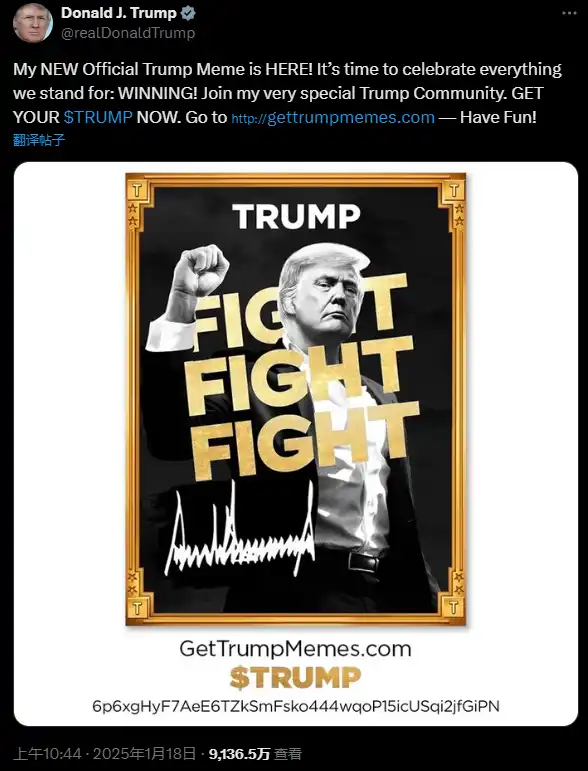
Initially, the market had doubts about this news, speculating that Trump's account might have been hacked. However, hours later, the post remained unaltered and without denial, and the TRUMP coin surged rapidly. Twelve hours after the token was launched, its trading price reached around $30, with a fully diluted valuation (FDV) of $300 billion. By 8 p.m. on January 19, Beijing time, according to CoinMarketCap data, the price of the TRUMP coin had risen to a peak of $85.2 within a day and a half of its launch, with a total circulating market cap of $852 billion. Trump's net worth soared by $68.16 billion (approximately 4.9893 trillion RMB), over ten times higher than before the coin launch. On the 19th, Binance, Coinbase, and OKX also announced the listing of TRUMP (OFFICIAL TRUMP) for spot trading. Aside from Trump and sol, which was used to purchase Trump, all other tokens experienced a sharp decline, with ETH dropping to a low of $3,127, down 12% from the early hours of the 18th. Other meme tokens, AI agent tokens, etc., all experienced varying degrees of decline.
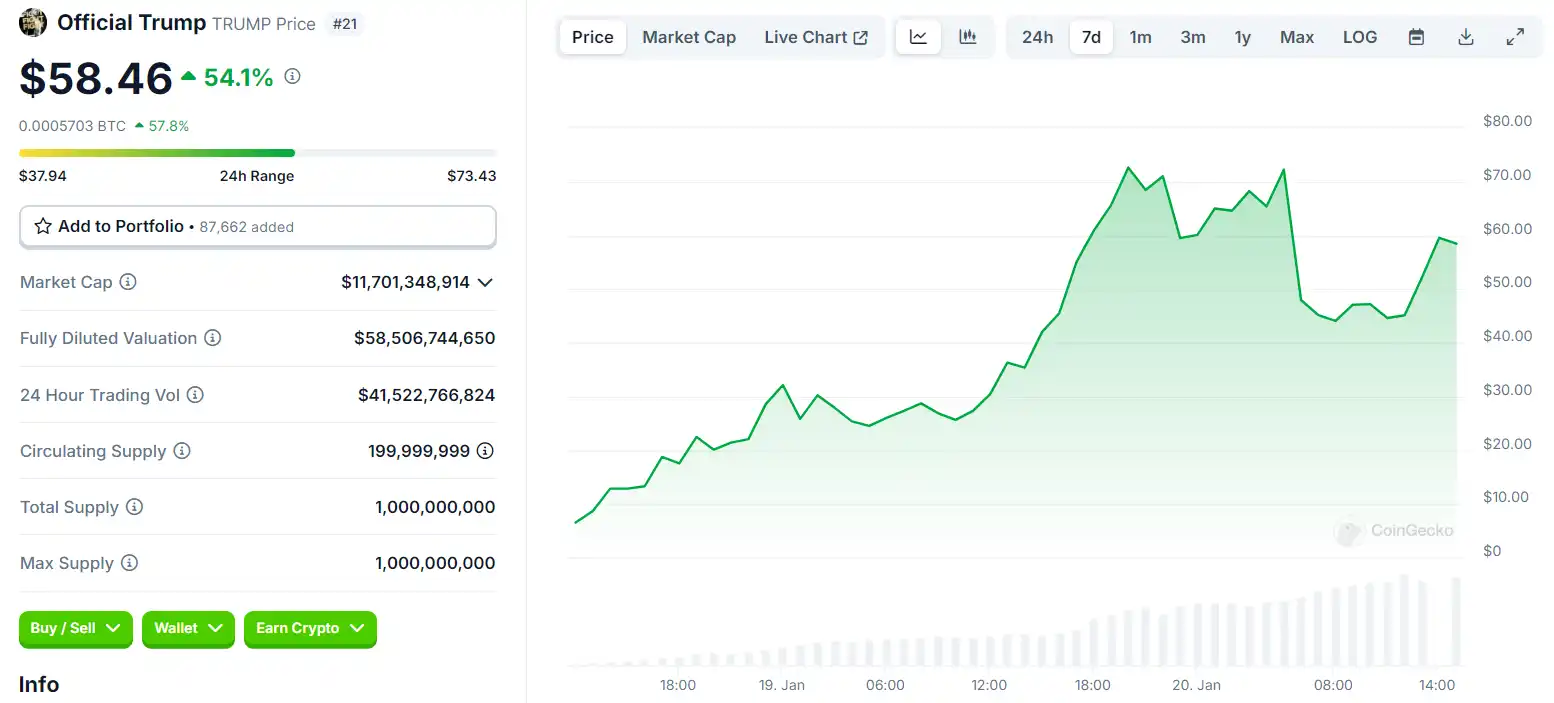
Image Source: CoinMarketCap
As $Trump was reaching the peak of his popularity and experiencing extreme FOMO, Trump's wife, Melania, also took advantage of the situation by launching her own cryptocurrency on the Solana blockchain, called MELANIA. On the 20th, Melania posted on social media, stating, "Melania Official Meme is live," along with a purchase link.
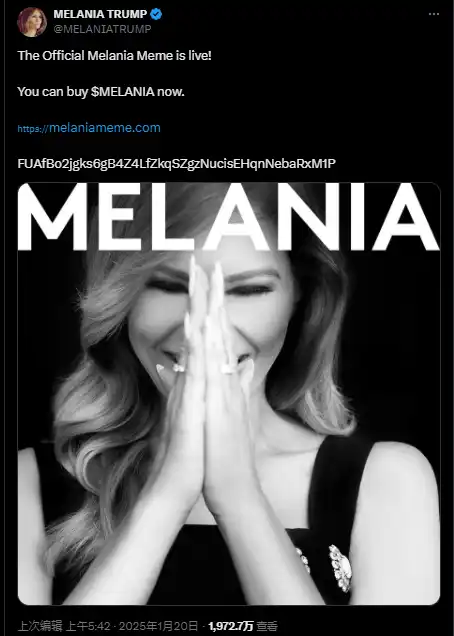
The Trump family's coin launch seemed to strike the market like a follow-the-leader move. While MELANIA surged to a market value of $120 amid the FOMO sentiment, all other coins experienced a sharp decline. TRUMP's market value plummeted from $75 billion to $35 billion, SOL dropped from $176 to $235, and Bitcoin saw a 6% drop in a short period. The crypto community angrily criticized the Trump family for treating cryptocurrency as their family's "ATM," blurring the line between governmental role and commercial interests. Many media outlets questioned the Trump family's coin issuance behavior and opposed and criticized this fundraising activity.
Riding the Hype While Holding the Bag: The Wealthy Asian Crypto Trader vs. the American Retail Investor Buying for Faith
Hu Xijin, former editor-in-chief of the Global Times in China, commented on Trump's coin launch, stating, "Capitalism! It turns out the presidency can be monetized this way! Mr. Trump has truly broadened my horizons as someone living in a socialist country." But perhaps what surprised this former professional media person even more was that, apart from the "pump and dump," the ones who profited the most from this presidential coin issuance were the Asian on-chain traders.
The chart below shows the TRUMP price trend based on US Eastern Time, with the coin's launch on Friday, January 17th at 9 p.m. From the chart, it can be observed that the significant price surges on January 18th and 19th mainly occurred during the Asian trading hours.
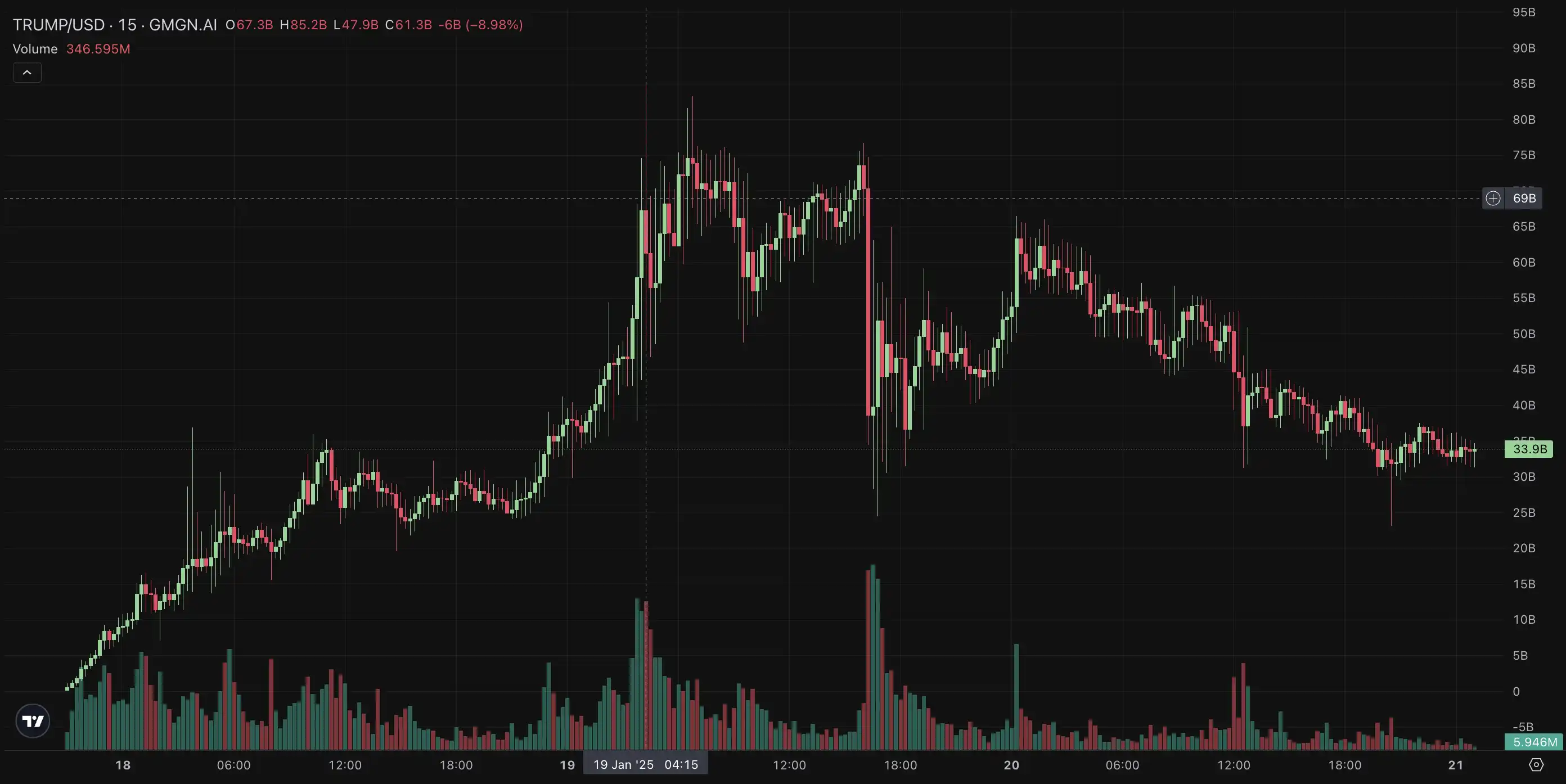
New York Time TRUMP Price Trend Chart
On January 18th, just one hour after the TRUMP coin launch and as its market cap crossed the $100 million mark, the community compiled a list of the top profit-taking addresses for TRUMP. It was found that 10 Chinese Key Opinion Leaders (KOLs) made profits exceeding $1 million each.
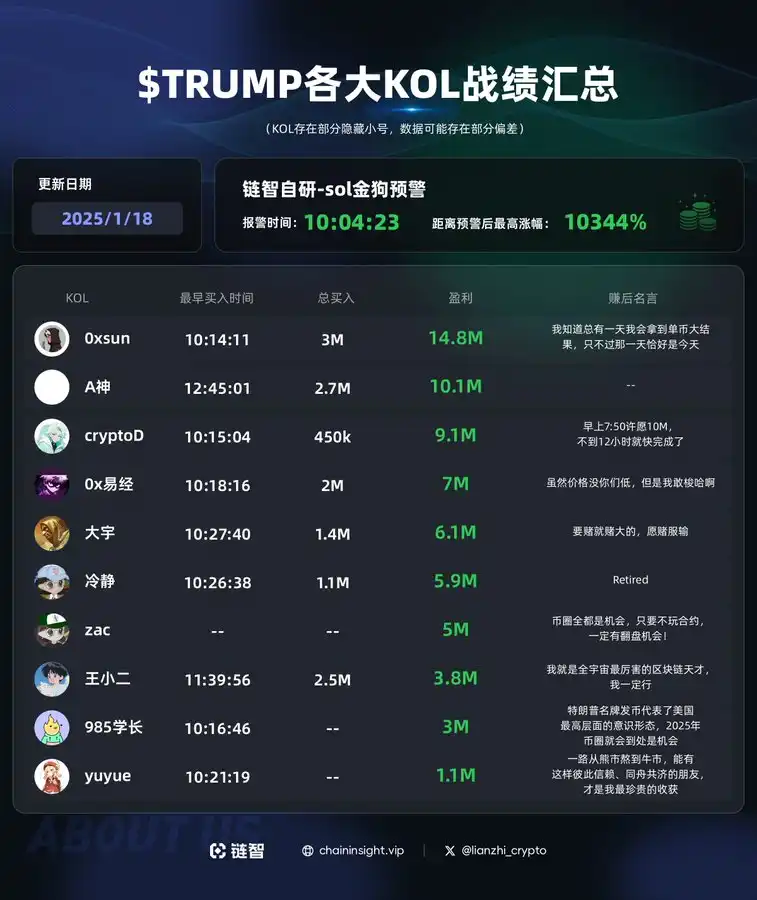
Image Source: ChainNews
When TRUMP's market cap rose to $15 billion, just 4 hours after the coin was launched, Chinese KOL 0xSun announced his TRUMP PnL on X, with a total cost of 3010 SOL and a profit of $10 million. A day later, 0xSun transferred TRUMP to a CEX and last updated his PnL, showing a profit of $27.5 million.
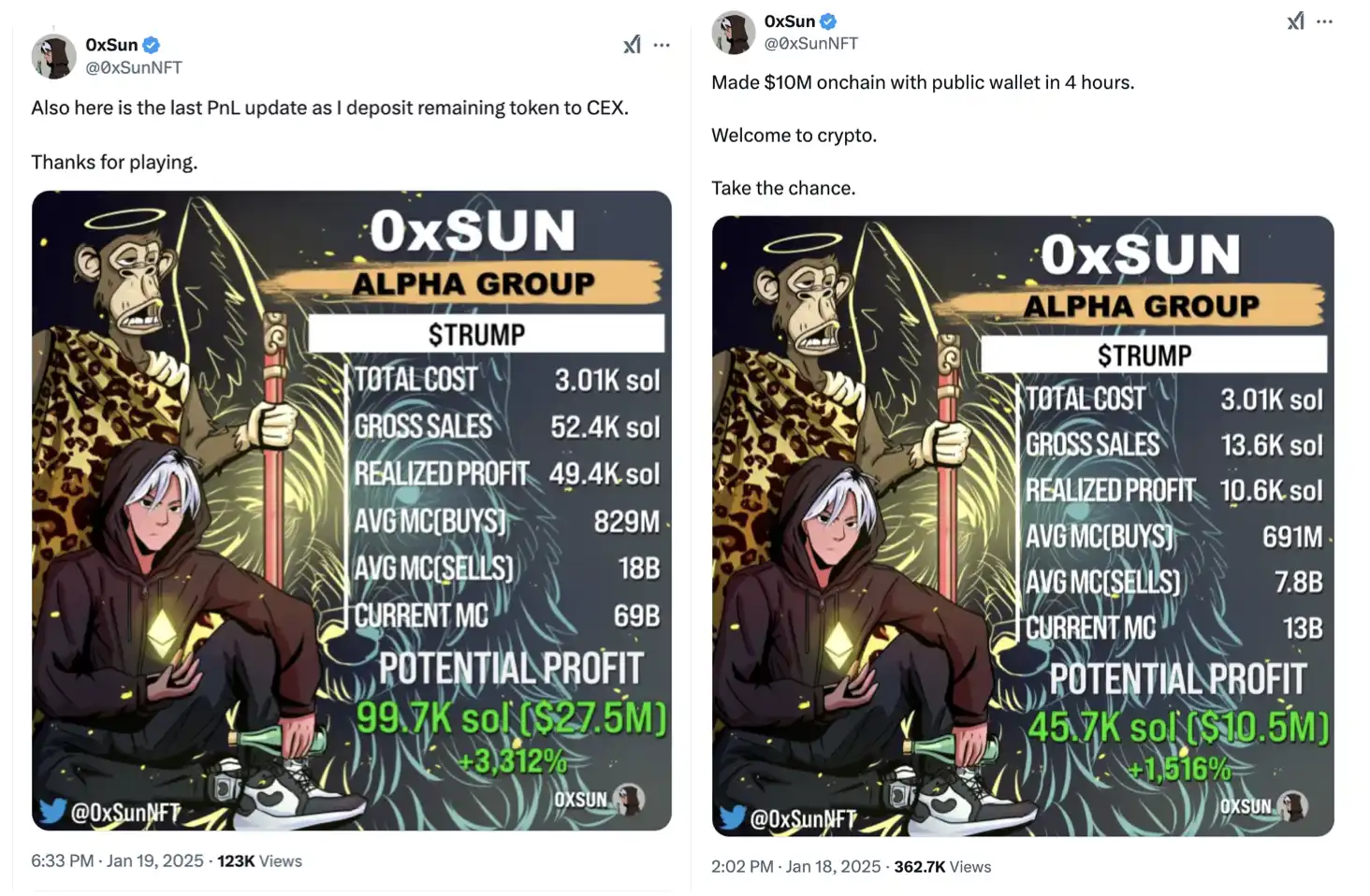
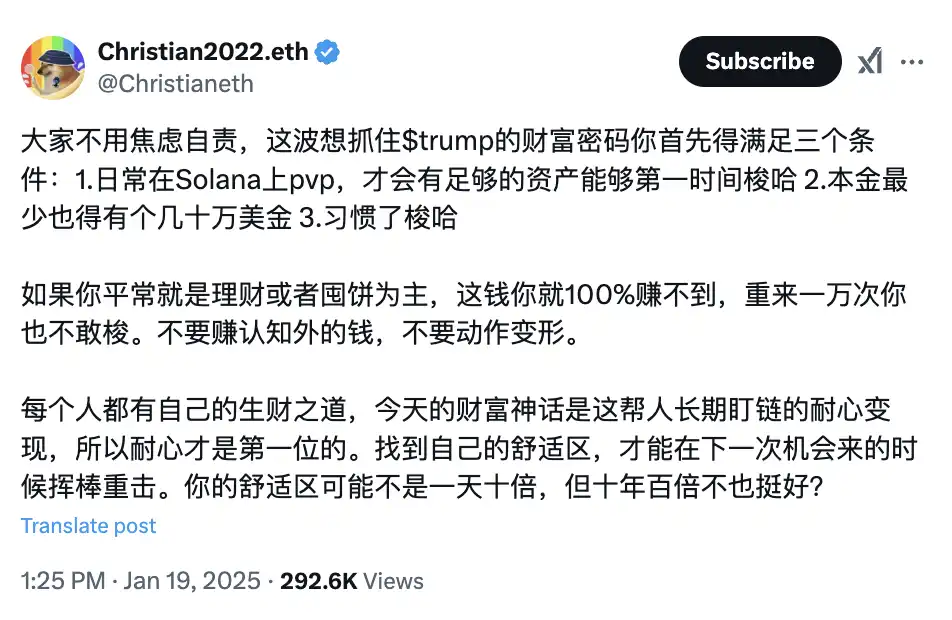
"It's been 4 hours, but also 3 years since I entered the circle and started living on the chain, sitting still for over 10 hours a day on average," 0xSun wrote in a tweet. As TRUMP's market cap soared past $30 billion, in the Chinese community, apart from astonishment and regret for not getting in at the bottom, some were also reflecting on why they missed this opportunity. Xinfini founder Christian provided an answer, stating that without a certain amount of initial capital and going all in at the first opportunity on the Solana chain, one could not achieve great results with TRUMP.
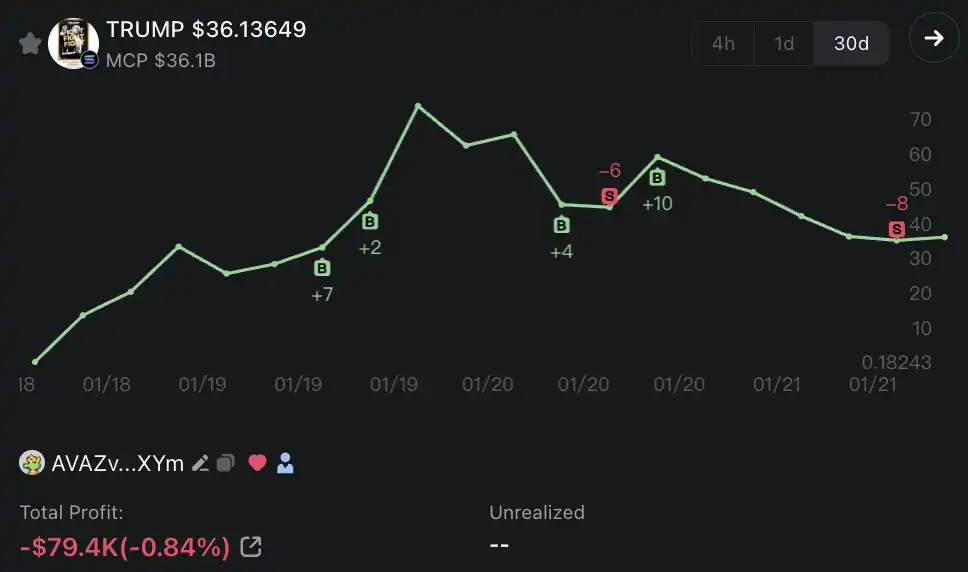
In contrast, the performance of U.S. retail investors appeared more passive. The number of open profit-taking positions in the English-speaking community on Trump's coin issuance was much lower, with even top meme KOL Ansem exiting at a loss.
The address marked as Ansem made a purchase on the morning of January 19th Beijing time, when TRUMP's market cap had already exceeded $30 billion. At that time, the U.S. cryptocurrency exchange Kraken had just launched TRUMP spot trading. On January 20th, as Robinhood announced support for TRUMP, Ansem further bought TRUMP, and on January 21st, Ansem sold all TRUMP, with a total loss kept within $80,000.
U.S. YouTuber voidzilla directly criticized in a video, saying, "This behavior is unprecedented in terms of stupidity and fraud, using the days leading up to the presidential inauguration to promote a hype project. Such a scam is simply mind-boggling. With only two days left until the inauguration, he should have been busy writing his inaugural speech instead of launching a meme coin. At a crucial moment in the presidential election, using power to hype like this not only breaks historical records but also blatantly tramples on all moral boundaries."
However, the President's brand was still irresistibly attractive to retail investors. Just on January 18, Moonshot added approximately 400,000 new users. Twitter was filled with posts about how to use Moonshot to purchase TRUMP, with some users even complaining about its complexity. In one discussion about the purchasing process, someone recommended using the Phantom wallet, to which another user replied, "I just wanted to deposit some cash or dollars, but it forces me to buy SOL, Bitcoin, or something like that."
Additionally, due to the inability of U.S. banks to process large deposits or fund transfers over the weekend, further restricting American investors' profits in TRUMP, the delayed fund flow caused U.S. retail investors to miss a crucial entry window, becoming liquidity providers in the later stages of the price surge.
On one hand, Asia-based traders who are always on-chain found the asset at the right time and heavily entered the market. On the other hand, the U.S. trading group had compliant channels for purchasing Moonshot combined with adoration for their national leader, causing them to overlook early chips and be willing to serve as exit liquidity for the President and whales.
How Much Money Did the Trump Family Make from the Cryptocurrency Market?
After Trump's wife, Melania, released a token under her name, the price of $Trump also plummeted from $78 to $35. With the news of $Trump being listed on RobinHOOD, the price rose again. The coordinated news and market-making activities in recent days make one sigh at the terrifying conspiracy of capital behind the scenes, quietly utilizing every exit liquidity to the fullest. This is not the first time the Trump team has made money in the blockchain field, but it is the most sensational. So, how much money did the Trump team make in the cryptocurrency field.
Cryptocurrency Political Donations
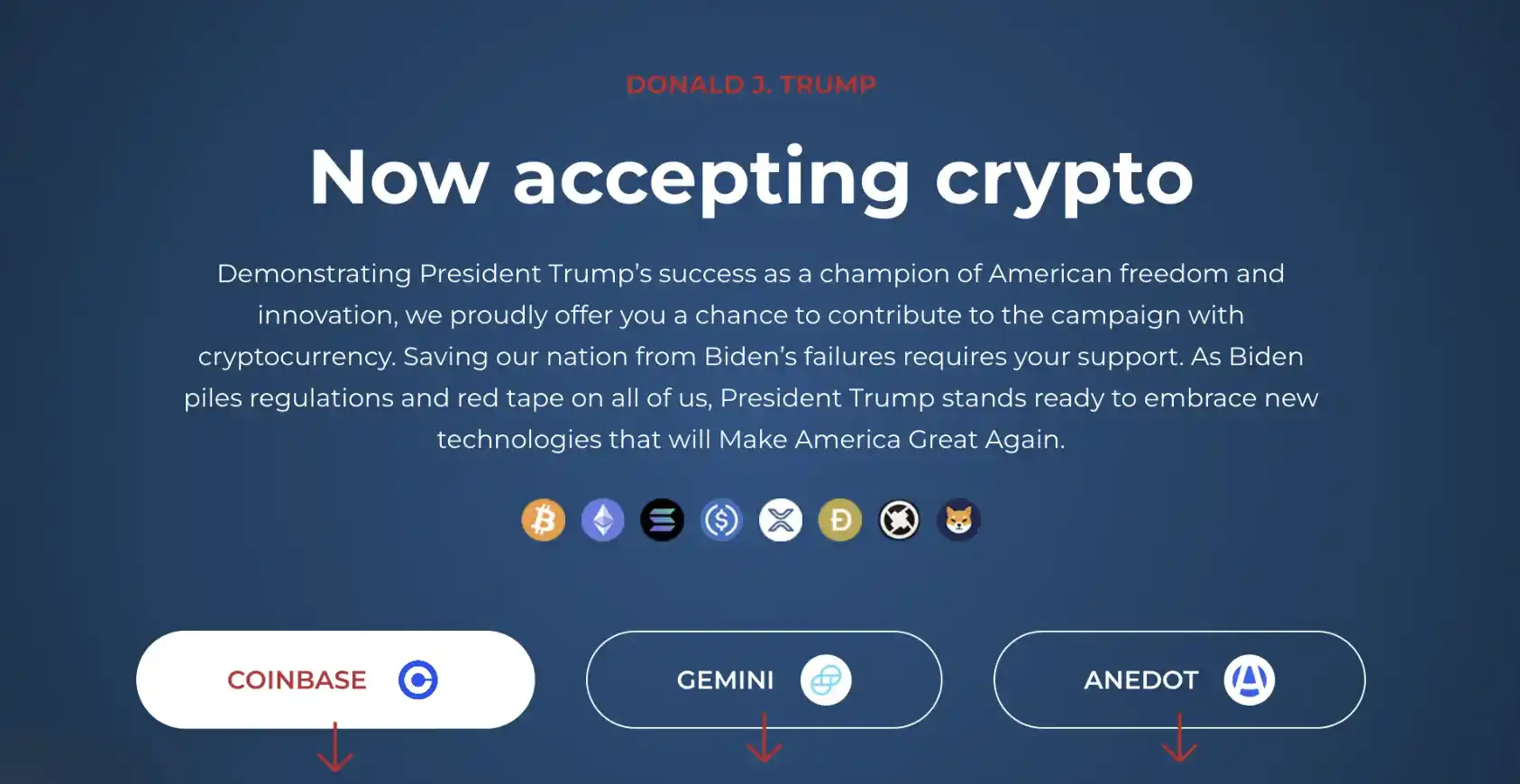
As the first president to accept cryptocurrency political donations, he unprecedentedly accepted not only BTC on his official website but also mainstream altcoins like ETH and SOL, as well as meme coins like Dogecoin. In the end, the value of cryptocurrency received exceeded $4 million, while his industry supporters in the crypto field also received millions in traditional investments.
Raking in $20 Million in NFTs was Just a Small Start
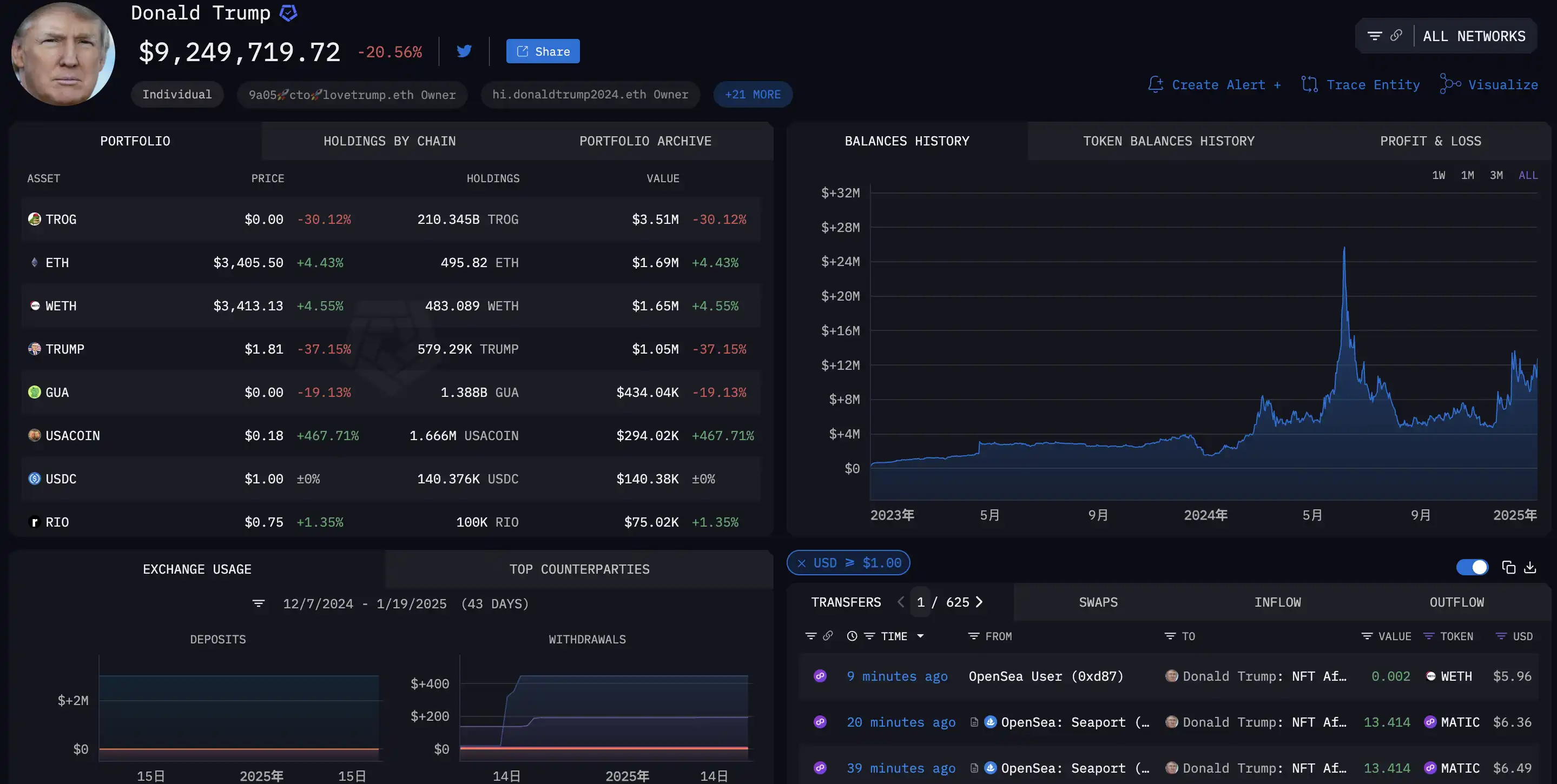
In December 2022, Trump announced the launch of the first set of Trump-themed NFTs. These trading cards featured Trump playing various roles, with a total of 45,000 cards priced at $99 each. Within 24 hours, the NFTs sold out, directly bringing Trump $4.5 million. This also allowed the then non-pro-cryptocurrency Trump to taste success. Similar products were released continuously by the Trump team on Polygon, including four series "one of which is a rare special edition," as well as a series on Bitcoin. The sale of nearly 200,000 Trump trading card NFTs and royalties brought the Trump team over $20 million in revenue.
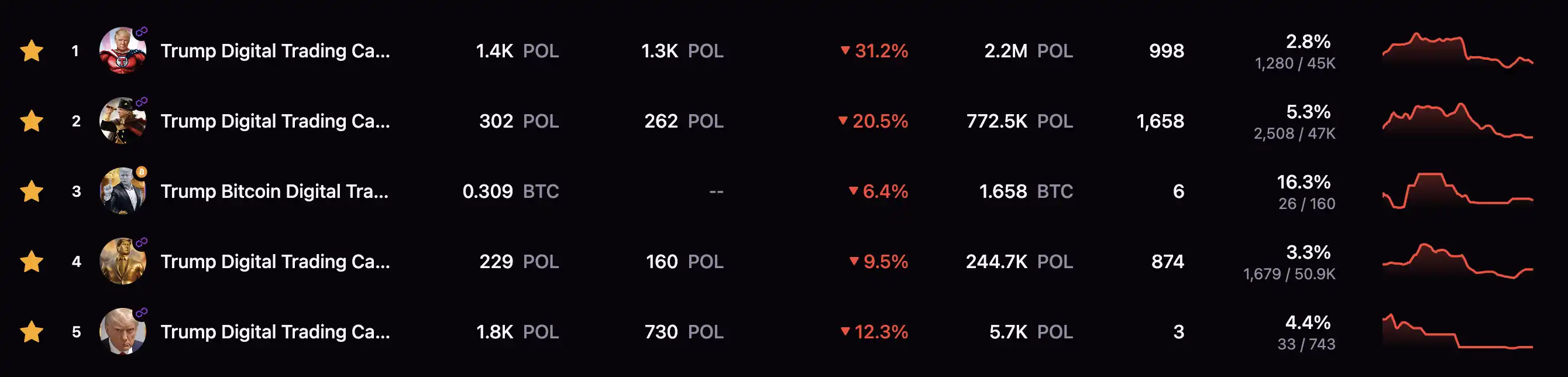
The key figure behind the scenes of this series is CIC Digital LLC, a company founded by former President Trump's lawyer John Marion and former advisor Nick Luna in 2021. The issuer of the "Trump Digital Trading Cards" NFT INT LLC stated on its website that it is an independent entity and that "NFT INT LLC" does not belong to, is not managed by, or under the control of Donald J. Trump. Instead, it obtained authorization to use Trump's name and likeness by purchasing it from CIC Digital LLC to create and sell this NFT series. However, upon further investigation of NFT INT LLC, their website lists a contact address at a UPS store in Park City, Utah, USA. However, the registered address is in Cheyenne, the capital of Wyoming, also known as the "American Little Cayman Islands," located approximately 480 kilometers away from Park City, indicating that this company is likely one of the many ghost companies.
《Trump's NFT 10x in 2 days, was the former president the issuer himself?》
Targeted Hunt for DeFi Newbies, $300M Not Enough to Fill the Gap
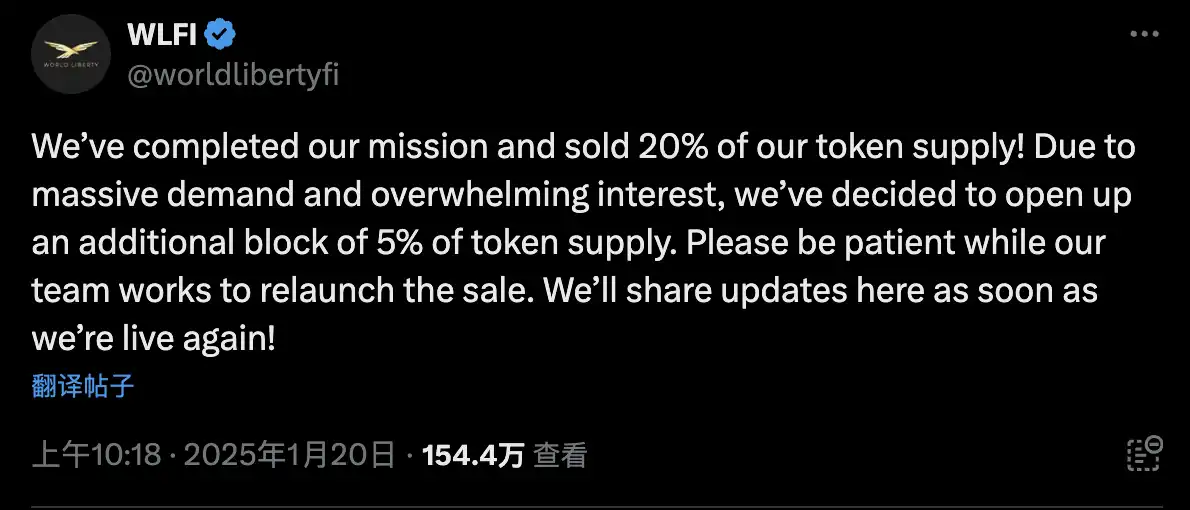
World Liberty Fi was jointly launched by former President Trump, Donald Trump Jr., and Eric Trump. Donald Trump Jr. emphasized that this is not just a meme coin but a project dedicated to providing top-notch decentralized financial and banking tools while strictly adhering to relevant regulations to ensure user safety. Interestingly, with the buzz surrounding Trump's $Trump Memecoin, the Trump family's DeFi project, World Liberty Financial (WLFI), sold out its 20 billion tokens in its public sale this morning at a price of $0.015 per token, raising a total of $300 million. Among the participants was Justin Sun, the owner of the well-known Tron chain, who contributed $30 million and announced an additional $45 million investment in the name of Tron DAO.
As the initially allocated 20% of the public sale was sold out, WLFI generously opened up an additional 5% allocation for the community to purchase. If this additional allocation is also filled, the on-chain address holding the $300 million could receive an additional $75 million.
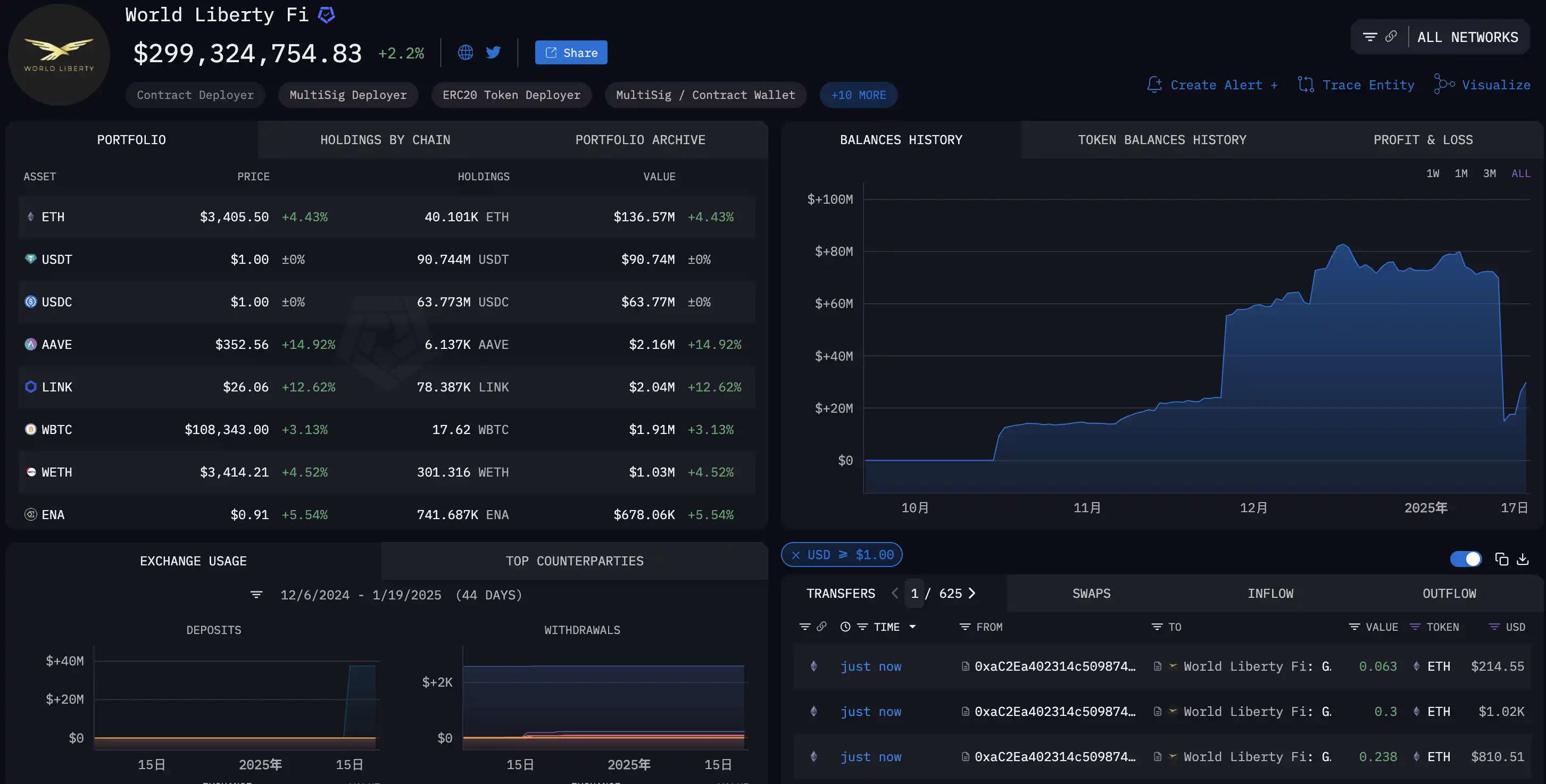
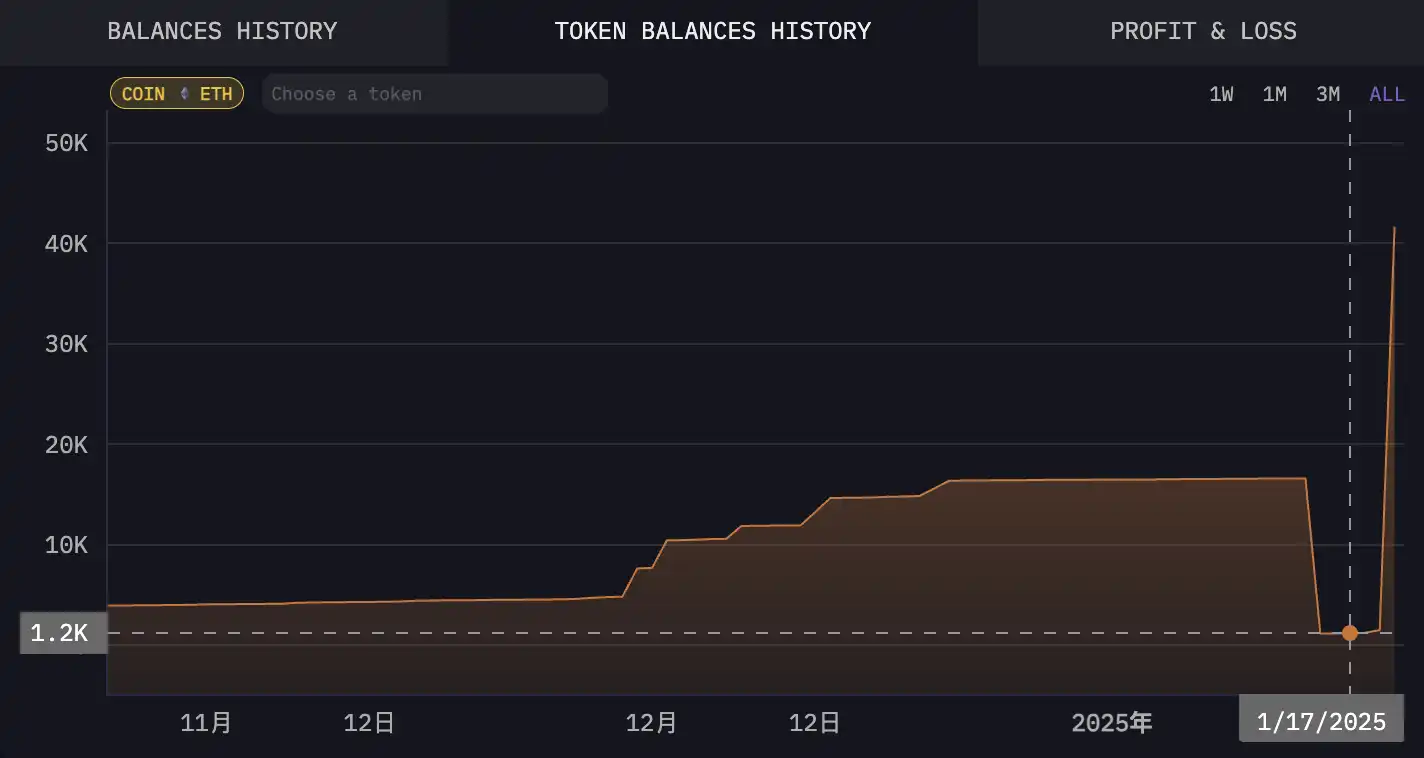
It is worth noting that WLFI, in the two days leading up to the $Trump launch, suddenly reduced its accumulation of nearly 17,000 Ethereum held in the address for months to 1,200 Ethereum "transferred to Coinbase or another address." This was followed by a significant depletion of on-chain assets during the $Trump vampire attack, as many ETH whales switched to Solana. Starting on the 19th, multiple purchases of Ethereum were made, and the current holdings have exceeded 42,000 Ethereum, executing a successful swing trade that turned Ethereum's losses into gains. This action also caused Ethereum to surpass one-third of the total assets held in that address.
The Ultimate Weapon, an unprecedented Crypto large-scale consolidation event
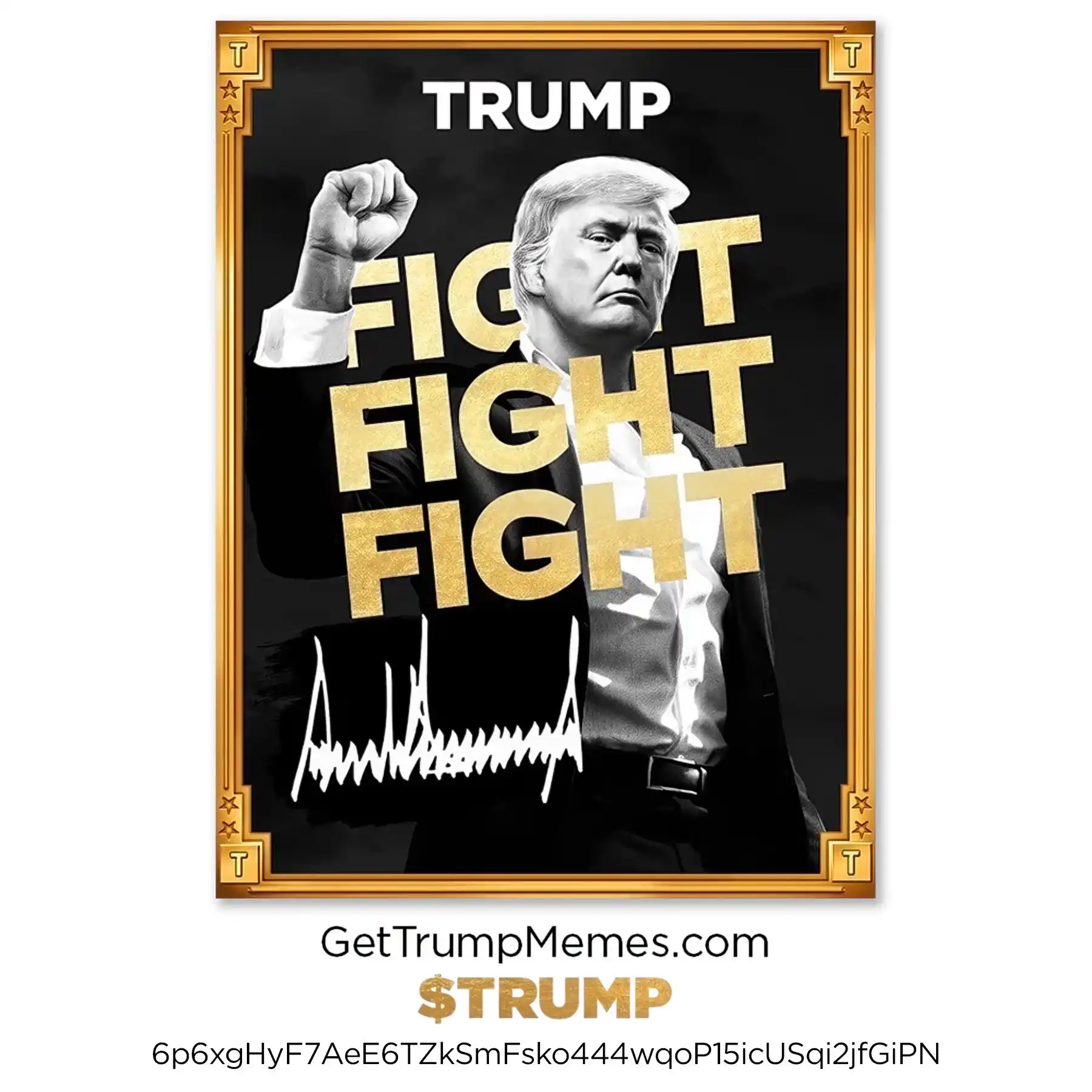
This is probably the chart you've seen the most in recent days: the US President launching a Memecoin. While it seemed impossible, the idea came to life with Trump, where the Trump family, having worked hard for three generations, finally amassed a family fortune of $4 billion. After releasing the Memecoin, the market capitalization reached $80 billion within two days, surpassing over a hundred years of struggle with just two days of global frenzy. At its peak, $Trump reached a market cap of $800 billion. Considering 20% of circulating supply, the actual market cap was $160 billion, but now it has dwindled to $60 billion. Additionally, the $10 billion of liquidity sucked in the market mostly vanished. Regardless of the market's reaction to the US President's influence, the impact of a single token on a market averaging $1 to $2 trillion is significant.
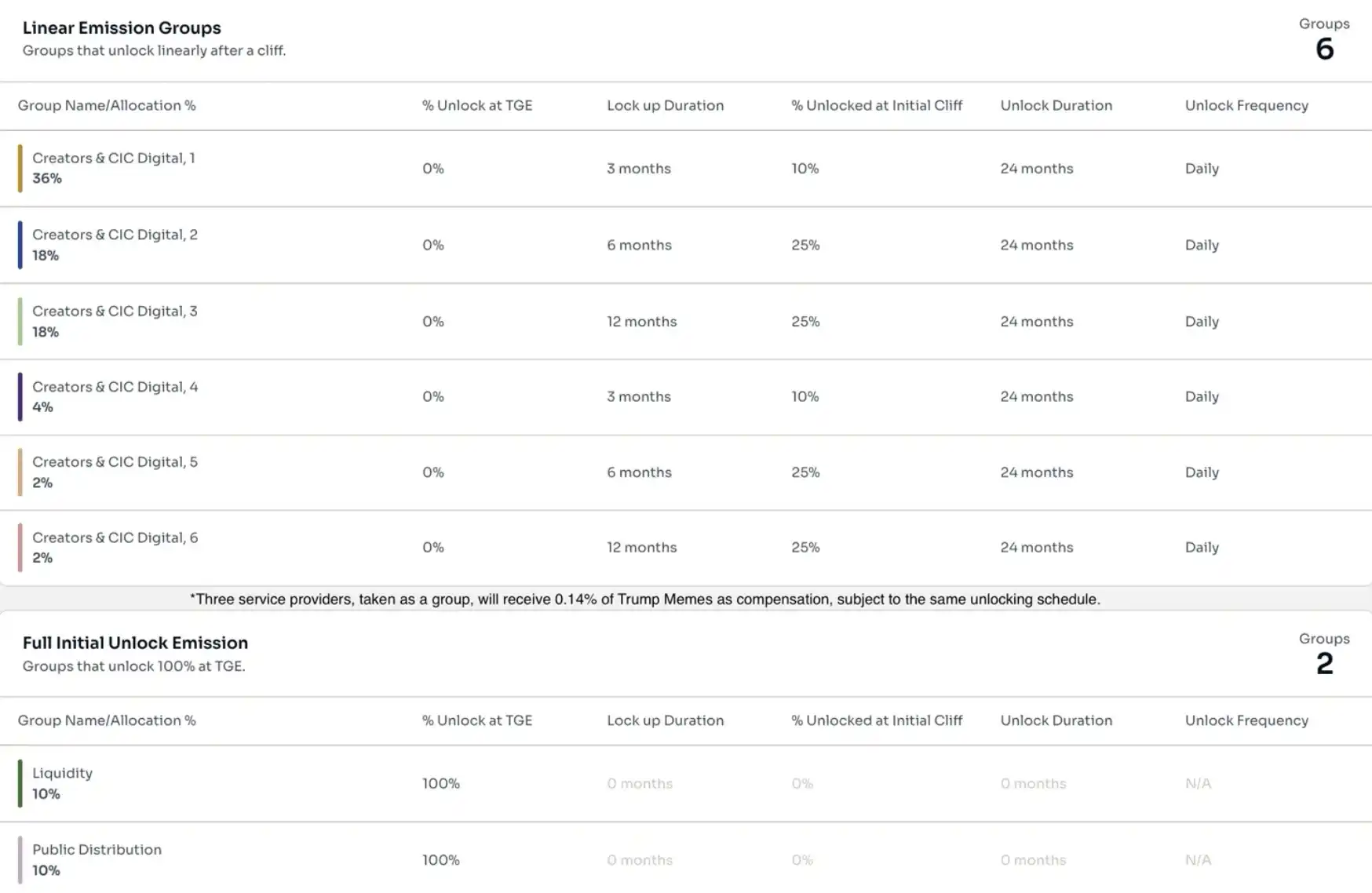
The entity responsible for the $Trump issuance is a company under the Trump family's umbrella, apart from the aforementioned Trump CIC Digital LLC, mainly known as Fight Fight Fight LLC. These two companies held 80% of the $Trump token allocation. While the total vesting period spans three years, the unlocking will occur in six phases, with the majority (40%) beginning to unlock in the third month. Although it is unknown how much insider traders benefited besides this 80%, based on the listing from Coinbase to Robinhood and the announcement by Moonshot that direct deposits from Robinhood are accepted, $Trump is likely to use the support of Trump's followers, funds from the traditional stock market, and plenty of newbies to sustain its hype and market cap for a considerable time. Thus, if 4% of the chips unlock after three months
Even if the market value is now half, it can still achieve a liquidity exit of tens of billions of dollars.
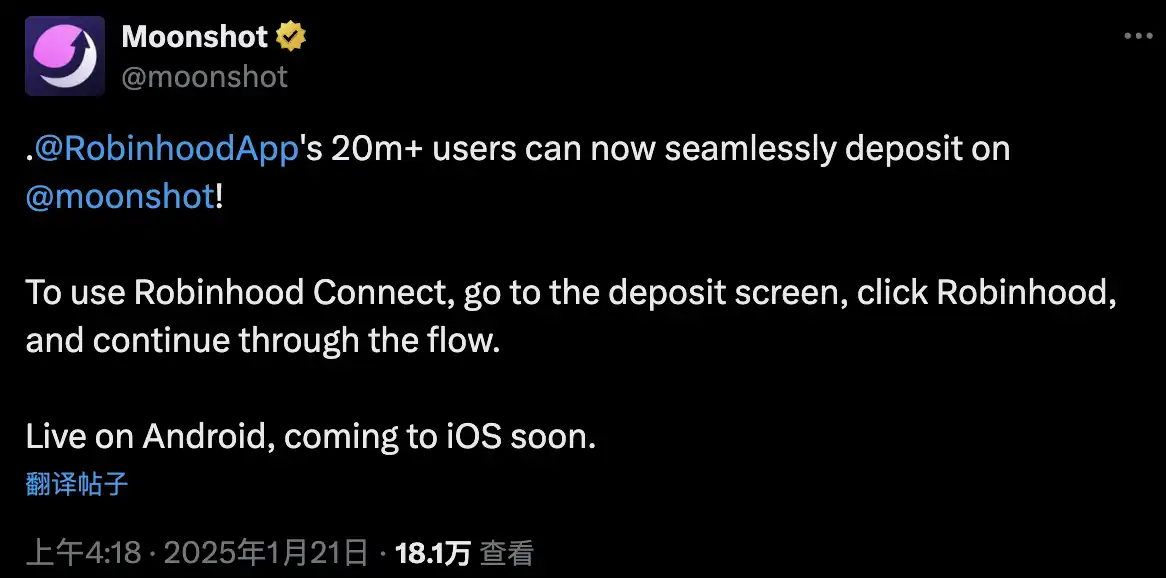
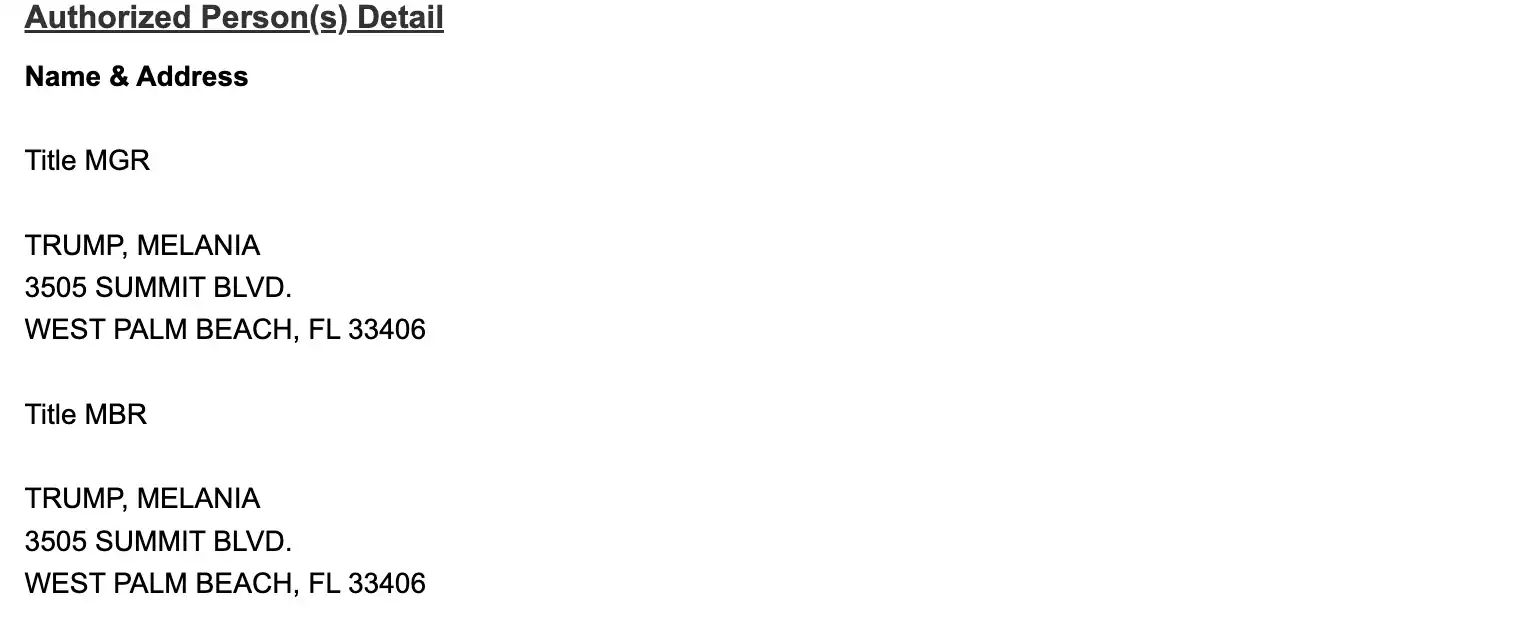
Meanwhile, the token of Trump's wife, the First Lady of the United States, $MELANIA, is similar to the token issued by Trump himself in that it is "unrelated" to Trump. The token is issued by MKT World, LLC, and information found in online records shows that Melania's position at the company is both a member and a manager. The company's address at 3505 SUMMIT BLVD. WEST PALM BEACH, FL 33406 is very close to the Trump family's residence in Florida.
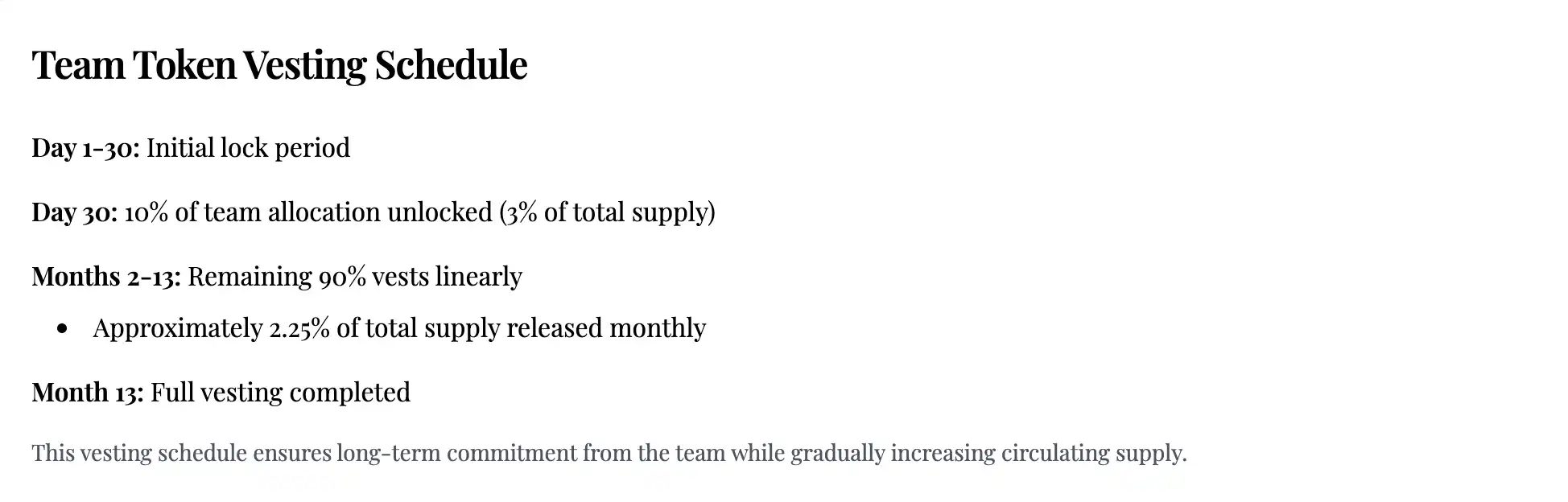
The tokenomics of $MELANIA are somewhat different from $TRUMP. Team share 35%, treasury 20%, community 20%, public issuance 15%, liquidity 10%. The biggest difference lies in the token unlock rules, where Trump's team share requires a 3-year lockup, but Melania's team only needs to lock up for 30 days. Starting from day 30, the team share will unlock 10% first, followed by a gradual linear unlock from months 2-13 until the end of the 13th month. This short-term and unclear chip allocation has caused the token's market value to plummet rapidly from $15 billion all the way down by 33 billion, almost only 20% of the peak. Such hasty token unlock rules and rapid declines resemble a meme coin. It inevitably raises speculation as to whether this is just a means for $Trump to shake out weak hands.
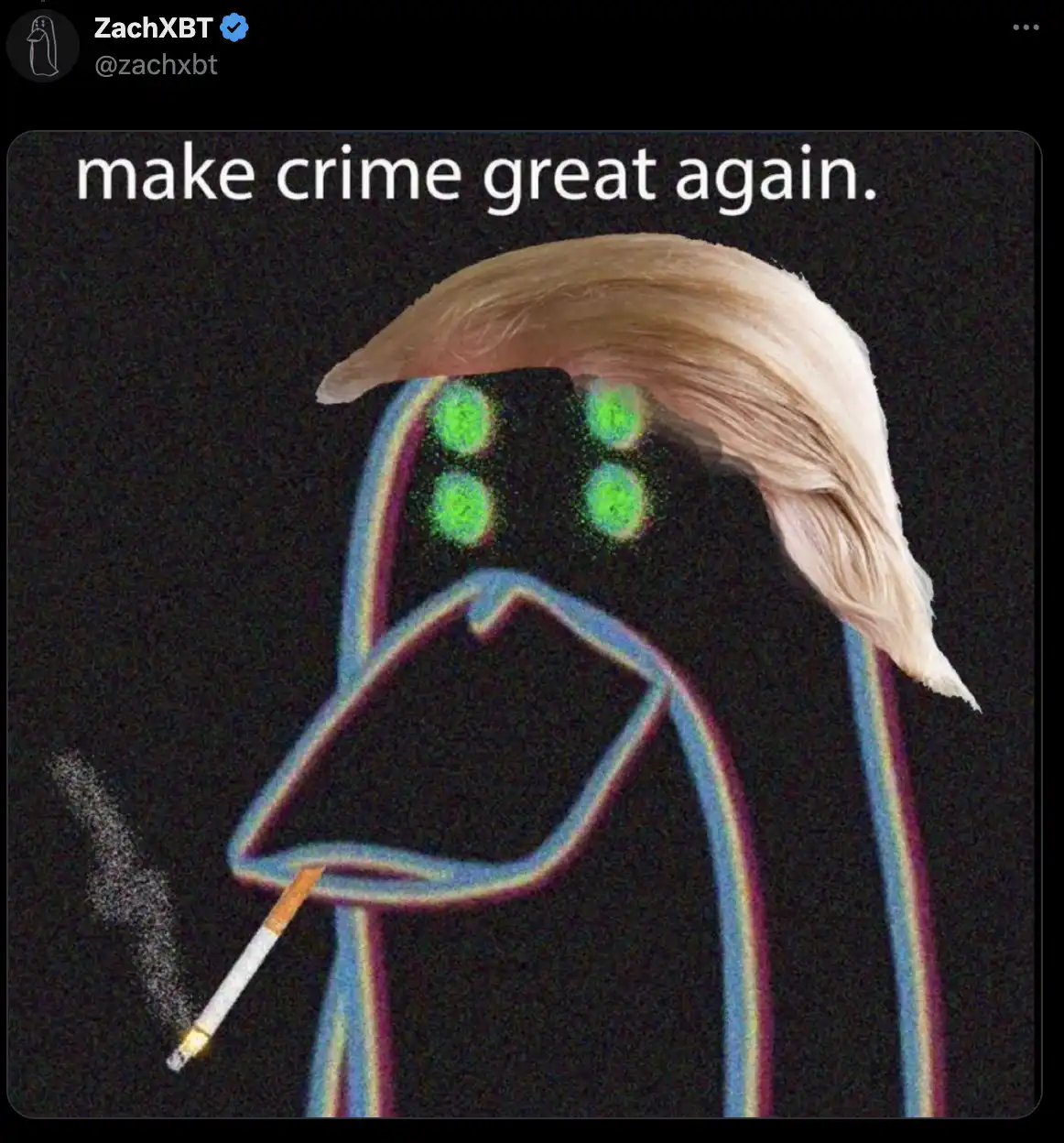
Regardless, the Trump team had retained some rationality in their accumulation until a few days ago. However, Trump's recent actions have left people stunned. Regardless of the numerous disclaimers or exploitation of legal loopholes, it is an undeniable fact that before taking office as the President of the United States to "Make America Great Again," he first aimed to "Make Crime Great Again."
Pro-China Cryptocurrency Group Starts a Fight, Is the "Trump Crypto Faction" Also Divided?
In fact, not everyone supports Trump's direct coin issuance behavior. Previously, the Trump team's NFT issuance to earn $20 million was considered relatively "mild," and many community members had not yet reacted.
However, today's nature is completely different. In order to circumvent presidential investment restrictions, on the eve of taking office in "Goose City," the Trump couple directly utilized coin issuance, locking up coins, and early high-point buy-in sell-off, allowing the entire interest group behind them to achieve "risk-free profits" at the fastest speed.
There can be many harvesters in the crypto world, but the one who cannot be is the President. Many have expressed strong concerns about this.
VC investor Nick Tomaino wrote on Platform X: "Trump holds 80% of Trump Coin and scheduled the issuance just a few days before the inauguration ceremony. This is undoubtedly a predatory act, and many people may be harmed as a result."
Anthony Scaramucci, a banker who briefly served as White House Communications Director during Trump's last term (fired after 10 days), also criticized on Platform X: "Trump meme coins are harmful to the cryptocurrency industry, and we cannot deceive ourselves."
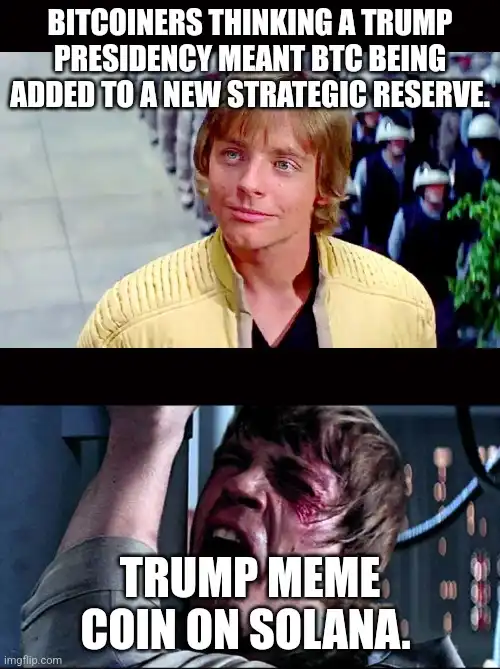
Image Source Community
More embarrassingly for the crypto world, initially, we made one political donation after another, we chanted "Fire Gary Gensler," we longed for a pro-crypto industry president, we hoped the crypto industry would receive more attention and liquidity.
Has it been achieved? Yes, it has. According to community and exchange platform staff, a well-known exchange platform usually had only a few hundred registered users and $700,000 in OTC transaction volume. However, on January 20, the number of registered users reached 120,000, and the OTC volume also reached $100 million. And the number of new user registrations on a top-tier exchange platform in three days also exceeded several million.
But the way it was achieved was not by treating Bitcoin as a U.S. national strategic reserve, not by approving a new batch of mainstream currencies through an ETF, not by enacting new crypto laws, but by launching meme coins that dried up most of the crypto world's liquidity.
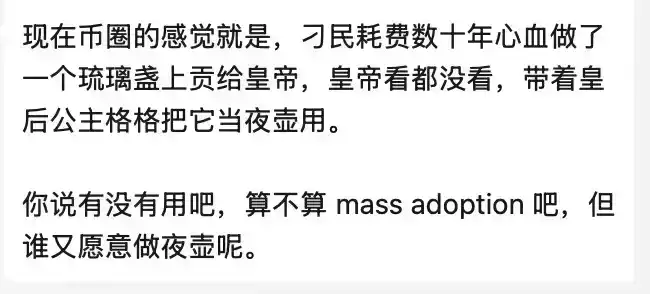
Image Source: Community WeChat
It is neither dignified nor ethical. Many in the crypto community who once supported Trump have now openly expressed their opposition.
"What he did is absolutely absurd." Nic Carter, founding partner of the cryptocurrency investment firm Castle Island Ventures, once publicly admitted to being a Trump supporter, but he still said, "Launching a meme coin to explore this is just plain stupid."
Even during the election period, the crypto-friendly media outlet Bitcoin Magazine, which had previously been pro-Trump, publicly referred to TRUMP as a shitcoin on social media.
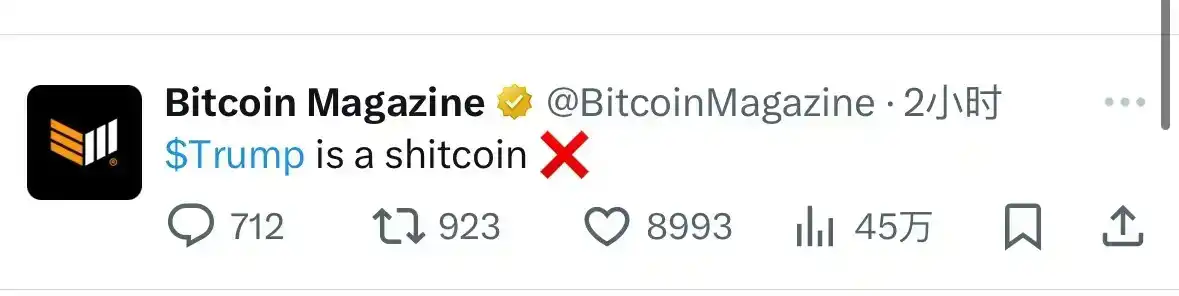
It is important to note that Trump was marketed as the "First Bitcoin President of the United States," and Bitcoin Magazine played a significant role in this. At the official Bitcoin 2024 conference hosted by the magazine, Trump took the stage to give a speech and announced the launch of a Bitcoin strategic reserve to ensure the U.S. becomes the world's crypto hub and a Bitcoin superpower. He also planned to dismiss the chairman of the U.S. Securities and Exchange Commission (SEC). Trump's crypto-friendly policies all began with this speech.
"In my view, this is nothing but a pump-and-dump, self-enrichment scam, an unethical act, and the investors involved (should I say 'fans') are extremely foolish." However, the authors of Bitcoin Magazine are now bluntly criticizing this. Related reading: "Bitcoin Magazine Criticizes $TRUMP: Trump Likes Cryptocurrency, as Long as It Can Be Used for Personal Gain"
The media's values are top-down, and although Bitcoin Magazine CEO David Bailey was a Trump campaign advisor in the past, he is said to be among the pro-Trump crypto community members who tried to dissuade Trump from launching a coin.
He has repeatedly clarified on social media, "I have no association with Trump's memecoin, was not informed in advance, and have no financial interest," and "My advice and advocacy are all beneficial to Bitcoin and the nation."
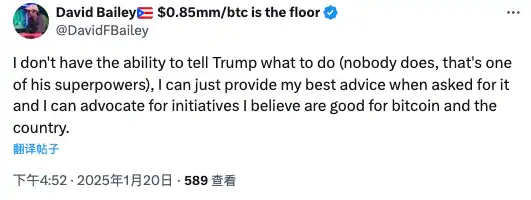
As a cryptocurrency advisor during the election period, David Bailey's current position is more like a lubricant between Trump and the community. Even though he doesn't agree with Trump's coin issuance plan, he still tries to appease the community: "I am very grateful for everything Trump has done for Bitcoin and the entire industry and everything he is going to do," "Events such as Ross's release will be realized," "I will continue to do my best to support the President and his family's acceptance of Bitcoin and provide honest advice when needed"...
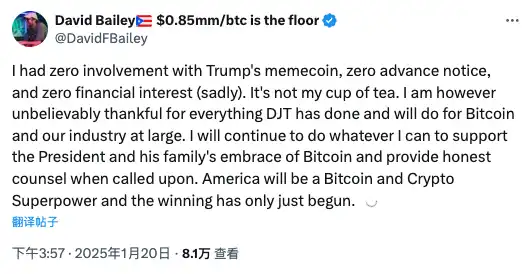
This also means that now the cryptos around Trump have split into two factions in terms of ideology.
One faction is Bitcoin Magazine, while the other faction opposite to Bitcoin Magazine is commonly referred to as the "Crypto Committee," whose members are personally appointed by Trump.
The chairman of the Crypto Committee is David Sacks, known as one of the founders of PayPal, who later became famous by creating Yammer and selling it to Microsoft for $1.2 billion. In the crypto circle, David Sacks' most important identity is as an investor in the crypto venture capital firm Multicoin and a Solana maximalist.
"One of the dumbest attacks against me this year is to say that I dumped SOL tokens on retail. If that were true, they should be rolling in money now. Congratulations to all SOL holders." Even when FTX blew up, Sacks never sold SOL.
Since $TRUMP is deployed on the Solana chain and when Trump issued $TRUMP coins, David Sacks has always remained silent on these "zero-sum meme coins." Therefore, many people believe that the chairman of the Crypto Committee was involved.
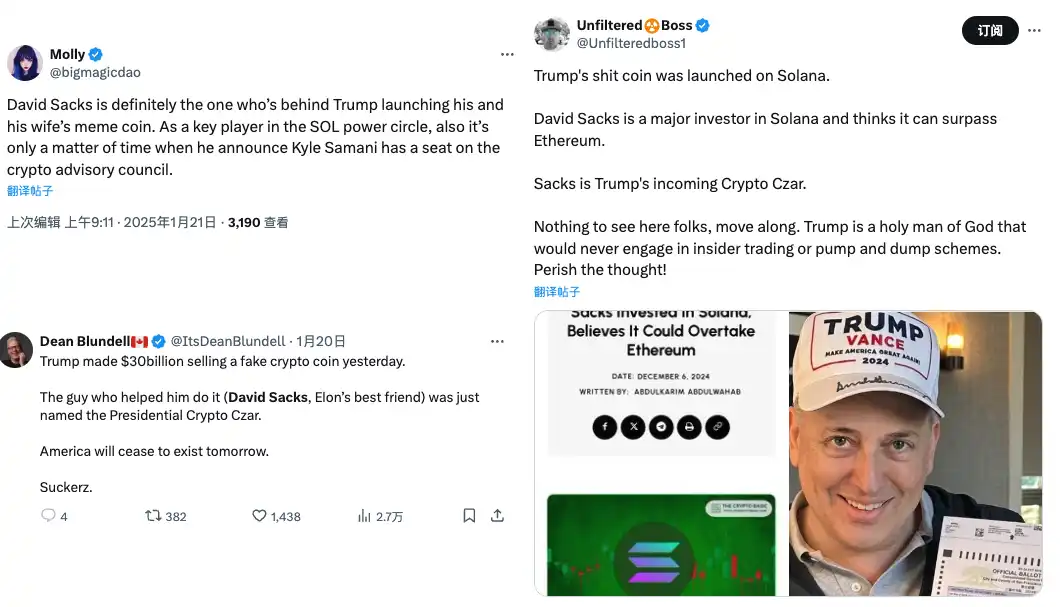
Another piece of evidence is that David Sacks has a "criminal record." In March 2024, David Sacks once posted about a memecoin named $Sacks after his own name.
Although when people started buying, he tweeted nine times telling them not to buy, this has already confirmed the evidence that he "once issued a coin," which is exactly the same as the $TRUMP coin issuance method. (According to community feedback, David Sacks recently deleted his posts about $Sacks.)
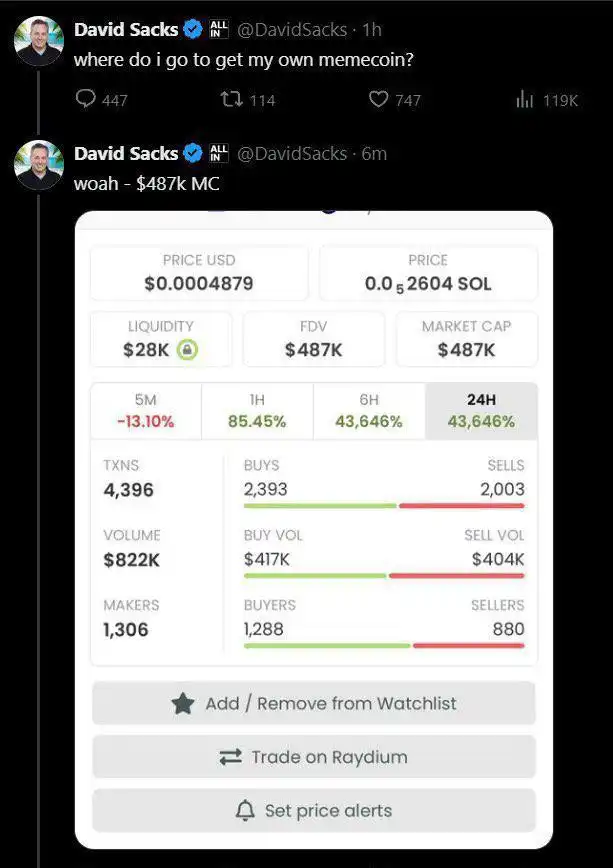
Image Source Community
This has made many people start to dislike David Sacks, feeling that his approach is too hasty and overly eager to profit through this aggressive means. Even if Sacks did not directly participate, as the chair of the Crypto Council, he should still be held responsible for this incident. There are even rumors that some have suggested that the entire leadership of David Sacks' Crypto Council be replaced with a new team.
According to a Washington cryptocurrency influencer who preferred to remain anonymous, almost everyone in the crypto field is currently vying for a seat on this council. Many crypto giants like a16z, Coinbase, Paradigm, Ripple, Kraken, and Circle are very interested in this, seeking to have a say in reforming U.S. crypto policy.
After all, the ordinary member seats on this Crypto Council are all very coveted positions, with David Sacks' words and actions as the council chair being crucial.
This is not the first time the Trump team has shown an unstable state. During the previous presidential term, there was a great deal of internal factional struggle and turnover within the Trump administration, with resignations being commonplace.
In addition to the competition for seats on the Crypto Council, in this term, the Trump team's internal political risk is also evident in other aspects.
Although not naming names, Messari founder Ryan Selkis tweeted urging Trump to dismiss the individuals behind the $MELANIA project. "The project team lacks expertise, may cause significant economic and reputational damage, and the project decisions do not adequately consider Trump's interests." Selkis pointed out the issues with $MELANIA.
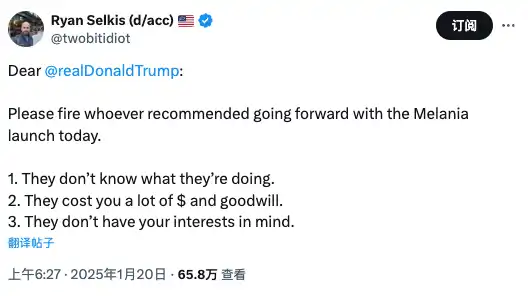
Compared to the $TRUMP coin, the launch of Melania Trump's $MELANIA was indeed more hasty. The front-end code is incomplete, the images were not compressed, the website was only built the day before the project's launch, and the legal text is also not precise. Many netizens speculate that $MELANIA and $TRUMP have many differences in their approaches, possibly not operated by the same team.
「If my source is not mistaken, $TRUMP was propelled by the Crypto Tsar, while $MELANIA was created by the worldliberty team. However, it can be assured that these two coins were not created by the same team.」 More than one community member revealed.
The Erosion of Trust, How Long Does It Take?
TRUMP emerged during the time when Trump was about to take office, originally a shocking event that stunned the world and exhilarated the cryptocurrency community. We have always hoped that cryptocurrency could demonstrate a more compliant, stable, and secure image to the world, and under such aspirations, $TRUMP carried too many expectations of the cryptocurrency community—it emerged from the hands of the soon-to-be U.S. president, and who could not imagine that this would be the beginning of the new U.S. government further embracing cryptocurrency? How much new attention could this beginning attract to cryptocurrency with a historical positive image?
TRUMP emerged from Trump's hand, but unfortunately, it did not come from the hand of the "U.S. President" Trump, but from the hand of the "Businessman" Trump. The "U.S. President" Trump had the ability to issue and promote $TRUMP and even the entire cryptocurrency market with higher ethical standards and more comprehensive legal compliance standards, but the "Businessman" Trump displayed blatant greed and disregard for ethics, treating the cryptocurrency market as a cash cow for his own influence, eagerly issuing asset after asset to seize more benefits.
In the end, Trump only mentioned the cryptocurrency industry for votes. Did he really consider how to better promote the industry's development? What we have seen is a "big shot" who is completely self-centered, disregards basic industry rules and ethics, and considers himself superior to the entire cryptocurrency market. In Trump's eyes, the cryptocurrency market may not be much different from setting up a stall in front of his own house. As long as someone is willing to pay for his influence, he might think, what's wrong with his actions, and what's not right?
Melania's issuance of coins has become a helpless self-mockery within the cryptocurrency community—Trump and his family are mocking how foolish our unrealistic expectations are.
From a speculator's perspective, this is certainly a speculative heyday, with no better narrative and sense of predestination. But is it really good for the industry?
What Trump will lose is not only the trust of the cryptocurrency community in him but also the moral integrity and responsibility of a U.S. president.
You may also like

Token Cannot Compound, Where Is the Real Investment Opportunity?

February 6th Market Key Intelligence, How Much Did You Miss?

China's Central Bank and Eight Other Departments' Latest Regulatory Focus: Key Attention to RWA Tokenized Asset Risk
Foreword: Today, the People's Bank of China's website published the "Notice of the People's Bank of China, National Development and Reform Commission, Ministry of Industry and Information Technology, Ministry of Public Security, State Administration for Market Regulation, China Banking and Insurance Regulatory Commission, China Securities Regulatory Commission, State Administration of Foreign Exchange on Further Preventing and Dealing with Risks Related to Virtual Currency and Others (Yinfa [2026] No. 42)", the latest regulatory requirements from the eight departments including the central bank, which are basically consistent with the regulatory requirements of recent years. The main focus of the regulation is on speculative activities such as virtual currency trading, exchanges, ICOs, overseas platform services, and this time, regulatory oversight of RWA has been added, explicitly prohibiting RWA tokenization, stablecoins (especially those pegged to the RMB). The following is the full text:
To the people's governments of all provinces, autonomous regions, and municipalities directly under the Central Government, the Xinjiang Production and Construction Corps:
Recently, there have been speculative activities related to virtual currency and Real-World Assets (RWA) tokenization, disrupting the economic and financial order and jeopardizing the property security of the people. In order to further prevent and address the risks related to virtual currency and Real-World Assets tokenization, effectively safeguard national security and social stability, in accordance with the "Law of the People's Republic of China on the People's Bank of China," "Law of the People's Republic of China on Commercial Banks," "Securities Law of the People's Republic of China," "Law of the People's Republic of China on Securities Investment Funds," "Law of the People's Republic of China on Futures and Derivatives," "Cybersecurity Law of the People's Republic of China," "Regulations of the People's Republic of China on the Administration of Renminbi," "Regulations on Prevention and Disposal of Illegal Fundraising," "Regulations of the People's Republic of China on Foreign Exchange Administration," "Telecommunications Regulations of the People's Republic of China," and other provisions, after reaching consensus with the Cyberspace Administration of China, the Supreme People's Court, and the Supreme People's Procuratorate, and with the approval of the State Council, the relevant matters are notified as follows:
(I) Virtual currency does not possess the legal status equivalent to fiat currency. Virtual currencies such as Bitcoin, Ether, Tether, etc., have the main characteristics of being issued by non-monetary authorities, using encryption technology and distributed ledger or similar technology, existing in digital form, etc. They do not have legal tender status, should not and cannot be circulated and used as currency in the market.
The business activities related to virtual currency are classified as illegal financial activities. The exchange of fiat currency and virtual currency within the territory, exchange of virtual currencies, acting as a central counterparty in buying and selling virtual currencies, providing information intermediary and pricing services for virtual currency transactions, token issuance financing, and trading of virtual currency-related financial products, etc., fall under illegal financial activities, such as suspected illegal issuance of token vouchers, unauthorized public issuance of securities, illegal operation of securities and futures business, illegal fundraising, etc., are strictly prohibited across the board and resolutely banned in accordance with the law. Overseas entities and individuals are not allowed to provide virtual currency-related services to domestic entities in any form.
A stablecoin pegged to a fiat currency indirectly fulfills some functions of the fiat currency in circulation. Without the consent of relevant authorities in accordance with the law and regulations, any domestic or foreign entity or individual is not allowed to issue a RMB-pegged stablecoin overseas.
(II)Tokenization of Real-World Assets refers to the use of encryption technology and distributed ledger or similar technologies to transform ownership rights, income rights, etc., of assets into tokens (tokens) or other interests or bond certificates with token (token) characteristics, and carry out issuance and trading activities.
Engaging in the tokenization of real-world assets domestically, as well as providing related intermediary, information technology services, etc., which are suspected of illegal issuance of token vouchers, unauthorized public offering of securities, illegal operation of securities and futures business, illegal fundraising, and other illegal financial activities, shall be prohibited; except for relevant business activities carried out with the approval of the competent authorities in accordance with the law and regulations and relying on specific financial infrastructures. Overseas entities and individuals are not allowed to illegally provide services related to the tokenization of real-world assets to domestic entities in any form.
(III) Inter-agency Coordination. The People's Bank of China, together with the National Development and Reform Commission, the Ministry of Industry and Information Technology, the Ministry of Public Security, the State Administration for Market Regulation, the China Banking and Insurance Regulatory Commission, the China Securities Regulatory Commission, the State Administration of Foreign Exchange, and other departments, will improve the work mechanism, strengthen coordination with the Cyberspace Administration of China, the Supreme People's Court, and the Supreme People's Procuratorate, coordinate efforts, and overall guide regions to carry out risk prevention and disposal of virtual currency-related illegal financial activities.
The China Securities Regulatory Commission, together with the National Development and Reform Commission, the Ministry of Industry and Information Technology, the Ministry of Public Security, the People's Bank of China, the State Administration for Market Regulation, the China Banking and Insurance Regulatory Commission, the State Administration of Foreign Exchange, and other departments, will improve the work mechanism, strengthen coordination with the Cyberspace Administration of China, the Supreme People's Court, and the Supreme People's Procuratorate, coordinate efforts, and overall guide regions to carry out risk prevention and disposal of illegal financial activities related to the tokenization of real-world assets.
(IV) Strengthening Local Implementation. The people's governments at the provincial level are overall responsible for the prevention and disposal of risks related to virtual currencies and the tokenization of real-world assets in their respective administrative regions. The specific leading department is the local financial regulatory department, with participation from branches and dispatched institutions of the State Council's financial regulatory department, telecommunications regulators, public security, market supervision, and other departments, in coordination with cyberspace departments, courts, and procuratorates, to improve the normalization of the work mechanism, effectively connect with the relevant work mechanisms of central departments, form a cooperative and coordinated working pattern between central and local governments, effectively prevent and properly handle risks related to virtual currencies and the tokenization of real-world assets, and maintain economic and financial order and social stability.
(5) Enhanced Risk Monitoring. The People's Bank of China, China Securities Regulatory Commission, National Development and Reform Commission, Ministry of Industry and Information Technology, Ministry of Public Security, State Administration of Foreign Exchange, Cyberspace Administration of China, and other departments continue to improve monitoring techniques and system support, enhance cross-departmental data analysis and sharing, establish sound information sharing and cross-validation mechanisms, promptly grasp the risk situation of activities related to virtual currency and real-world asset tokenization. Local governments at all levels give full play to the role of local monitoring and early warning mechanisms. Local financial regulatory authorities, together with branches and agencies of the State Council's financial regulatory authorities, as well as departments of cyberspace and public security, ensure effective connection between online monitoring, offline investigation, and fund tracking, efficiently and accurately identify activities related to virtual currency and real-world asset tokenization, promptly share risk information, improve early warning information dissemination, verification, and rapid response mechanisms.
(6) Strengthened Oversight of Financial Institutions, Intermediaries, and Technology Service Providers. Financial institutions (including non-bank payment institutions) are prohibited from providing account opening, fund transfer, and clearing services for virtual currency-related business activities, issuing and selling financial products related to virtual currency, including virtual currency and related financial products in the scope of collateral, conducting insurance business related to virtual currency, or including virtual currency in the scope of insurance liability. Financial institutions (including non-bank payment institutions) are prohibited from providing custody, clearing, and settlement services for unauthorized real-world asset tokenization-related business and related financial products. Relevant intermediary institutions and information technology service providers are prohibited from providing intermediary, technical, or other services for unauthorized real-world asset tokenization-related businesses and related financial products.
(7) Enhanced Management of Internet Information Content and Access. Internet enterprises are prohibited from providing online business venues, commercial displays, marketing, advertising, or paid traffic diversion services for virtual currency and real-world asset tokenization-related business activities. Upon discovering clues of illegal activities, they should promptly report to relevant departments and provide technical support and assistance for related investigations and inquiries. Based on the clues transferred by the financial regulatory authorities, the cyberspace administration, telecommunications authorities, and public security departments should promptly close and deal with websites, mobile applications (including mini-programs), and public accounts engaged in virtual currency and real-world asset tokenization-related business activities in accordance with the law.
(8) Strengthened Entity Registration and Advertisement Management. Market supervision departments strengthen entity registration and management, and enterprise and individual business registrations must not contain terms such as "virtual currency," "virtual asset," "cryptocurrency," "crypto asset," "stablecoin," "real-world asset tokenization," or "RWA" in their names or business scopes. Market supervision departments, together with financial regulatory authorities, legally enhance the supervision of advertisements related to virtual currency and real-world asset tokenization, promptly investigating and handling relevant illegal advertisements.
(IX) Continued Rectification of Virtual Currency Mining Activities. The National Development and Reform Commission, together with relevant departments, strictly controls virtual currency mining activities, continuously promotes the rectification of virtual currency mining activities. The people's governments of various provinces take overall responsibility for the rectification of "mining" within their respective administrative regions. In accordance with the requirements of the National Development and Reform Commission and other departments in the "Notice on the Rectification of Virtual Currency Mining Activities" (NDRC Energy-saving Building [2021] No. 1283) and the provisions of the "Guidance Catalog for Industrial Structure Adjustment (2024 Edition)," a comprehensive review, investigation, and closure of existing virtual currency mining projects are conducted, new mining projects are strictly prohibited, and mining machine production enterprises are strictly prohibited from providing mining machine sales and other services within the country.
(X) Severe Crackdown on Related Illegal Financial Activities. Upon discovering clues to illegal financial activities related to virtual currency and the tokenization of real-world assets, local financial regulatory authorities, branches of the State Council's financial regulatory authorities, and other relevant departments promptly investigate, determine, and properly handle the issues in accordance with the law, and seriously hold the relevant entities and individuals legally responsible. Those suspected of crimes are transferred to the judicial authorities for processing according to the law.
(XI) Severe Crackdown on Related Illegal and Criminal Activities. The Ministry of Public Security, the People's Bank of China, the State Administration for Market Regulation, the China Banking and Insurance Regulatory Commission, the China Securities Regulatory Commission, as well as judicial and procuratorial organs, in accordance with their respective responsibilities, rigorously crack down on illegal and criminal activities related to virtual currency, the tokenization of real-world assets, such as fraud, money laundering, illegal business operations, pyramid schemes, illegal fundraising, and other illegal and criminal activities carried out under the guise of virtual currency, the tokenization of real-world assets, etc.
(XII) Strengthen Industry Self-discipline. Relevant industry associations should enhance membership management and policy advocacy, based on their own responsibilities, advocate and urge member units to resist illegal financial activities related to virtual currency and the tokenization of real-world assets. Member units that violate regulatory policies and industry self-discipline rules are to be disciplined in accordance with relevant self-regulatory management regulations. By leveraging various industry infrastructure, conduct risk monitoring related to virtual currency, the tokenization of real-world assets, and promptly transfer issue clues to relevant departments.
(XIII) Without the approval of relevant departments in accordance with the law and regulations, domestic entities and foreign entities controlled by them may not issue virtual currency overseas.
(XIV) Domestic entities engaging directly or indirectly in overseas external debt-based tokenization of real-world assets, or conducting asset securitization activities abroad based on domestic ownership rights, income rights, etc. (hereinafter referred to as domestic equity), should be strictly regulated in accordance with the principles of "same business, same risk, same rules." The National Development and Reform Commission, the China Securities Regulatory Commission, the State Administration of Foreign Exchange, and other relevant departments regulate it according to their respective responsibilities. For other forms of overseas real-world asset tokenization activities based on domestic equity by domestic entities, the China Securities Regulatory Commission, together with relevant departments, supervise according to their division of responsibilities. Without the consent and filing of relevant departments, no unit or individual may engage in the above-mentioned business.
(15) Overseas subsidiaries and branches of domestic financial institutions providing Real World Asset Tokenization-related services overseas shall do so legally and prudently. They shall have professional personnel and systems in place to effectively mitigate business risks, strictly implement customer onboarding, suitability management, anti-money laundering requirements, and incorporate them into the domestic financial institutions' compliance and risk management system. Intermediaries and information technology service providers offering Real World Asset Tokenization services abroad based on domestic equity or conducting Real World Asset Tokenization business in the form of overseas debt for domestic entities directly or indirectly venturing abroad must strictly comply with relevant laws and regulations. They should establish and improve relevant compliance and internal control systems in accordance with relevant normative requirements, strengthen business and risk control, and report the business developments to the relevant regulatory authorities for approval or filing.
(16) Strengthen organizational leadership and overall coordination. All departments and regions should attach great importance to the prevention of risks related to virtual currencies and Real World Asset Tokenization, strengthen organizational leadership, clarify work responsibilities, form a long-term effective working mechanism with centralized coordination, local implementation, and shared responsibilities, maintain high pressure, dynamically monitor risks, effectively prevent and mitigate risks in an orderly and efficient manner, legally protect the property security of the people, and make every effort to maintain economic and financial order and social stability.
(17) Widely carry out publicity and education. All departments, regions, and industry associations should make full use of various media and other communication channels to disseminate information through legal and policy interpretation, analysis of typical cases, and education on investment risks, etc. They should promote the illegality and harm of virtual currencies and Real World Asset Tokenization-related businesses and their manifestations, fully alert to potential risks and hidden dangers, and enhance public awareness and identification capabilities for risk prevention.
(18) Engaging in illegal financial activities related to virtual currencies and Real World Asset Tokenization in violation of this notice, as well as providing services for virtual currencies and Real World Asset Tokenization-related businesses, shall be punished in accordance with relevant regulations. If it constitutes a crime, criminal liability shall be pursued according to the law. For domestic entities and individuals who knowingly or should have known that overseas entities illegally provided virtual currency or Real World Asset Tokenization-related services to domestic entities and still assisted them, relevant responsibilities shall be pursued according to the law. If it constitutes a crime, criminal liability shall be pursued according to the law.
(19) If any unit or individual invests in virtual currencies, Real World Asset Tokens, and related financial products against public order and good customs, the relevant civil legal actions shall be invalid, and any resulting losses shall be borne by them. If there are suspicions of disrupting financial order and jeopardizing financial security, the relevant departments shall deal with them according to the law.
This notice shall enter into force upon the date of its issuance. The People's Bank of China and ten other departments' "Notice on Further Preventing and Dealing with the Risks of Virtual Currency Trading Speculation" (Yinfa [2021] No. 237) is hereby repealed.

Former Partner's Perspective on Multicoin: Kyle's Exit, But the Game He Left Behind Just Getting Started
Why Bitcoin Is Falling Now: The Real Reasons Behind BTC's Crash & WEEX's Smart Profit Playbook
Bitcoin's ongoing crash explained: Discover the 5 hidden triggers behind BTC's plunge & how WEEX's Auto Earn and Trade to Earn strategies help traders profit from crypto market volatility.

Wall Street's Hottest Trades See Exodus

Vitalik Discusses Ethereum Scaling Path, Circle Announces Partnership with Polymarket, What's the Overseas Crypto Community Talking About Today?

Believing in the Capital Markets - The Essence and Core Value of Cryptocurrency

Polymarket's 'Weatherman': Predict Temperature, Win Million-Dollar Payout

$15K+ Profits: The 4 AI Trading Secrets WEEX Hackathon Prelim Winners Used to Dominate Volatile Crypto Markets
How WEEX Hackathon's top AI trading strategies made $15K+ in crypto markets: 4 proven rules for ETH/BTC trading, market structure analysis, and risk management in volatile conditions.

A nearly 20% one-day plunge, how long has it been since you last saw a $60,000 Bitcoin?

Raoul Pal: I've seen every single panic, and they are never the end.

Key Market Information Discrepancy on February 6th - A Must-Read! | Alpha Morning Report

2026 Crypto Industry's First Snowfall
The Harsh Reality Behind the $26 Billion Crypto Liquidation: Liquidity Is Killing the Market
Why Is Gold, US Stocks, Bitcoin All Falling?

Key Market Intelligence for February 5th, how much did you miss out on?

Wintermute: By 2026, crypto had gradually become the settlement layer of the Internet economy
Token Cannot Compound, Where Is the Real Investment Opportunity?
February 6th Market Key Intelligence, How Much Did You Miss?
China's Central Bank and Eight Other Departments' Latest Regulatory Focus: Key Attention to RWA Tokenized Asset Risk
Foreword: Today, the People's Bank of China's website published the "Notice of the People's Bank of China, National Development and Reform Commission, Ministry of Industry and Information Technology, Ministry of Public Security, State Administration for Market Regulation, China Banking and Insurance Regulatory Commission, China Securities Regulatory Commission, State Administration of Foreign Exchange on Further Preventing and Dealing with Risks Related to Virtual Currency and Others (Yinfa [2026] No. 42)", the latest regulatory requirements from the eight departments including the central bank, which are basically consistent with the regulatory requirements of recent years. The main focus of the regulation is on speculative activities such as virtual currency trading, exchanges, ICOs, overseas platform services, and this time, regulatory oversight of RWA has been added, explicitly prohibiting RWA tokenization, stablecoins (especially those pegged to the RMB). The following is the full text:
To the people's governments of all provinces, autonomous regions, and municipalities directly under the Central Government, the Xinjiang Production and Construction Corps:
Recently, there have been speculative activities related to virtual currency and Real-World Assets (RWA) tokenization, disrupting the economic and financial order and jeopardizing the property security of the people. In order to further prevent and address the risks related to virtual currency and Real-World Assets tokenization, effectively safeguard national security and social stability, in accordance with the "Law of the People's Republic of China on the People's Bank of China," "Law of the People's Republic of China on Commercial Banks," "Securities Law of the People's Republic of China," "Law of the People's Republic of China on Securities Investment Funds," "Law of the People's Republic of China on Futures and Derivatives," "Cybersecurity Law of the People's Republic of China," "Regulations of the People's Republic of China on the Administration of Renminbi," "Regulations on Prevention and Disposal of Illegal Fundraising," "Regulations of the People's Republic of China on Foreign Exchange Administration," "Telecommunications Regulations of the People's Republic of China," and other provisions, after reaching consensus with the Cyberspace Administration of China, the Supreme People's Court, and the Supreme People's Procuratorate, and with the approval of the State Council, the relevant matters are notified as follows:
(I) Virtual currency does not possess the legal status equivalent to fiat currency. Virtual currencies such as Bitcoin, Ether, Tether, etc., have the main characteristics of being issued by non-monetary authorities, using encryption technology and distributed ledger or similar technology, existing in digital form, etc. They do not have legal tender status, should not and cannot be circulated and used as currency in the market.
The business activities related to virtual currency are classified as illegal financial activities. The exchange of fiat currency and virtual currency within the territory, exchange of virtual currencies, acting as a central counterparty in buying and selling virtual currencies, providing information intermediary and pricing services for virtual currency transactions, token issuance financing, and trading of virtual currency-related financial products, etc., fall under illegal financial activities, such as suspected illegal issuance of token vouchers, unauthorized public issuance of securities, illegal operation of securities and futures business, illegal fundraising, etc., are strictly prohibited across the board and resolutely banned in accordance with the law. Overseas entities and individuals are not allowed to provide virtual currency-related services to domestic entities in any form.
A stablecoin pegged to a fiat currency indirectly fulfills some functions of the fiat currency in circulation. Without the consent of relevant authorities in accordance with the law and regulations, any domestic or foreign entity or individual is not allowed to issue a RMB-pegged stablecoin overseas.
(II)Tokenization of Real-World Assets refers to the use of encryption technology and distributed ledger or similar technologies to transform ownership rights, income rights, etc., of assets into tokens (tokens) or other interests or bond certificates with token (token) characteristics, and carry out issuance and trading activities.
Engaging in the tokenization of real-world assets domestically, as well as providing related intermediary, information technology services, etc., which are suspected of illegal issuance of token vouchers, unauthorized public offering of securities, illegal operation of securities and futures business, illegal fundraising, and other illegal financial activities, shall be prohibited; except for relevant business activities carried out with the approval of the competent authorities in accordance with the law and regulations and relying on specific financial infrastructures. Overseas entities and individuals are not allowed to illegally provide services related to the tokenization of real-world assets to domestic entities in any form.
(III) Inter-agency Coordination. The People's Bank of China, together with the National Development and Reform Commission, the Ministry of Industry and Information Technology, the Ministry of Public Security, the State Administration for Market Regulation, the China Banking and Insurance Regulatory Commission, the China Securities Regulatory Commission, the State Administration of Foreign Exchange, and other departments, will improve the work mechanism, strengthen coordination with the Cyberspace Administration of China, the Supreme People's Court, and the Supreme People's Procuratorate, coordinate efforts, and overall guide regions to carry out risk prevention and disposal of virtual currency-related illegal financial activities.
The China Securities Regulatory Commission, together with the National Development and Reform Commission, the Ministry of Industry and Information Technology, the Ministry of Public Security, the People's Bank of China, the State Administration for Market Regulation, the China Banking and Insurance Regulatory Commission, the State Administration of Foreign Exchange, and other departments, will improve the work mechanism, strengthen coordination with the Cyberspace Administration of China, the Supreme People's Court, and the Supreme People's Procuratorate, coordinate efforts, and overall guide regions to carry out risk prevention and disposal of illegal financial activities related to the tokenization of real-world assets.
(IV) Strengthening Local Implementation. The people's governments at the provincial level are overall responsible for the prevention and disposal of risks related to virtual currencies and the tokenization of real-world assets in their respective administrative regions. The specific leading department is the local financial regulatory department, with participation from branches and dispatched institutions of the State Council's financial regulatory department, telecommunications regulators, public security, market supervision, and other departments, in coordination with cyberspace departments, courts, and procuratorates, to improve the normalization of the work mechanism, effectively connect with the relevant work mechanisms of central departments, form a cooperative and coordinated working pattern between central and local governments, effectively prevent and properly handle risks related to virtual currencies and the tokenization of real-world assets, and maintain economic and financial order and social stability.
(5) Enhanced Risk Monitoring. The People's Bank of China, China Securities Regulatory Commission, National Development and Reform Commission, Ministry of Industry and Information Technology, Ministry of Public Security, State Administration of Foreign Exchange, Cyberspace Administration of China, and other departments continue to improve monitoring techniques and system support, enhance cross-departmental data analysis and sharing, establish sound information sharing and cross-validation mechanisms, promptly grasp the risk situation of activities related to virtual currency and real-world asset tokenization. Local governments at all levels give full play to the role of local monitoring and early warning mechanisms. Local financial regulatory authorities, together with branches and agencies of the State Council's financial regulatory authorities, as well as departments of cyberspace and public security, ensure effective connection between online monitoring, offline investigation, and fund tracking, efficiently and accurately identify activities related to virtual currency and real-world asset tokenization, promptly share risk information, improve early warning information dissemination, verification, and rapid response mechanisms.
(6) Strengthened Oversight of Financial Institutions, Intermediaries, and Technology Service Providers. Financial institutions (including non-bank payment institutions) are prohibited from providing account opening, fund transfer, and clearing services for virtual currency-related business activities, issuing and selling financial products related to virtual currency, including virtual currency and related financial products in the scope of collateral, conducting insurance business related to virtual currency, or including virtual currency in the scope of insurance liability. Financial institutions (including non-bank payment institutions) are prohibited from providing custody, clearing, and settlement services for unauthorized real-world asset tokenization-related business and related financial products. Relevant intermediary institutions and information technology service providers are prohibited from providing intermediary, technical, or other services for unauthorized real-world asset tokenization-related businesses and related financial products.
(7) Enhanced Management of Internet Information Content and Access. Internet enterprises are prohibited from providing online business venues, commercial displays, marketing, advertising, or paid traffic diversion services for virtual currency and real-world asset tokenization-related business activities. Upon discovering clues of illegal activities, they should promptly report to relevant departments and provide technical support and assistance for related investigations and inquiries. Based on the clues transferred by the financial regulatory authorities, the cyberspace administration, telecommunications authorities, and public security departments should promptly close and deal with websites, mobile applications (including mini-programs), and public accounts engaged in virtual currency and real-world asset tokenization-related business activities in accordance with the law.
(8) Strengthened Entity Registration and Advertisement Management. Market supervision departments strengthen entity registration and management, and enterprise and individual business registrations must not contain terms such as "virtual currency," "virtual asset," "cryptocurrency," "crypto asset," "stablecoin," "real-world asset tokenization," or "RWA" in their names or business scopes. Market supervision departments, together with financial regulatory authorities, legally enhance the supervision of advertisements related to virtual currency and real-world asset tokenization, promptly investigating and handling relevant illegal advertisements.
(IX) Continued Rectification of Virtual Currency Mining Activities. The National Development and Reform Commission, together with relevant departments, strictly controls virtual currency mining activities, continuously promotes the rectification of virtual currency mining activities. The people's governments of various provinces take overall responsibility for the rectification of "mining" within their respective administrative regions. In accordance with the requirements of the National Development and Reform Commission and other departments in the "Notice on the Rectification of Virtual Currency Mining Activities" (NDRC Energy-saving Building [2021] No. 1283) and the provisions of the "Guidance Catalog for Industrial Structure Adjustment (2024 Edition)," a comprehensive review, investigation, and closure of existing virtual currency mining projects are conducted, new mining projects are strictly prohibited, and mining machine production enterprises are strictly prohibited from providing mining machine sales and other services within the country.
(X) Severe Crackdown on Related Illegal Financial Activities. Upon discovering clues to illegal financial activities related to virtual currency and the tokenization of real-world assets, local financial regulatory authorities, branches of the State Council's financial regulatory authorities, and other relevant departments promptly investigate, determine, and properly handle the issues in accordance with the law, and seriously hold the relevant entities and individuals legally responsible. Those suspected of crimes are transferred to the judicial authorities for processing according to the law.
(XI) Severe Crackdown on Related Illegal and Criminal Activities. The Ministry of Public Security, the People's Bank of China, the State Administration for Market Regulation, the China Banking and Insurance Regulatory Commission, the China Securities Regulatory Commission, as well as judicial and procuratorial organs, in accordance with their respective responsibilities, rigorously crack down on illegal and criminal activities related to virtual currency, the tokenization of real-world assets, such as fraud, money laundering, illegal business operations, pyramid schemes, illegal fundraising, and other illegal and criminal activities carried out under the guise of virtual currency, the tokenization of real-world assets, etc.
(XII) Strengthen Industry Self-discipline. Relevant industry associations should enhance membership management and policy advocacy, based on their own responsibilities, advocate and urge member units to resist illegal financial activities related to virtual currency and the tokenization of real-world assets. Member units that violate regulatory policies and industry self-discipline rules are to be disciplined in accordance with relevant self-regulatory management regulations. By leveraging various industry infrastructure, conduct risk monitoring related to virtual currency, the tokenization of real-world assets, and promptly transfer issue clues to relevant departments.
(XIII) Without the approval of relevant departments in accordance with the law and regulations, domestic entities and foreign entities controlled by them may not issue virtual currency overseas.
(XIV) Domestic entities engaging directly or indirectly in overseas external debt-based tokenization of real-world assets, or conducting asset securitization activities abroad based on domestic ownership rights, income rights, etc. (hereinafter referred to as domestic equity), should be strictly regulated in accordance with the principles of "same business, same risk, same rules." The National Development and Reform Commission, the China Securities Regulatory Commission, the State Administration of Foreign Exchange, and other relevant departments regulate it according to their respective responsibilities. For other forms of overseas real-world asset tokenization activities based on domestic equity by domestic entities, the China Securities Regulatory Commission, together with relevant departments, supervise according to their division of responsibilities. Without the consent and filing of relevant departments, no unit or individual may engage in the above-mentioned business.
(15) Overseas subsidiaries and branches of domestic financial institutions providing Real World Asset Tokenization-related services overseas shall do so legally and prudently. They shall have professional personnel and systems in place to effectively mitigate business risks, strictly implement customer onboarding, suitability management, anti-money laundering requirements, and incorporate them into the domestic financial institutions' compliance and risk management system. Intermediaries and information technology service providers offering Real World Asset Tokenization services abroad based on domestic equity or conducting Real World Asset Tokenization business in the form of overseas debt for domestic entities directly or indirectly venturing abroad must strictly comply with relevant laws and regulations. They should establish and improve relevant compliance and internal control systems in accordance with relevant normative requirements, strengthen business and risk control, and report the business developments to the relevant regulatory authorities for approval or filing.
(16) Strengthen organizational leadership and overall coordination. All departments and regions should attach great importance to the prevention of risks related to virtual currencies and Real World Asset Tokenization, strengthen organizational leadership, clarify work responsibilities, form a long-term effective working mechanism with centralized coordination, local implementation, and shared responsibilities, maintain high pressure, dynamically monitor risks, effectively prevent and mitigate risks in an orderly and efficient manner, legally protect the property security of the people, and make every effort to maintain economic and financial order and social stability.
(17) Widely carry out publicity and education. All departments, regions, and industry associations should make full use of various media and other communication channels to disseminate information through legal and policy interpretation, analysis of typical cases, and education on investment risks, etc. They should promote the illegality and harm of virtual currencies and Real World Asset Tokenization-related businesses and their manifestations, fully alert to potential risks and hidden dangers, and enhance public awareness and identification capabilities for risk prevention.
(18) Engaging in illegal financial activities related to virtual currencies and Real World Asset Tokenization in violation of this notice, as well as providing services for virtual currencies and Real World Asset Tokenization-related businesses, shall be punished in accordance with relevant regulations. If it constitutes a crime, criminal liability shall be pursued according to the law. For domestic entities and individuals who knowingly or should have known that overseas entities illegally provided virtual currency or Real World Asset Tokenization-related services to domestic entities and still assisted them, relevant responsibilities shall be pursued according to the law. If it constitutes a crime, criminal liability shall be pursued according to the law.
(19) If any unit or individual invests in virtual currencies, Real World Asset Tokens, and related financial products against public order and good customs, the relevant civil legal actions shall be invalid, and any resulting losses shall be borne by them. If there are suspicions of disrupting financial order and jeopardizing financial security, the relevant departments shall deal with them according to the law.
This notice shall enter into force upon the date of its issuance. The People's Bank of China and ten other departments' "Notice on Further Preventing and Dealing with the Risks of Virtual Currency Trading Speculation" (Yinfa [2021] No. 237) is hereby repealed.
Former Partner's Perspective on Multicoin: Kyle's Exit, But the Game He Left Behind Just Getting Started
Why Bitcoin Is Falling Now: The Real Reasons Behind BTC's Crash & WEEX's Smart Profit Playbook
Bitcoin's ongoing crash explained: Discover the 5 hidden triggers behind BTC's plunge & how WEEX's Auto Earn and Trade to Earn strategies help traders profit from crypto market volatility.


 App
App