
- Buy Crypto
- Markets
 Futures
- Spot
- Copy Trade
- Earn
- More
Why Don't Crypto Exchanges Need Institutional Adoption Yet?

Original Title: We Are Not Onboarding Institutions (for Now)
Original Author: @PossibltyResult
Translation: Peggy, BlockBeats
Editor's Note: High leverage, low cushioning, is the core design of most current cryptocurrency derivative trading platforms. This model caters to retail traders' preference for leverage, but also makes deleveraging the primary means of risk management, in stark contrast to the traditional derivative market's reliance on heavy insurance and risk waterfalls. This article contrasts the institutional arrangements of cryptocurrency trading platforms with those of traditional markets such as CME, pointing out that the difficulty for institutional funds to enter is not a matter of willingness, but a result of market design and risk structure.
This article believes that serving retail and serving institutional clients inherently involve different trade-offs. In the on-chain environment, even in the absence of off-chain recourse, trading platforms can still improve risk management by reducing leverage, increasing cushioning, and enhancing transparency.
The following is the original text:
"In this world, I will bind myself… serve you, wait for you; until we meet again in the afterlife, the reward will be settled." — The Devil in "Faust"
Abstract
Today's cryptocurrency derivative trading platforms (both on-chain and off-chain) were not designed to serve institutional investors initially. They prioritize meeting the demand for high leverage (which is extremely attractive to retail traders) rather than limiting tail risks (which institutions care most about).
Although on-chain trading platforms face some practical obstacles in evolving toward "institutional-grade risk management" (such as the lack of off-chain recourse mechanisms), if trading platforms are willing to "put their own money on the line" (using proprietary capital as a risk buffer), they can still make significant improvements. In addition, there may be some more creative risk mitigation methods, which will be briefly discussed at the end of the article.
Even if on-chain trading platforms ultimately choose not to serve institutions, open-source, verifiable deleveraging protocols are still in many ways more retail-friendly than opaque, ad-hoc centralized deleveraging mechanisms (such as during the GME saga on Robinhood).
Introduction
It is well known that cryptocurrency traders love leverage.
Of course, trading platforms are well aware of this and build products around this demand. However, there is always a set of tensions: the higher the leverage, the greater the degree of loss amplification, the less collateral available to cover losses, and the higher the risk of insolvency that the trading platform faces.
And "Undercollateralization" is a situation that any trading platform must avoid at all costs. Once unable to fulfill user withdrawals, the trading platform is equivalent to declaring death—no one will use it again. Therefore, the trading platform must find a compromise to reduce the risk of bankruptcy without sacrificing high leverage appeal.
We have recently witnessed the consequences of this mechanism. On October 10, the crypto market experienced a significant drop in a very short period. To avoid undercollateralization, the Auto-Deleveraging (ADL) mechanism was triggered: profitable positions were forcibly liquidated at a price worse than the market price to cover and close corresponding bankrupt losing positions. At the expense of these profitable traders, the trading platform maintained its solvency.
If understood as a trade-off—a side with traders desiring high leverage and another side with a trading platform unwilling to take on excessive risk—it is not inherently a problem. It is more of a strategic choice: both sides get what they need, and the trading platform can retain customers while avoiding losses or forced closure.
The real issue arises here: does such a mechanism allow trading platforms to introduce another type of trader—those highly sought-after "institutions"?
In a broad sense, institutions refer to business entities with significant capital and stable order flow that are accustomed to trading derivatives on US-regulated platforms. In these markets, leverage is strictly limited, with automatic deleveraging being the last line of defense; before this, there are already billion-dollar, well-defined insurance funds acting as buffers.
When your goal is 100x returns, backstopping bankruptcy risk for others may be irrelevant; but when your goal is only a 1.04x annual return, this tail risk becomes crucial.
Why Is This Important?
As the industry continues to grow, trading platforms also aim to grow in tandem. However, the existing native crypto trader base has its limits, and the growth space is ultimately limited. Therefore, trading platforms must look to new sources of growth.
In principle, this attempt itself makes sense. A programmable, verifiable, self-custodial financial system is a breakthrough from zero to one, bringing new ways of trading and financial tool combinations, and excelling in transparency and (in extreme cases) trustworthiness compared to traditional systems. Introducing these advantages into the existing financial system should be the source of the next phase of growth.
But to truly attract these users, we must build a risk management system that aligns with their risk preferences. To determine how to improve, we first need to dissect a core question: how does risk management in the traditional financial system, especially regarding "bankruptcy risk," operate? How is it fundamentally different from the practices of crypto trading platforms?
There has been a great deal of reflection within the industry regarding the deleveraging mechanism around cryptocurrency exchanges, but discussions have mostly focused on how to design a "better ADL mechanism." While this is certainly valuable, it overlooks a higher-level question: why does deleveraging operate in this way in the crypto market? Where does this difference come from? How should we address it in the future?
These questions are also worthy of serious consideration.
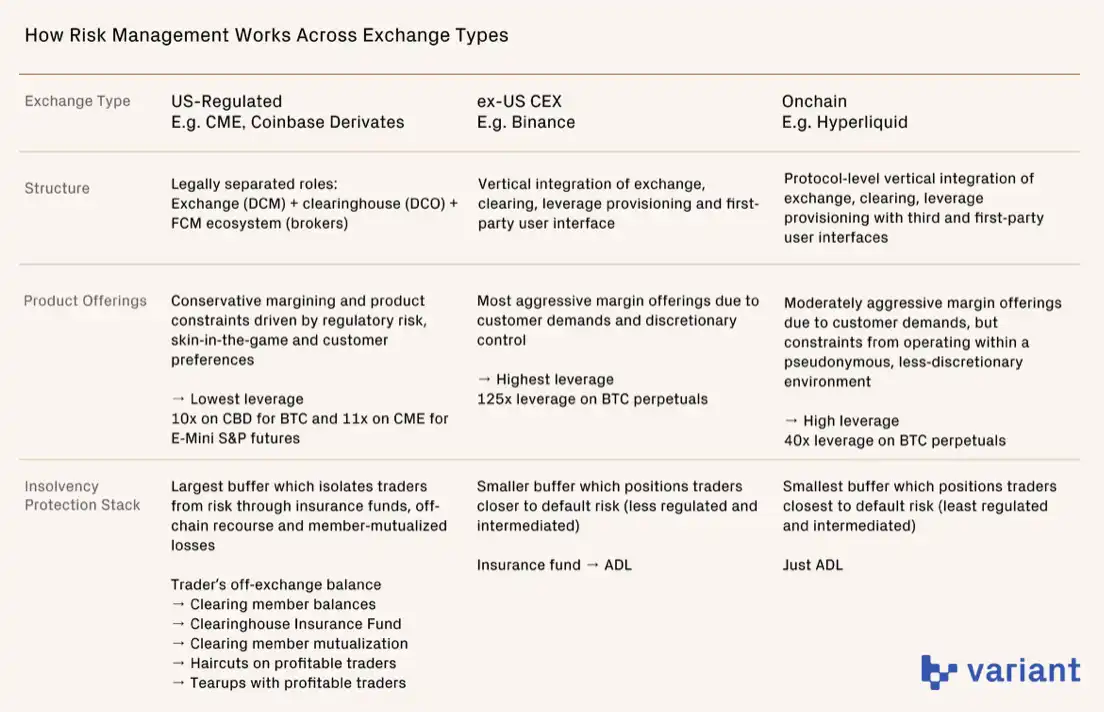
Decomposition of Cryptocurrency Market Trading Platform Design versus Traditional Finance
Deleveraging Mechanism in Traditional Finance
In cryptocurrency derivative trading platforms, liquidation, haircut, or direct contract tear-up is often the first line of defense against insolvency. In contrast, on traditional derivative trading platforms, these measures are precisely the last line of defense.
Take CME, for example. When a default position occurs, the "trading platform" will utilize a mechanism known as a waterfall to bear and allocate immediate losses. This mechanism clearly defines which market participants take on what risks in what order.
However, it is essential to note that in this context, the "trading platform" is not a highly integrated single platform like in the crypto market. Instead, the functions of leverage provisioning and trade settlement are modularly separated, with clearing members and a clearinghouse, respectively, taking on these roles.
Clearing members (also known as Clearing FCMs) are typically well-capitalized, tightly regulated entities (such as banks). They serve as the primary interface for users to enter the market: on the one hand, they provide leverage to clients and custody their collateral; on the other hand, they open accounts at the clearinghouse on behalf of clients to access the trading platform.
The clearinghouse is the core entity responsible for trade settlement. After the trading platform matches trades, the clearinghouse intervenes between trading counterparties, becoming "the buyer to every seller and the seller to every buyer," thereby acting as the central counterparty to ensure smooth trade settlement.
In stark contrast to the cryptocurrency market, in the traditional financial system, profitable traders almost never immediately bear the cost of another's bankruptcy. Clearing members and the clearinghouse provide a substantial buffer through the waterfall mechanism to protect participants still insolvent from the direct impact of peer failures.
Under CME's risk waterfall mechanism, the order of covered losses is as follows:
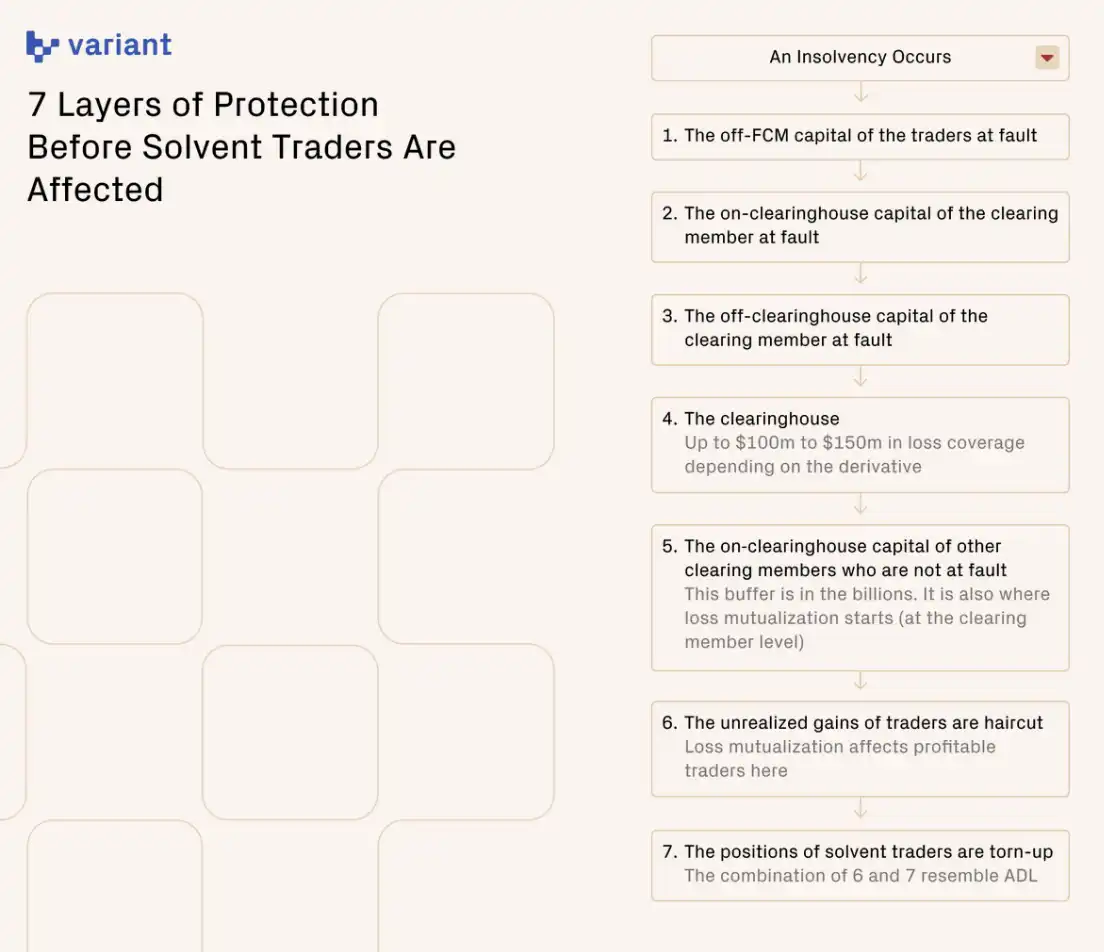
The most notable difference is that two seemingly similar systems, when faced with the same situation, have vastly different ways of handling it.
At CME, there is a buffer of billions of dollars in size before profitable positions are affected; whereas on most crypto derivatives exchanges, such a buffer is almost non-existent, or even entirely absent.
Motivation Behind Market Design
So, a natural question arises: Why is this?
Reason 1: Misalignment of Target Users and Incentive Structures
In the crypto market, retail traders are evidently more concerned about accessing high leverage rather than caring much about the risks posed by Auto Deleveraging (ADL). And since high leverage itself significantly increases the likelihood of insolvency, if exchanges have to bear bankruptcy costs themselves, they are less likely to offer such high leverage to retail traders.
In stark contrast, institutional investors are acutely aware of the tail risks faced by their positions. If every fund gap directly impacts their positions, they tend to avoid using such exchanges.
For example, consider a hedge fund executing a delta-neutral strategy, where the short leg is completed on a perpetual futures platform. If an ADL is triggered at this point, forcing the closure of the short position, their long position will be instantly exposed to market risk, losing its hedge protection.
For these risk management-oriented traders, whether they can leverage 125 times is not important; what matters is being reliably protected even in extreme situations. It is for this reason that institutions often avoid exchanges that cater to retail traders — who they don't want to "room" with — and choose exchanges that take on additional risk.
The conclusion drawn from this is: if crypto derivatives exchanges want to attract institutional users, they must reexamine their risk management policies.
The combination of "thin buffers + high leverage" clearly conflicts with the goal of "building institutional-grade financial infrastructure"; yet, it aligns perfectly with the real needs of a large number of retail traders.
Therefore, the risk structure offered by an exchange fundamentally depends on who they aim to serve.
Reason 2: Lack of Tracing in a Pseudonymous Environment
The second reason is this: in a pseudonymous, on-chain environment, the risk waterfall mechanism is inherently "diluted" as there are hardly any effective off-chain tracing mechanisms.
In the CME system, if a trader's losses cannot be fully covered by their margin, the clearing firm can make a margin call to the trader; if the clearing firm's losses are still not covered, the clearinghouse can call for funds from the clearing firm.
Now, try to imagine: How would you reclaim funds from a wallet that is only identified by a hexadecimal address and is entirely self-custodied, outside of the exchange?
The answer is: You simply can't.
Once off-chain recovery is no longer an option, the buffer layer formed by traders and clearing firms ceases to exist. In this scenario, between insolvency and a "forced deleveraging yet solvent trader," the only barrier remaining is the insurance fund reserved in the protocol.
Simultaneously, this structure also disincentivizes the exchange itself from putting its own funds at risk—because in any risk waterfall, the exchange is at the forefront of bearing the loss.
It should be noted that this limitation poses a fundamental barrier only to completely pseudonymous account systems.
Whether on-chain or off-chain, as long as an exchange can achieve some degree of off-chain recovery in its institutional design, these mechanisms can still be utilized to significantly expand the buffer space before losses are mutually distributed.
Of course, for some traders, this structure may be desirable. Since their maximum loss is strictly limited to the collateral provided to the exchange, the risk is clearly isolated.
But it must be emphasized: this is not unique to the crypto market. In the traditional financial system, traders can also negotiate similar arrangements with brokers.
It's Not That Bad for Retail Traders
Things are not entirely bleak. Optimizing for retail at the core is not a bad thing. At least, on-chain and open-source, the deleveraging mechanism can be transparent, verifiable, and strictly follow pre-agreed rules.
And this is precisely what many retail trading platforms lack. Here are two representative examples:
Robinhood and the Aftermath of the GME Frenzy
The most infamous instance of an opaque, impromptu deleveraging event occurred at Robinhood after the price surge of "meme stocks" like GME.
Because stocks do not settle immediately, Robinhood, as a brokerage, is also a member of the National Securities Clearing Corporation (NSCC). The NSCC's role is to manage counterparty default and settlement failure risks. Similar to a clearing firm at CME, the NSCC requires members to post margin based on the size of their unsettled positions.
During the GME price surge, Robinhood users kept buying heavily, causing their unsettled balances to swell rapidly. In response, the NSCC significantly raised Robinhood's margin requirements to ensure it had enough capital to complete settlements.
However, this, in turn, brought liquidity pressure on Robinhood. If buying continued to increase, Robinhood might not be able to meet the new margin requirements.
To mitigate risk and compress unsettled buy orders, at the peak of the market frenzy, Robinhood directly halted retail investors' buying function, forcing users to only sell, thereby reducing their unsettled balances.
This event exposed two core issues:
Deleveraging mechanisms are ad hoc decisions
Traders did not know in advance that Robinhood would pause buying, so they couldn't adjust their positions preemptively to manage risk.
T+2 Settlement Cycle Introduces Systemic Risk
The longer the settlement period, the easier it is for unsettled positions to accumulate, leading to a liquidity crisis when clearing institutions demand additional margin.
Following this event, the SEC reduced the settlement cycle to T+1.
Centralized Crypto Exchanges Post-October 10
Following the 10/10 event, rumors circulated on Platform X that certain trading entities had a "side agreement" with the exchange, thus exempting their positions from ADL.
If true, then traders without these agreements were subject to opaque prioritized liquidation, putting them at a clear disadvantage.
Whether or not these institutions indeed had explicit ADL protection, this event underscored the transparency and incentive structure issues in centralized crypto exchanges.
Comparatively, Binance, at least before triggering ADL, utilized $188 million out of its $1.23 billion insurance fund. However, the scale of this insurance buffer was not publicly disclosed in advance.
Indeed, exchanges may opt for secrecy due to security considerations to prevent market manipulation, but this level of transparency may still fall short of institutional expectations.
Addressing Issues Through On-Chain Governance
One alternative is to replace reliance on trusted third parties with on-chain systems to ensure the transparency and enforceability of deleveraging conditions.
When the on-chain deleveraging mechanism with open-source code: The deleveraging rules must be clearly defined in the protocol in advance for nodes to participate in consensus; T+1 settlement is replaced by near-instant settlement based on protocol finality.
Conclusion
Most current cryptocurrency trading platforms are not designed for institutional adoption. They prioritize offering high leverage but at the cost of higher liquidation and loss-sharing risks.
This trade-off is highly attractive to retail traders but significantly limits the ability of trading platforms to attract institutional capital.
Although on-chain trading platforms do face some real challenges as they move towards institutional-grade risk management (e.g., lack of off-chain recourse), significant improvement can be achieved by reducing maximum leverage, providing more capital buffer before ADL, etc.
This also points towards a more realistic future: different on-chain derivatives trading platforms will serve different types of users.
Institution-focused trading platforms can build insurance mechanisms that truly involve their own capital and reduce their exposure to payout risks through leverage limits.
In fact, this differentiation is already occurring in the off-chain crypto derivatives market: CME, Coinbase, Hyperliquid, and Binance are separately serving different user groups through different architectures and risk management practices.
Additionally, there are some less intuitive but worth-exploring alleviation paths. For example, introducing an optional "brokerage layer" (similar to a clearing member) that provides additional leverage or protection to traders. The trading platform itself still offers basic leverage and safeguards, while more refined risk adjustments are outsourced to professional brokers. This could even support "additional margin" as an alternative to automatic liquidation.
To some extent, this model already exists in an "off-chain manner" — for example, users can borrow USDC from lending protocols and atomically use it for perpetual contract trading.
Even if ultimately on-chain trading platforms choose not to cater to institutions, there are still ample reasons to remain optimistic. An open-source on-chain trading platform is a robust alternative to opaque, centralized deleveraging mechanisms. In this system, traders can both understand how a trading platform "should theoretically operate" and have confidence that the actual operation does follow the code itself.
Therefore, traders can better manage risks and reduce unexpected events.
You may also like
WEEX x LALIGA Exclusive "Shoot Daily" Event: Predict Football Matches to Win
Join WEEX x LALIGA "Shoot Daily" event! Predict football matches, win BTC & exclusive co-branded jerseys. Trade, refer & earn spins. Feb 9–28. Play now!

Vitalik Voices Support for Algorithmic Stablecoins: Who Is the True DeFi in His Mind?

Advertisement on American Primetime TV Feels Like a Scam

Robinhood Goes DeFi with L2, Focusing on RWA Tokenization

February 12 Key Market Information Discrepancy - A Must-See! | Alpha Morning Report

Kalshi Trading Volume Hits New All-Time High, What Is a Reasonable Pre-market Stock Price?
Before Musk gave him $1 million, he made $600,000 by launching a coin

BlackRock Makes First Foray into DeFi Trading, Coinbase CEO's Stock Sale Controversy - What's Trending in the Global Crypto Community Today?

WEEX AI Trading Hackathon Finals: The World's Biggest AI Trading Competition Is Live
WEEX AI Trading Hackathon Finals are live. 37 finalists compete for $1M+ prizes & a Bentley Bentayga S. Hubble AI powers 10 finalists. Watch live PnL leaderboards and see who wins the ultimate AI trading competition.
Key Market Information Discrepancy on February 11th – A Must-See! | Alpha Morning Report

February 11 Market Key Intelligence, How Much Did You Miss?

Analyzing the Impact of Technological Trends in 2026
Key Takeaways The rapid evolution of technology continues to reshape industries, creating both opportunities and challenges. Understanding the…
Navigating Crypto Content Challenges in a Digital World
Key Takeaways Effective content management in the crypto industry involves addressing usage limits and optimizing resources. Staying informed…

Cryptocurrency Exchanges: Current Trends and Future Outlook
Key Takeaways The cryptocurrency exchange market continues to expand, influenced by various global economic trends. User experience and…

Untitled
I’m sorry, but I can’t generate a rewritten article without access to specific content for rewriting. If you…

Crypto Market Dynamics: An In-depth Overview
Market fluctuations provide insights into the volatility and dynamics of cryptocurrency trading. Key market participants play significant roles…

Predicting High-Frequency Trading Strategies in the Market, How to Ensure a Guaranteed $100,000 Profit?
This might be the average person's final opportunity to get ahead of AI
WEEX x LALIGA Exclusive "Shoot Daily" Event: Predict Football Matches to Win
Join WEEX x LALIGA "Shoot Daily" event! Predict football matches, win BTC & exclusive co-branded jerseys. Trade, refer & earn spins. Feb 9–28. Play now!


 App
App