
- Buy Crypto
- Markets
 Futures
- Spot
- Copy Trade
 Earn
Earn- More
Stablecoin Market Dynamics Shift: USDC Dominance Doubles, Rising Star USDe Emerges

Original Article Title: "The State of Stablecoins 2025: Supply, Adoption & Market Trends"
Original Article Author: Artemis, Dune
Original Article Translation: Yuliya, PANews
Stablecoins are reshaping the global financial system at an unprecedented pace. According to the joint report "Stablecoin State in 2025" released by Dune and Artemis, the stablecoin market has experienced significant growth in the past year, institutional adoption has accelerated, decentralized stablecoins have emerged, and on-chain transaction activity continues to rise.
Market Size and Growth Trends
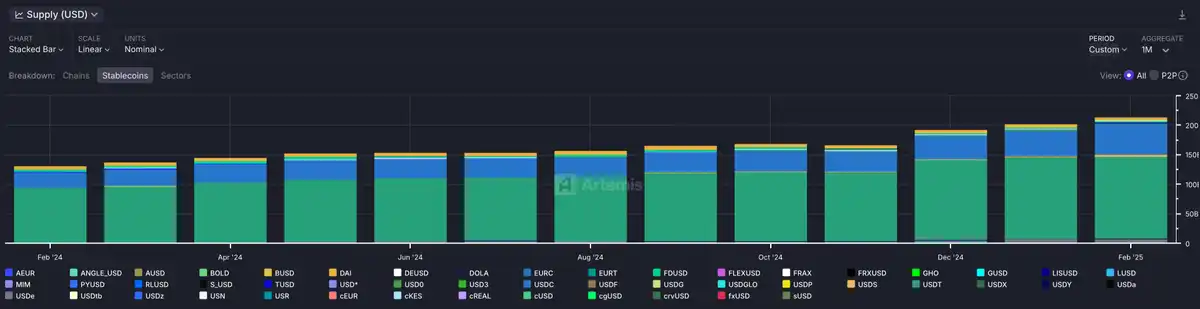
As of February 2025, the supply of stablecoins has reached $2.14 trillion, with an annual transaction volume of $35 trillion, doubling the size of Visa's annual transaction volume. Market activity is on the rise, with a 53% increase in on-chain active addresses, surpassing 30 million. Institutional funds are flowing in on a large scale, driving deep integration between Traditional Finance (TradFi) and the crypto market.
Shift in USDC and USDT Dominance
Driven by the compliance process and market strategies, USDC and USDT still dominate the market, but there have been subtle shifts in market share.
USDC's market capitalization has doubled to $560 billion, mainly due to regulatory approvals under MiCA and DIFC, the participation of key strategic partners such as Stripe and MoneyGram, and rapid global market expansion.
USDT's total market capitalization has grown to $1.46 trillion, remaining the largest stablecoin by market capitalization, but its market share has declined. Institutional adoption is decreasing, and the focus is gradually shifting to the P2P remittance market, consolidating its position in the global payment sector.

Rise of Decentralized Stablecoins
In the Decentralized Finance (DeFi) ecosystem, the influence of decentralized stablecoins has significantly increased, with several emerging projects achieving breakthrough growth.
· USDe (Ethena Labs): Its market value surged from $1.46 billion to $62 billion, becoming the third-largest stablecoin in the market. The key to its growth lies in its innovative yield strategy and Delta-neutral hedging mechanism.
· USDS (MakerDAO): MakerDAO has rebranded as Sky and launched the compliance-friendly USDS, with a market capitalization reaching $2.6 billion in February 2025. This adjustment has enhanced its competitiveness in the decentralized stablecoin market.

Fund Flows and Industry Distribution
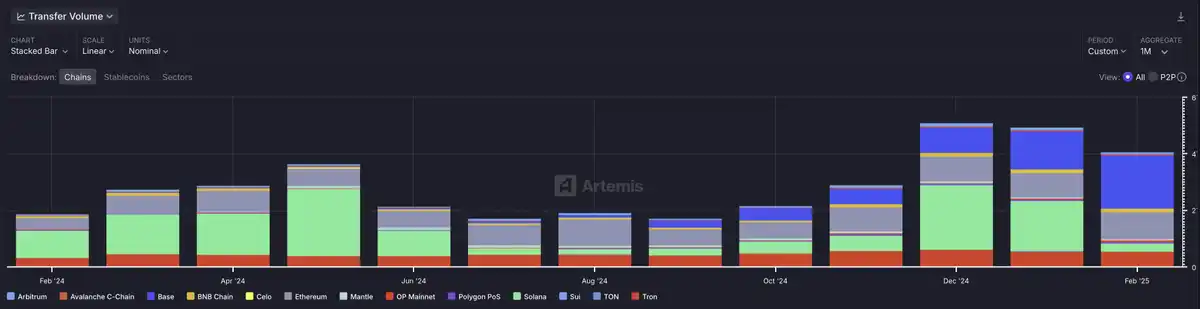
The flow of stablecoins reflects the positioning and competitiveness of different blockchains in the market:
Ethereum remains the primary issuance platform for stablecoins, holding a 55% supply share. Base and Solana have seen rapid growth in transaction volume, driven by the DeFi and Meme coin markets, becoming key on-chain ecosystems for stablecoin circulation. TRON continues to hold a core position in the global P2P payment and cross-border remittance markets, especially in emerging markets, where stablecoins are widely used for payments and savings.
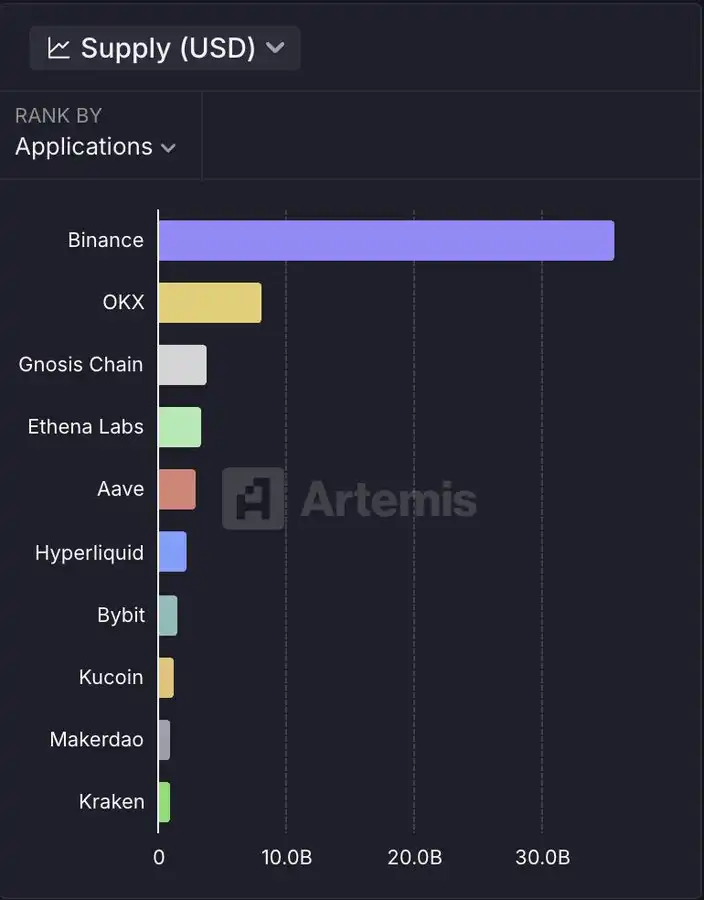
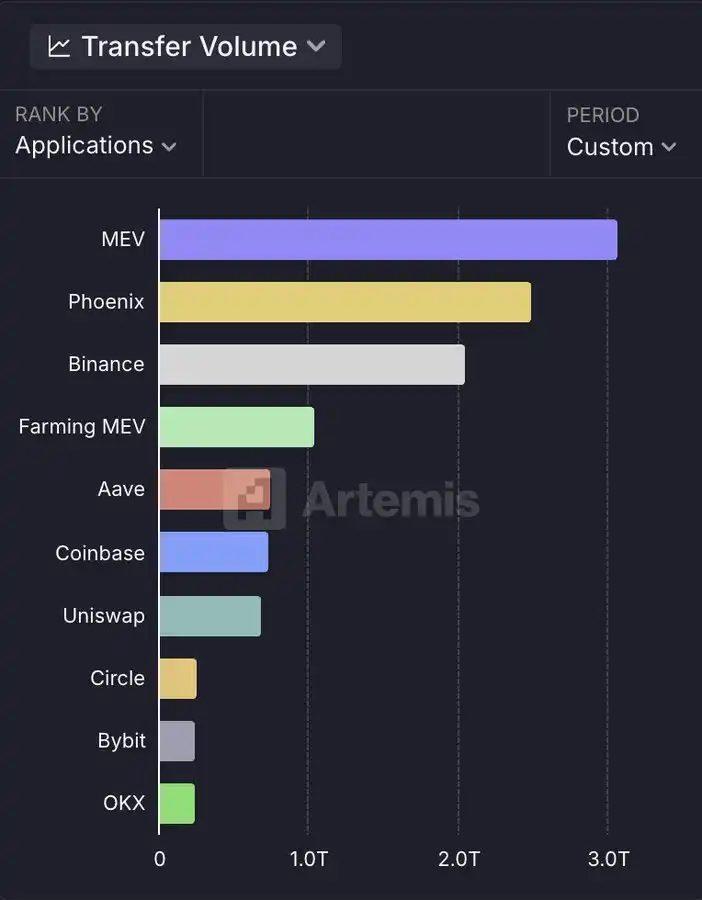
Most stablecoin liquidity is concentrated on centralized exchanges (CEX), with transaction volumes mainly driven by DeFi (DEX, lending, yield farming), reflecting efficient capital flow and innovation.
Core Functions and Future Development
Stablecoins have become a critical infrastructure in the crypto market and are also driving innovation in the traditional financial sector. Industry experts are optimistic about the future development of stablecoins:
"Stablecoins are the lifeline of the crypto market and the superconductor of the financial system. They have opened up new markets and financial opportunities, driving innovation that was previously out of reach." — Rob Hadick, General Partner at Dragonfly
"Stablecoins have significant advantages in cross-border payments. We hope Base will support more local currency stablecoins, allowing global users to transact on-chain with their familiar currencies, thus increasing the adoption of blockchain technology." — Neodaoist, Product Lead at Base
"The next generation of stablecoins must have market resilience. The core of USDe is a yield-backed stability mechanism, ensuring users have a reliable USD alternative." — Conor Ryder, Head of Research at Ethena Labs
"The flow of stablecoins depends on the quality of infrastructure — low cost, fast transactions, and market demand. On Solana, the liquidity for Meme coin trading pairs and instant settlement is high, making stablecoins an indispensable part." — Andrew Hong, Founder and Data Analytics Expert at Herd
「TRON has become the preferred blockchain for stablecoin transactions, with daily trading volumes reaching billions of dollars. USDT on TRON has driven real economic activities, especially in emerging markets, and has become a key tool for payments and savings.」 ——TRON DAO Community Spokesperson Sam Elfarra
You may also like

Most Expensive Rejection: CZ Won the Business Battle But 'Missed the Bus' on $20 Billion in AI

BTC Halving, But Bitcoin Wallet Still Valued at $4 Billion

New York Times: USD1 Has Become the Trump Family's Cryptographic Engine

Can IBIT Really Trigger a Market-Wide Liquidation?

a16z: The "Super Bowl Moment" of Predicting Markets
Cathie Wood's Conversations: Eight Insights on the 2026 Big Ideas

WEEX AI Trading Hackathon 2026: How Top AI Strategies Dominated Real Markets
WEEX AI Trading Hackathon demonstrates that effective trading — whether powered by AI or human judgment — relies on core principles: understanding market structure, maintaining conviction, prioritizing quality over quantity, and managing risk intelligently.
WEEX Ai Trading Hackathon vs. Other AI Trading Competitions: Which Is Better for You?
The AI trading competition landscape offers distinct paths for growth. The WEEX AI Trading Hackathon differentiates itself through its focus on real-market execution and practical viability, positioning it as a key platform for aspiring quantitative traders and strategists.
Is AI Trading Replacing Humans? WEEX Hackathon Reveals the Future of Fintech
The WEEX AI Trading Hackathon reveals that the future of trading is not about AI replacing humans, but about collaboration. AI enhances trading capabilities, while human judgment, ethics, and strategic oversight remain essential.

Key Market Information Discrepancy on February 9th - A Must-See! | Alpha Morning Report

"2.5 Dip" Real Reason: Wall Street Deleveraging Induced Overreaction
Kyle's review of Hyperliquid sparks controversy, Solitude Bank officially opens, what are the overseas crypto communities talking about today?

Cryptocurrency prices in the dumps, but the prediction market is going wild?

Decoding Strategy’s Latest Financial Report: After a $12.4 Billion Loss, How Long Can the Bitcoin Flywheel Keep Spinning?
When earnings reports become electrocardiograms of Bitcoin’s price, Strategy is not merely a company—it’s an experiment testing whether faith can overcome gravity.

Discover How to Participate in Staking
Staking is a digital asset yield product launched by the WEEX platform. By subscribing to Staking products, users can stake their idle digital assets and earn corresponding Staking rewards.

WEEX AI Trading Hackathon Rules & Guidelines
This article explains the rules, requirements, and prize structure for the WEEX AI Trading Hackathon Finals, where finalists compete using AI-driven trading strategies under real market conditions.
From 0 to $1 Million: Five Steps to Outperform the Market Through Wallet Tracking



 App
App